What Is The Australian UFO File?
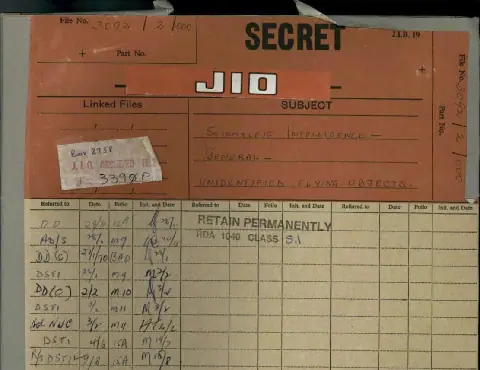
The record is held by the National Archives of Australia as item 30030606 in series A13693. Its title is Scientific Intelligence - General - Unidentified Flying Objects, and its contents span 1957 to 1971.
The cover carries a SECRET classification. Inside are Australian Defence minutes, correspondence about responsibility for investigating UFO reports, historical summaries of American programs and tables of alleged close encounters from several countries.
The document at the centre of the file was written on 27 May 1971 by O. H. Turner, Head of the Nuclear Branch within the Joint Intelligence Organisation. Turner told the JIO director that his two attached papers concerned the American response to UFOs and possible “weapon systems” described in encounter reports. He proposed examining propulsion, operational motives, detection and defence. The original minute can be read on page 6 of the NAA file.
Turner was not writing a neutral literature review. He argued that some early United States Air Force reports described real objects with performance so advanced that an extraterrestrial origin appeared necessary. His discussion of Project Blue Book and the CIA-linked Robertson Panel also presented public debunking as cover for private American interest in UFO propulsion and anti-gravity research. His summary appears on page 7.
His second paper tried to identify recurring effects in close-encounter stories. This is where the cat-like occupants and dwarfs appear.
The “Cat-Faced” Occupants Of Case 848
On page 27 of the file, a table headed “Stalled Engines” includes Case 848. Its brief description reads:
“Vehicles stalled in vicinity of brilliant, transparent mushroom-shaped object having occupants with cat-like faces.”

This was not an Australian sighting. The entry refers to an alleged encounter near Itajubá, Brazil, during the early hours of 7 June 1967.
Longer versions identify the witness as an ambulance driver named Geraldo Baqueiro, with the surname also rendered as Barqueira in English-language sources. He reportedly said that a luminous object approached his vehicle, after which the engine and headlights failed. Several faces resembling cats were allegedly visible through its transparent surface.
An account published by the civilian Aerial Phenomena Research Organization described a round object about five metres wide and five faces visible in windows. The account survives in an online APRO Bulletin archive.
The surviving source trail appears to run through UFO researchers and specialist magazines before reaching Jacques Vallée’s catalogue of landing reports. Turner then reduced the catalogue entry to two sentences in his Australian intelligence paper.
No witness statement, photograph, instrument reading or Brazilian government investigation accompanies the Australian entry. The words “cat-like” describe the witness’s reported visual impression. They do not establish the occupants’ biology or demonstrate that occupants were present.
Calling them “cat-faced aliens” adds two conclusions that the entry itself does not support. A resemblance becomes a literal anatomy, and an unidentified occupant becomes extraterrestrial.
The Two Dwarfs At Quarouble
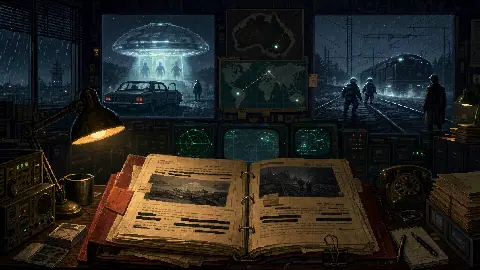
The second story appears under “Paralysis/Hypnosis Devices” on page 32. Case 144 summarises an alleged encounter involving Marius Dewilde at Quarouble in northern France on 10 September 1954.

Some online retellings say that two people encountered two dwarfs. The file describes one human witness and two small figures.
Dewilde, a 34-year-old metalworker, reportedly went outside after hearing his dog barking. He saw a dark object on railway tracks near his home and two figures moving towards it. Contemporary accounts described them as less than one metre tall, broad or bulky, and dressed in something resembling dark diving suits. Their faces and arms were not clearly visible.
When Dewilde attempted to approach, he said that a brilliant light came from the object. He reportedly lost the ability to move or call out until the light ended. The figures then disappeared and the object departed.
Police examined marks on railway sleepers, and the episode received substantial French newspaper coverage. Investigators found no physical trace of the alleged beings, and the marks did not establish what had caused them. Later retellings added further encounters and disputed physical details, making it difficult to separate the earliest report from the legend that grew around it. A detailed collection of contemporary and later Quarouble sources records those variations.
Vallée considered the episode worthy of attention but acknowledged a central limitation. No adequate psychological assessment of the witness had been conducted. The Australian table contains none of that uncertainty. It compresses the entire case into a proposed example of a paralysis device.
Why Were These Stories In An Intelligence File?
Turner explained his method on page 24. He had extracted cases from a list of approximately 1,000 reported landings or near-landings compiled by French researcher Jacques Vallée, who had worked with astronomer and former USAF consultant J. Allen Hynek.
The catalogue covered reports from 1868 to 1968. Turner grouped selected entries into three proposed systems:
- interference with electrical circuits
- induced paralysis
- a heat-producing weapon
The stalled vehicles formed his first category. Reports of immobility, tingling, unconsciousness and beams formed the second. Stories involving burns or intense heat formed the third.
This was an intelligence hypothesis built from recurring narrative features. It was not a laboratory finding. Turner had no control group, no consistent evidence standard and no way to calculate how many mundane engine failures or episodes of temporary paralysis occurred without a UFO report.
The catalogue also mixed very different source types. A single-witness story published in a UFO magazine could sit beside a military report or a case with several observers. Reducing each incident to a few lines removed the contextual information needed to assess credibility.
Pattern recognition can identify questions worth testing. It cannot establish a shared technology when the underlying reports have not first been independently verified.
What Did Australian Intelligence Actually Conclude?
The strongest check on Turner’s paper is the response written by R. W. Furlonger, Director of the Joint Intelligence Organisation, on the same date.
Furlonger thought some selected reports could not readily be explained and considered limited investigation worthwhile. He proposed that the Department of Supply examine approximately six Australian cases per year for two or three years. The results could then be reviewed to determine whether any defence interest existed.
He also stated that significant JIO resources should not be committed unless the investigation demonstrated a strategic-intelligence concern. The full response appears on page 37.
That response did not endorse extraterrestrial craft, gravity-control propulsion or alien weapons. It treated the subject as a low-volume research question that might justify further attention if stronger evidence emerged.
The wider file shows that staffing had been a problem for years. The RAAF collected sightings but devoted limited personnel to the work. Other scientific-intelligence sections repeatedly resisted taking responsibility because they lacked the time and facilities. The bureaucracy was debating who, if anyone, should investigate unusual reports.
What Does The File Prove?
The Australian record supports several firm conclusions:
- O. H. Turner believed some UFO reports described advanced technology and possibly extraterrestrial craft.
- He presented international encounter stories as possible evidence of electrical, paralysis and heat-producing systems.
- Australian intelligence officials accepted that a small number of reports remained difficult to explain.
- The JIO director recommended limited scientific investigation rather than a major intelligence commitment.
It does not prove that cat-faced beings were seen in Brazil, that dwarf-like figures paralysed a man in France or that any government recovered alien technology.
The SECRET marking establishes how the file was handled inside Defence. Classification can protect intelligence discussions, foreign liaison material and internal assessments. It is not a quality rating for every claim contained within a file.
The same principle applies to declassification. Opening a document allows the public to see what officials recorded and debated. It does not convert the document’s allegations into verified events.
A Strange Record, Not Alien Confirmation
The cat-faced beings and Quarouble dwarfs were not inventions added by a modern viral post. They are genuinely present in an authentic Australian Defence file. Their presence tells us that at least one scientific-intelligence officer considered the stories relevant enough to include in a national-security argument.
The evidence becomes thinner as soon as the provenance is reconstructed. Both entries were compressed foreign witness stories drawn through layers of civilian UFO literature. Australian officials did not interview the witnesses, examine the alleged sites or verify the claimed effects.
That leaves a document with two distinct values. As evidence for exotic beings or weapons, it is weak. As evidence of how UFO reports entered Cold War intelligence thinking, it is unusually revealing.
Frequently Asked Questions
Does The Australian UFO File Really Mention Cat-Like Faces?
Yes. Case 848 on page 27 mentions occupants with cat-like faces inside a transparent mushroom-shaped object. The alleged incident occurred in Brazil, and the Australian file provides only a short secondary summary.
Were The Dwarf Figures Reported In Australia?
No. Case 144 refers to Marius Dewilde’s 1954 report from Quarouble, France. He claimed to see two short, bulky figures near an object on railway tracks.
Did Australia Confirm That The Beings Were Aliens?
No. The file records Turner’s interpretation of selected UFO reports. The senior JIO response proposed limited investigation and withheld major resources unless a strategic-intelligence interest could be demonstrated.
Why Was The File Classified Secret?
It was an internal Defence and intelligence file discussing foreign programs, intelligence assessments and possible national-security implications. The classification does not establish that its UFO allegations were verified.