The Turner Paper In 60 Seconds
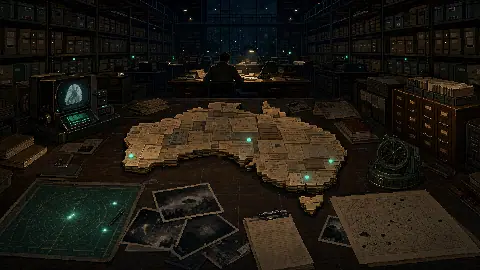
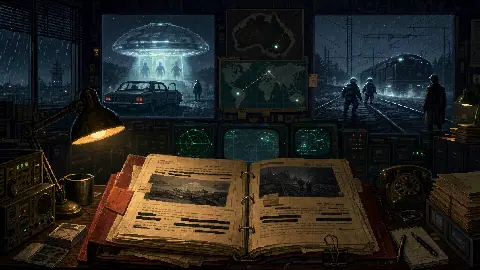
The so-called Turner Paper is a group of documents inside the National Archives of Australia file Scientific Intelligence - General - Unidentified Flying Objects. The file is item 30030606 in series A13693 and covers correspondence from 1957 to 1971.
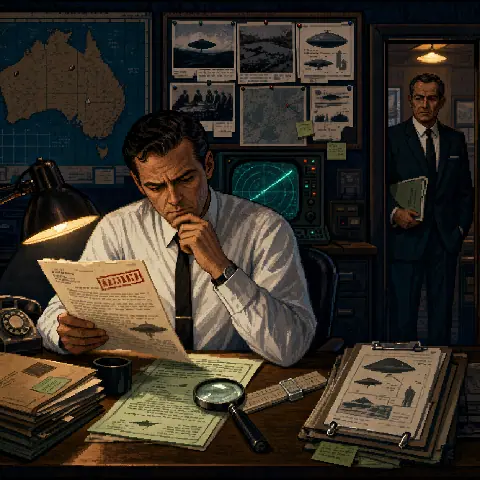
On 27 May 1971, O. H. Turner, Head of Nuclear Branch in Australia's Joint Intelligence Organisation, submitted a one-page minute with two attached papers. The first presented his history of the United States Government's UFO response. The second sorted alleged close encounters into possible electrical-interference, paralysis and heat-producing systems.
Turner believed the public American position concealed a deeper interest in UFO performance and propulsion. He urged Australia to develop its own scientific and intelligence capability instead of simply following United States Air Force statements.
The file was marked SECRET, but the classification does not make every proposition inside it an official conclusion. Turner's paper was advice moving through a bureaucracy. On the same date, JIO Director R. W. Furlonger proposed a limited trial in which the Department of Supply might investigate about six selected Australian cases a year for two or three years.
Nothing in this file shows that Australia confirmed extraterrestrial craft, possessed recovered technology or adopted Turner's explanation of American policy.
Who Was O. H. Turner?
O. H. Turner was Oliver Harry Turner. A National Archives of Australia record about a 1960 light sighting near Maralinga identifies him as a Health Physics Officer who conducted an independent investigation and extensive calculations. Turner thought that particular light was not natural, while the security officer who closed the inquiry favoured a meteor or static electricity.
By 1971 Turner was Head of Nuclear Branch in the Joint Intelligence Organisation. The organisation occupied an important analytical role. The Joint Intelligence Bureau, created in 1947 to collate and evaluate intelligence, had been renamed the JIO in 1969. It later became the Defence Intelligence Organisation.
This background explains why Turner's minute is historically unusual. It was not a letter from a member of the public or a routine RAAF sighting form. A scientific intelligence officer responsible for nuclear matters was asking his organisation to treat UFO reports as a potential source of technical and strategic intelligence.
It also explains why the paper must be attributed carefully. Turner had relevant scientific and intelligence experience, but expertise and seniority do not turn inference into evidence. The file lets us examine his reasoning rather than requiring us to accept it.
What Turner Sent To Australian Intelligence In 1971
Turner's covering minute said that two documents were intended to focus attention on aspects of the UFO problem that had remained hidden.
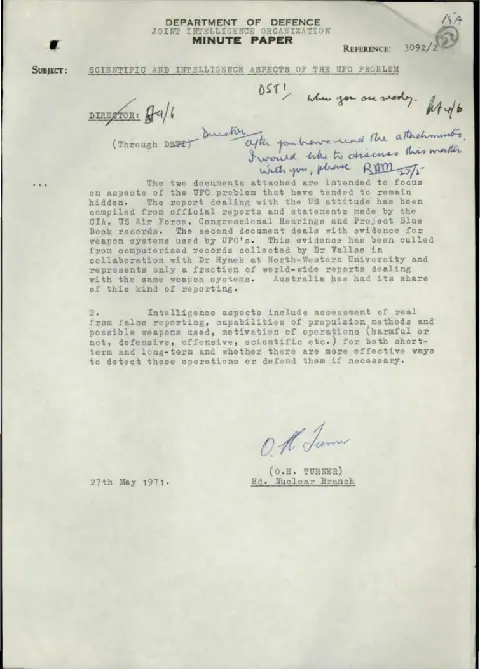
He described the first as a report compiled from official CIA and US Air Force statements, congressional hearings and Project Blue Book records. The second drew on computerised records collected by Jacques Vallée in collaboration with astronomer J. Allen Hynek. Turner wanted JIO to consider whether the reports could reveal genuine phenomena, propulsion capabilities, possible weapons, operational motives and better methods of detection or defence.
That introduction is important. The attachments did not use one consistent evidence base. The American history mixed official documents with statements by former officers and Turner's interpretation of research programs. The weapons paper relied on summaries of international witness reports collected by civilian UFO researchers.
The American UFO History
Turner's first attachment traced United States activity from Project Sign through Project Grudge, Project Blue Book, the CIA-sponsored Robertson Panel and the Condon study.
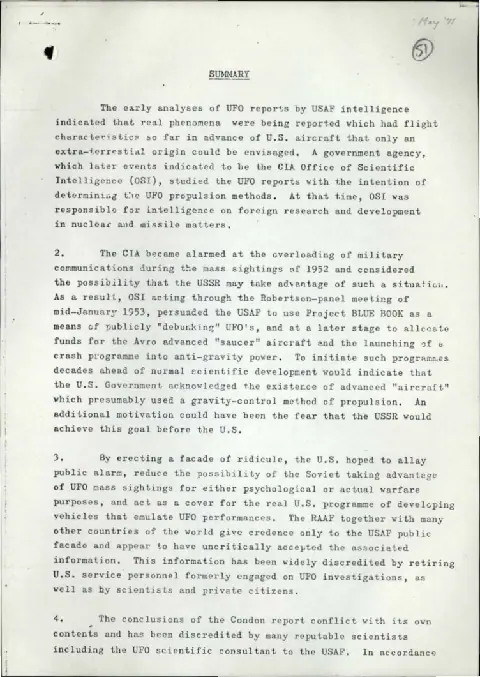
Its opening summary made the paper's central claim. Turner wrote that early USAF intelligence analysis indicated real phenomena with performance so far beyond American aircraft that only an extraterrestrial origin could be envisaged. He then argued that the CIA Office of Scientific Intelligence studied propulsion while Project Blue Book publicly debunked UFOs.
Turner linked this alleged hidden program to the Canadian Avro disc aircraft and American anti-gravity research. In his account, public ridicule reduced alarm and protected a genuine effort to understand and reproduce UFO performance.
He was equally critical of Australia. The attached section headed “RAAF Attitude To UFO's” said the Directorate of Air Force Intelligence had never assigned more than one part-time officer to the subject. Turner accused the RAAF of following public USAF messaging, making weak identifications and leaving reports to be filed rather than scientifically analysed.
His alternative was an independent Australian program that was scientifically sound and more open with the public than its American and British counterparts.
The Alleged UFO Weapon Systems
Turner's second attachment began with approximately 1,000 reported landings or near-landings catalogued by Vallée. He selected cases that appeared to fit three categories:
- interference with electrical circuits
- induced paralysis
- a heat-producing ray or field
The paper listed stalled engines, failed headlights, radio interference, tingling, loss of movement, burns and reports of beams. Turner compared petrol and diesel engines, separated cases by the apparent position of the object, and tried to infer operating range and deliberate use.
This is the section containing the “cat-faced” beings case, alongside foreign stories involving small figures, landed objects and temporary paralysis. The entries are genuinely present in the Australian file, but they were not Australian intelligence investigations. They were compressed summaries of reports from several countries.
Turner's method could identify a recurring motif worth testing. It could not establish a weapon system. The reports had different source quality, no common investigation protocol and no verified mechanism. Grouping stories by similar effects assumes that the reported events were accurate before explaining why the effects recurred.
Which Parts Of Turner's Case Hold Up?
Several foundations of Turner's history are real and well documented.
The United States Air Force did operate Project Sign, Project Grudge and Project Blue Book. Blue Book closed in December 1969. US records state that 12,618 reports had been collected and 701 remained unidentified, while the Air Force said it found no evidence of a national-security threat, technology beyond contemporary knowledge or extraterrestrial vehicles.
The CIA did sponsor the 1953 Robertson Panel. The panel was concerned that mass reporting could clog defence communications, encourage false alarms and be exploited during a hostile attack. Its report recommended education and “debunking” to reduce public susceptibility and improve the recognition of ordinary objects.
The Canadian Avro disc project also existed. The United States Army and Air Force eventually funded the VZ-9AV Avrocar, a circular vertical-takeoff aircraft that looked like a flying saucer. Official museum records show that the craft became unstable more than a few feet above the ground, reached only 35 miles per hour and was cancelled in 1961.
Turner was therefore not inventing Project Blue Book, CIA involvement, official debunking language or a military disc aircraft. His paper drew together authentic fragments that were not widely understood by the public in 1971.
The Australian side of the file also supports his complaint about limited capacity. Earlier correspondence shows the RAAF asking scientific intelligence to take responsibility, while other officials replied that they lacked spare staff and were not convinced the problem justified diverting scarce resources. The agencies were debating ownership as much as evidence.
Where The Turner Paper Overreaches The Record
The paper becomes less secure when it moves from documented events to a single explanatory story.
First, an official statement that some observations appeared real did not establish that the objects were extraterrestrial. “Real” could mean that observers genuinely reported a stimulus which investigators had not identified. It did not identify the cause.
Second, the Robertson Panel's debunking recommendation is documented, but the panel's stated rationale was public and defence-system resilience. Its report said the evidence showed no direct physical threat and no need to revise current scientific concepts. That is not proof that Blue Book was created as cover for a separate program to exploit alien propulsion.
Third, the Avrocar does not close that gap. Official records describe a Canadian engineering concept built around jet exhaust and ground effect. The American services took over the project in 1958, and its severe performance limits are documented. The craft proves that military engineers tested a disc-shaped vehicle, not that the design came from UFO observations or recovered technology.
Turner made a similar leap with gravity research. Scientists and aerospace companies had legitimate reasons to investigate difficult questions in propulsion and fundamental physics. The existence of such work cannot, by itself, reveal what prompted it or show that it succeeded.
Finally, the weapons paper begins with witness narratives and ends with technical systems. Engine failure, paralysis and heat are reported effects, not measured mechanisms. Turner sometimes acknowledged alternative explanations, but his categories still treated heterogeneous cases as if they described a common technology.
These limits do not make the Turner Paper worthless. They make it an intelligence hypothesis that required testing. Its most important unanswered question was whether new Australian investigations would produce evidence strong enough to survive the assumptions built into the paper.
What R. W. Furlonger Actually Recommended
The most consequential page is often separated from the claims that made the document famous.
On 27 May 1971, JIO Director R. W. Furlonger sent the Department of Defence a short proposal after discussing Australian UFO investigations. He wrote that some RAAF and United States cases could not readily be explained by natural phenomena or human activity. He considered thorough investigation of selected Australian reports warranted.
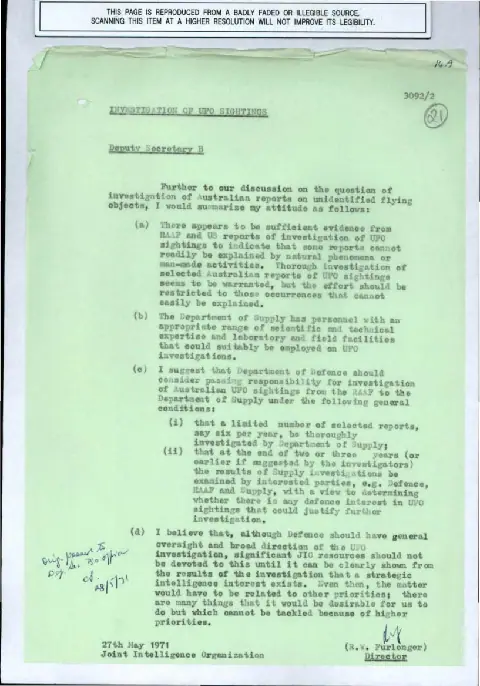
His proposed scale was modest. The Department of Supply would investigate about six selected reports a year. After two or three years, Defence, the RAAF and Supply would review the results to decide whether any defence interest justified further work.
Furlonger also placed a firm limit on JIO involvement. He said significant JIO resources should not be committed until the investigation showed a strategic intelligence interest, and even then the work would have to compete with higher priorities.
This was neither a dismissal nor an endorsement of Turner's thesis. Furlonger accepted uncertainty and proposed a controlled way to reduce it. The plan concentrated on a small number of reports that resisted ordinary explanations, then required the evidence to justify any expansion.
The contrast is revealing. Turner argued from American history and international encounter catalogues towards concealed technology and possible weapons. Furlonger brought the problem back to a testable Australian sample, limited cost and a defined decision point.
Did Australia Start A Secret UFO Program?
The 58-page file does not establish that Furlonger's proposed trial was implemented. It preserves the recommendation, but not a directive creating the program, annual case lists, investigation reports or the final review he described.
The broader correspondence instead shows a long-running struggle over responsibility. In 1957 the RAAF asked the Joint Intelligence Bureau's scientific section to take over UFO evaluation. The response said the branch lacked the time and facilities. In 1968 the Department of Air considered whether another Commonwealth agency was better placed. After Blue Book closed, the RAAF explored reducing its own effort.
That history makes it unsafe to describe the Turner Paper as proof of a hidden, fully funded Australian UFO unit. It documents pressure from inside intelligence for better scientific work and a director's proposal for a limited trial. Whether later files demonstrate that any part of the plan operated must be answered from those later records, not inferred from this recommendation.
Why The Turner Paper Is Still Important
The Turner Paper deserves attention without being turned into alien confirmation.
It shows that an Australian scientific intelligence officer was willing to challenge the RAAF's handling of UFO reports and the public position of a close ally. Turner assembled official history, research programs and civilian case catalogues into a strategic argument. His director did not suppress the question or accept the answer. He converted it into a small research proposal with explicit resource limits.
The file therefore preserves more than a set of unusual claims. It captures intelligence analysis in motion: a hypothesis, contested evidence, institutional boundaries and a proposed experiment that might have resolved part of the dispute.
Its strongest historical lesson is not that the Australian Government knew UFOs were extraterrestrial. It is that some officials regarded unexplained reports as a legitimate scientific intelligence problem, while the organisation around them demanded a much higher evidentiary threshold before committing resources.
That tension runs through the wider Australian UFO Files. The records are most useful when we keep belief, evidence and official action separate.
Frequently Asked Questions
Is It The Turner Paper Or The Turner Report?
Both names are used online. The archive itself contains a Joint Intelligence Organisation minute and attached papers rather than a formally titled publication called The Turner Report. “Turner Paper” is the more precise shorthand, while “Turner Report” remains a common search term.
Did Australian Intelligence Confirm Alien Spacecraft?
No. Turner argued that some reports pointed towards extraterrestrial craft and advanced technology. Furlonger's response proposed limited investigation and withheld significant JIO resources unless a strategic intelligence interest could be demonstrated.
Was The Turner Paper Classified Secret?
Yes. The file cover carries a SECRET classification. Classification described how the Defence record was handled. It did not certify the accuracy of every witness report or conclusion inside it.
Where Can I Read The Turner Paper?
The complete file is available through the National Archives of Australia digital viewer. Turner's minute begins at digital image 6, his attachments follow, and Furlonger's response appears at digital image 37.
Sources
- National Archives of Australia, A13693, 3092/2/000, item 30030606
- O. H. Turner, Scientific And Intelligence Aspects Of The UFO Problem, 27 May 1971
- R. W. Furlonger, Investigation Of UFO Sightings, 27 May 1971
- National Archives of Australia, history of Australian intelligence and security
- CIA, Report Of The Scientific Panel On Unidentified Flying Objects, 17 January 1953
- CIA, A Die-Hard Issue: CIA's Role In The Study Of UFOs, 1947-90
- US National Archives, Project BLUE BOOK records and Air Force fact sheet
- National Museum of the United States Air Force, Avro Canada VZ-9AV Avrocar