What Webb Actually Measured
The study examined nine galaxies at a redshift of about 0.7. We see those systems as they were roughly six to seven billion years ago, after their main periods of star formation had ended. They are not the first galaxies observed directly at cosmic dawn.
Their old stellar populations preserve information about much earlier formation. The oldest galaxy in the sample formed at a redshift above 5, within roughly the first 1.2 billion years after the Big Bang. The researchers describe the oldest systems as descendants of the unexpectedly mature galaxies that JWST has found in the early universe.
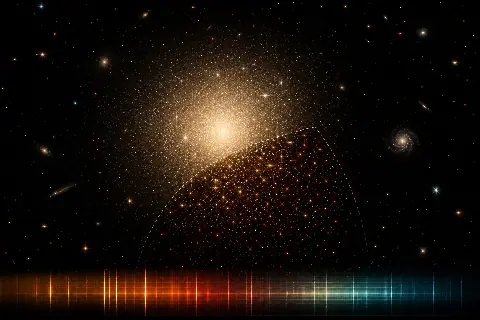
JWST's Near-Infrared Spectrograph supplied the redder part of each spectrum through the IMFERNO programme. The team extended that coverage towards bluer wavelengths with spectra from the Very Large Telescope's LEGA-C survey. Fitting the combined wavelength range allowed the researchers to separate stellar-mass signatures from differences in age and elemental abundance.
How Small Stars Hide So Much Mass
A galaxy's integrated light is dominated by its brightest stars. Low-mass stars are dim enough to disappear inside that glare even when they greatly outnumber the luminous stars. Astronomers therefore estimate the hidden population through an initial mass function, which describes how many stars formed at different masses.
Many distant-galaxy estimates assume a distribution similar to the Milky Way. Cheng and colleagues found that several galaxies in their sample have a more bottom-heavy initial mass function, meaning they contain a larger proportion of low-mass stars.
For the two oldest galaxies, changing from a Milky Way-like distribution to the measured bottom-heavy distribution increased the stellar-mass estimate by a factor of about three to four. The correction also brought most stellar-mass estimates into better agreement with independent virial-mass estimates based on the galaxies' size and internal motion.
What Is Evidence and What Is Inference
| Evidence or Result | What It Supports |
|---|---|
| Ultra-deep spectra of nine quiescent galaxies at redshift 0.7. | Direct analysis of old stellar populations beyond the local universe. |
| Absorption features associated with faint, low-mass stars. | Several sampled galaxies have a bottom-heavy stellar distribution. |
| Full-spectrum population modelling. | The oldest two galaxies may hold three to four times more stellar mass than Milky Way-based estimates. |
| An early formation history for the oldest galaxies. | Their cosmic-dawn progenitors may also have contained excess low-mass stars. |
| No planets or biological signatures were observed. | Any implication for alien life remains probabilistic. |
The Early-Galaxy Problem Gets Harder
JWST has repeatedly found massive, mature galaxies at epochs when models expected less stellar assembly. This study does not overturn the standard cosmological model, but it can deepen the disagreement between observations and galaxy-formation simulations.
If early massive galaxies formed many more low-mass stars than assumed, models must explain how that extra stellar mass assembled so quickly. They must also reproduce the unusual distribution of birth masses, not only the total brightness.
The result currently rests on a small, deliberately selected sample. The decisive test is whether the same spectral signatures appear across larger groups of galaxies and at higher redshifts. The team plans to extend the method closer to the first generations of stars.
How This Strengthens the Case for Alien Life
The scientific case for alien life is not based on one dramatic observation. It grows from the number of possible habitats, the frequency of planets, the chemistry available to them and the time those environments remain stable. This study potentially increases the first number in some of the universe's oldest massive galaxies.
NASA's Kepler mission established that planets outnumber stars in the Milky Way and that small planets are common. If old galaxies also contained more low-mass stars than previously counted, the universe may have offered more planetary systems earlier than our census suggested. Study leader Mariska Kriek identified that possibility in the research announcement, while keeping it conditional.
Low-mass stars can also survive far longer than Sun-like stars. NASA notes that the smallest red dwarfs can remain active for more than 100 billion years. A larger population of long-lived stars expands both the number of potential sites and the time available for planetary evolution.
In the Drake Equation, more stars and planets raise the number of possible locations where life could begin. They do not tell us how often life starts, becomes complex or develops detectable technology. The new result therefore strengthens the scale argument for alien life without supplying the biological probabilities that remain unknown.
Why More Stars Are Not Proof of Inhabited Worlds
A star is only the first requirement. Planet formation depends on the material and environment around the young star. Habitability then depends on the planet's orbit, atmosphere, geology, radiation exposure and long-term climate.
The faint stars inferred in this study are not individually resolved or classified as hosts. Astronomers cannot apply planet-occurrence rates measured around nearby Milky Way stars to ancient galaxies without accounting for their different formation conditions and chemical histories.
Small stars also introduce a serious counterweight. Many red dwarfs produce intense flares and high-energy radiation, especially when young. NASA models and observations show that this activity can erode nearby planetary atmospheres. A long stellar lifetime is valuable only if a planet can survive the star's violent early phase.
The result supports a universe with potentially more chances for life, not a universe where life is guaranteed. That distinction sits at the centre of the Fermi Paradox. Every increase in the number of possible worlds makes the absence of confirmed extraterrestrial evidence more conspicuous.
What Astronomers Need to Test Next
Higher-redshift spectra are the immediate priority. Measuring the stellar distribution closer to the galaxies' formation era would reduce the need to infer the properties of their progenitors from later descendants.
Larger samples will show whether bottom-heavy stellar populations are common among massive old galaxies or concentrated in unusual systems. Independent checks from gravitational lensing and detailed dynamical models can test whether the revised stellar masses remain compatible with each galaxy's total mass.
The alien-life branch requires a different chain of observations. Researchers would need evidence that planets formed efficiently in those early environments, retained atmospheres and developed chemistry compatible with life. None of those steps can be measured in the nine distant galaxies studied here.
Source Trail
- Nature Astronomy study, published 18 August 2026
- Open preprint and methods record, submitted 28 January 2026
- Netherlands Research School for Astronomy research announcement, 18 August 2026
- NASA's summary of Kepler planet-occurrence findings
- NASA on rocky planets and red-dwarf atmosphere survival
Verdict
The strongest conclusion is astronomical. Some old, massive galaxies appear to contain far more low-mass stars than estimates based on the Milky Way allow, and their early progenitors may have been heavier than already surprising JWST measurements suggest.
The alien-life implication is narrower but genuinely interesting. More long-lived stars can mean more planetary opportunities across more cosmic time. That improves the numerical case for life elsewhere while leaving the central evidence gap unchanged. No alien world, biosignature or civilisation was detected.