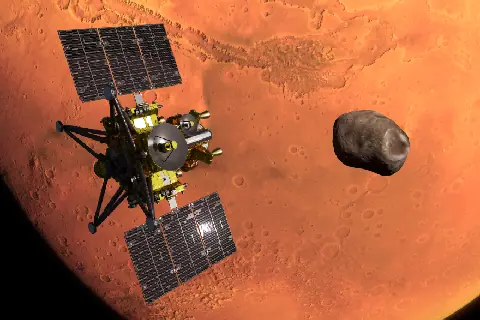
JAXA’s H3 rocket lifted off from the Tanegashima Space Center at 04:41:03 Japan Standard Time on 20 October 2026. That was 06:41 in Sydney and 19:41 UTC on 19 October. The spacecraft separated approximately 71 minutes and 13 seconds after launch and entered its planned trajectory, according to JAXA’s launch result.
The successful launch begins a mission expected to reach Mars in 2027 and return a sample capsule to Earth in 2031. The capsule’s intended landing site is in Australia. Those later stages are objectives, rather than completed achievements.
Two Different Origins For Phobos
Phobos and Deimos remain poorly understood despite decades of spacecraft exploration around Mars. Brief encounters can reveal their shapes and surface features, but recovering material would allow scientists to examine their composition with laboratory instruments.
One explanation is that the moons began as asteroids and were captured by Mars. Another is that an enormous collision blasted material from Mars into orbit, where debris assembled into moons. ESA identifies these competing possibilities in its MMX mission overview.
A returned sample could distinguish between materials inherited from an asteroid and those associated with Mars and an impact. Scientists would be testing the moons’ history through their physical composition, rather than choosing an explanation from their appearance alone.
Major impacts are part of the wider story of planetary formation. Our coverage of Webb’s observations of extreme debris discs examines how collision debris around other stars preserves mineral clues. MMX aims to investigate a possible impact legacy much closer to home, using material that can be brought into a laboratory.
A Small Rover In Extremely Weak Gravity
Before the main spacecraft touches down, it will deploy Idefix, a rover developed by the French and German space agencies. The rover will investigate the composition and texture of Phobos’s surface and gather information to help prepare the larger spacecraft’s sampling operation.
ESA gives Idefix a mass of 25 kilograms. On Phobos, its weight will be equivalent to that of roughly 15 grams on Earth. Its mass does not disappear; the much weaker gravity reduces the force pulling it towards the surface.
That environment makes landing, manoeuvring and sample collection different from operations on Earth or Mars. MMX carries two different sampling devices. Its science payload includes seven instruments on the main spacecraft and four on the rover, giving the team observations to assess alongside the eventual returned material.
What Happens Between Launch And Sample Return?
ESA’s published mission plan sets out a sequence extending over five years.
- August 2027: arrival in orbit around Mars.
- September 2027: operations in a quasi-satellite orbit around Phobos.
- Early 2029: deployment of Idefix after remote observations.
- 2030: landing and sample collection by the main spacecraft.
- 2031: return of the sample capsule to Earth.
The spacecraft will also investigate Deimos and Mars. Partners include NASA, CNES, DLR and ESA, alongside mission leader JAXA. ESA supplied deep-space communications equipment and ground-station support through its Estrack network.
Why Bring Ten Grams Back To Earth?
The mission aims to deliver at least ten grams of Phobos material. After landing in Australia, the capsule is to be transferred to Japan, where its contents can be extracted, catalogued and shared with mission partners.
The small quantity is intended for precise analysis. Laboratories can use equipment too large, complex or sensitive to send aboard a spacecraft. Preserved samples also allow future researchers to apply techniques that are unavailable today.
Spacecraft observations remain essential. Our examination of Perseverance’s organic-carbon findings at Jezero Crater shows how chemistry and geological context can be studied on Mars. MMX would add laboratory access to material collected from a different body in the same planetary system.
A Moon’s Origin Is Still An Open Question
MMX has not yet collected a sample or resolved how Phobos formed. Its launch establishes that the spacecraft is on its way, with years of navigation, observations and surface operations still ahead.
Small bodies preserve different records of the Solar System’s history. The tiny worlds studied by Hubble and Webb beyond Neptune offer clues from their colours and population. Phobos presents a more direct opportunity: recover a small piece of a moon, then ask what its material reveals about the planet beside it.