Explore PURSUE Release 8
A radar plot points to a possible speed of Mach 2.5. Harry Reid asks for tighter secrecy around an aerospace programme. A Lockheed aircraft designer describes something he cannot identify, while the Air Force files it as a cloud.
They arrived together on 20 November 2026, in the eighth batch of Pentagon UFO files.
We downloaded the 40 PDFs and checked their page counts and file hashes, then examined the documents behind the biggest claims. The surprise is how often the assessment changes between a witness statement, an internal memorandum and the label on the archive.
1. What Is in PURSUE Release 8?
The official collection calls this batch PURSUE Release 08. It contains 37 Department of War records and six CIA records. The 40 PDFs total 841 pages; the other three entries are videos hosted on DVIDS. There are no separate photograph or audio entries.
| Group | Records | Contents |
|---|---|---|
| Recent sensor records | 4 | One 2023 radar slide and three Middle East videos from 2020, 2023 and 2026. |
| BAASS and AAWSAP | 8 | The July 2009 contractor report plus seven contract, status and review files. |
| CIA policy papers | 6 | Scientific research, warning systems and psychological-warfare discussions from 1952. |
| Historical sighting packets | 25 | Air intelligence and case records, including the 1953 Kelly Johnson sighting. |
“Released now” and “created now” are different dates. Most of this UFO files release concerns events and decisions from decades ago. The BAASS report was already circulating publicly before PURSUE included it, and several AAWSAP papers had appeared in earlier disclosures.
The PURSUE UAP archive brings those records into one official collection, including proposals, witness accounts and the decisions officials made about them.
Our May 2026 UFO files release guide covers the archive’s opening batch. Release 8 adds a much fuller view of the people commissioning and judging the research.
2. Did Radar Track a UFO at Mach 2.5?
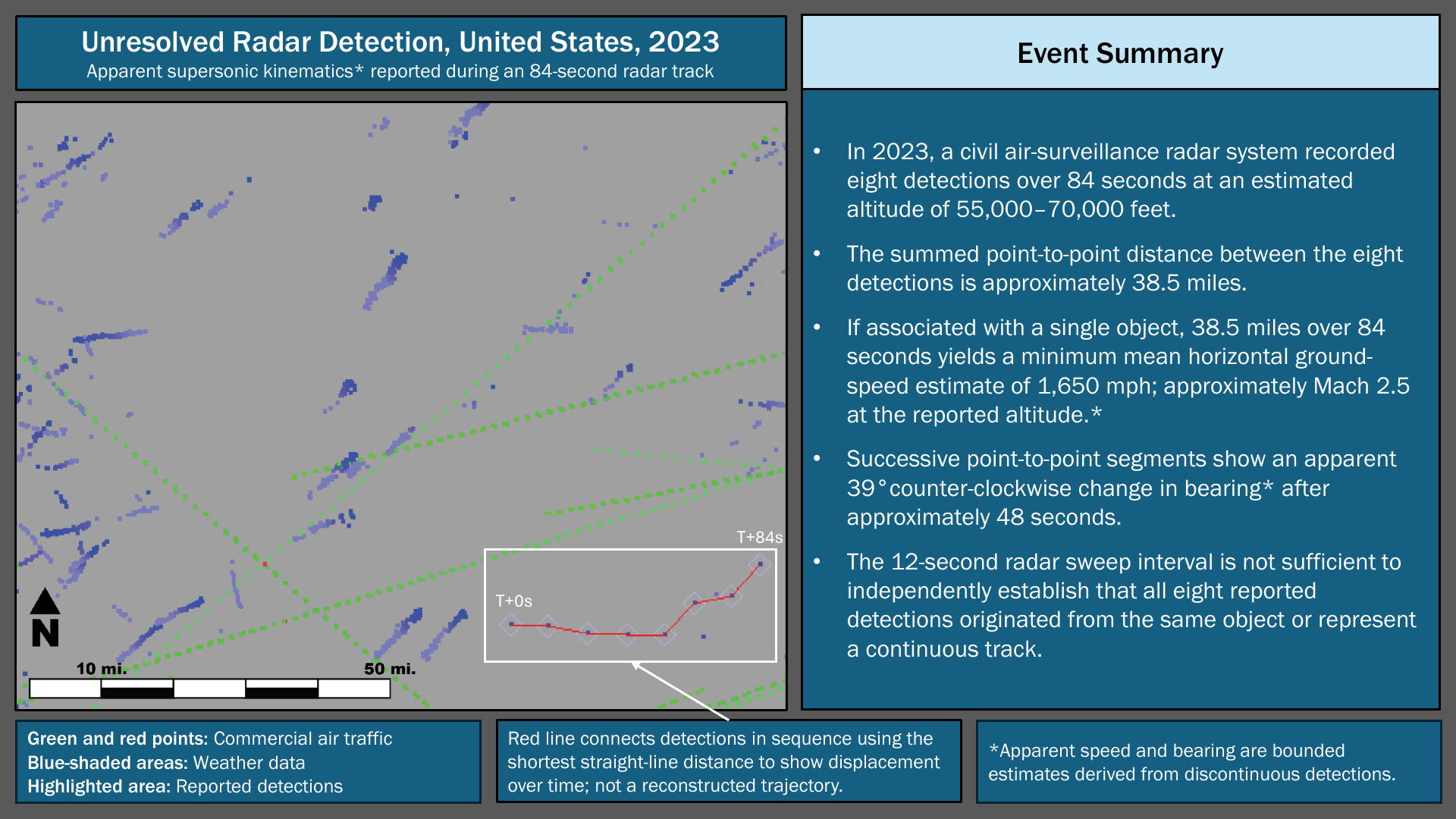
DOW-UAP-D165 describes eight radar detections over the United States in 2023. They span 84 seconds at an estimated altitude of 55,000 to 70,000 feet. Joining the returns in sequence gives a combined separation of about 38.5 miles.
Divide that distance by the elapsed time and the result is 1,650 mph, roughly Mach 2.5 at the reported altitude. The slide also describes an apparent 39-degree change in bearing after about 48 seconds.
That is an intriguing set of numbers. It is also a conditional calculation.
The radar swept once every 12 seconds. AARO’s slide says that interval cannot independently establish that the eight returns came from one object or formed a continuous track. The red line is a series of straight connections between detections, rather than a reconstruction of the route travelled.
Picture two road-camera photographs taken 12 seconds apart. Even if a car appears in both, the pictures do not show every turn it made between them. Here, the radar analysis has an earlier problem to settle as well. Did all eight detections belong to the same object?
Two readings of the plot remain possible from the released information.
- One object generated the returns. The slide’s calculation then gives a minimum mean horizontal ground-speed estimate of 1,650 mph.
- The returns do not form one continuous object track. In that case, connecting them does not establish a single object’s speed or manoeuvre.
The release supplies the plot and its limitations together. An instant right-angle turn, a measured acceleration or a propulsion system cannot be recovered from those eight points.
Release 8 therefore puts a potentially supersonic radar case on the public record, while leaving the association between its detections unresolved. Earlier sensor material in PURSUE Release 4 provides a useful comparison with the wider archive.
3. What Do the Three Release 8 UFO Videos Show?
The three Release 8 UFO videos are separate Middle East recordings submitted by US Central Command to AARO. Their event years are 2020, 2026 and 2023. The DVIDS upload date is not the date all three encounters occurred.
PR166 Shows a Feature Crossing the Infrared Picture
In the 20-second 2020 clip, a contrasting feature enters from the right and moves left across the image during the first nine seconds. The sensor then pans and changes magnification. DVIDS describes those operations directly; the apparent scale change is part of the camera sequence.
PR168 Includes Several Features and Intermittent Tracking
The 54-second 2026 recording begins with multiple contrasting features moving across the picture. The sensor pans and zooms, then moves towards two of them. Tracking is intermittent in the later part of the clip.
Several points on a sensor image can look like a formation. Establishing a shared flight path requires more than their arrangement on the screen. The released clip and its description do not supply a measured separation or a three-dimensional formation track.
PR169 Keeps One Feature Near the Centre
The 13-second 2023 clip shows the camera panning to keep a contrasting feature near the centre of the image. The background moves as the camera follows it, just as a landscape slides past when you track a distant light with your phone.
All three records are officially described as unresolved. Their public descriptions identify sensor behaviour and visible contrast features, rather than identifying an aircraft type, a physical size or an extraordinary speed.
The clips are real released military sensor recordings. Their identities remain open in the published records. Our Release 5 breakdown covers the earlier sensor videos and reporting that preceded them.
4. Why Did DIA Praise AAWSAP and Then Question Its Value?
AAWSAP was the Advanced Aerospace Weapon System Applications Program. DIA’s solicitation and objectives asked for research into future aerospace threats across 12 technical areas, including propulsion, lift, materials, power generation and human effects.
The work looked decades ahead. DIA was commissioning a survey of technologies that might transform aviation and change the threats facing US aircraft.
BAASS, Bigelow Aerospace Advanced Space Studies, was the sole bidder. A May 2009 talking paper dates the signed contract to 22 September 2008. That paper describes a programme still expanding its ambitions.
The Early Assessments Were Enthusiastic
A 2 January 2009 briefing paper says the 12 management plans had received ratings from very good to excellent. The contract was on schedule and within cost. By May, officials were describing BAASS’s performance as excellent.
The praise was not confined to administrative progress. A 30 October 2009 review memorandum reports positive reviews of the technical studies, some exceptionally favourable. Eight reviews came from other authors in the report group; five came from outside reviewers, including three Sandia research staff.
The memorandum says the intended quality had been achieved within the constraints of unclassified research. It also envisages further studies and potential uses for defence agencies, laboratories and industry.
Those are substantial endorsements of the commissioned research. They concern the quality and possible applications of the papers, rather than a successful demonstration of every technology discussed in them.
Reid Wanted More Secrecy Than DIA Could Justify
On 24 June 2009, Senator Harry Reid asked William Lynn III for restricted special-access protection around parts of the programme. His letter used the AATIP name and argued that sensitive findings, methods and personnel needed stronger safeguards.
A special access programme adds controls beyond ordinary classified handling. Think of extra locks and a shorter list of people holding the keys. Asking for those locks does not, by itself, establish what was inside the room.
DIA’s 13 November 2009 response says it could not find adequate grounds for the requested restrictions. All first-year deliverables to the Defense Warning Office had been unclassified. Most projected products were also expected to remain unclassified, although some future reports could add classified information.
On the second page, DIA says it knew of no report sufficiently sensitive and vulnerable to need the proposed extra protection. The disagreement was explicit. Reid wanted special safeguards; the reviewing agency said the material did not justify them.
Director Ronald Burgess later described a November 2009 meeting in which the reports were judged of limited value to DIA. He also suggested that another organisation might find them useful and could take over the project after the DIA contract.
A technical study can receive good reviews and still fail to answer the questions of the intelligence office that bought it. Release 8 preserves both judgements. Neither the early praise nor the later frustration should disappear from the account.
The sixth PURSUE release had already introduced AAWSAP’s objectives and technical reference papers. The programme records collected here show how officials assessed that work while it was under way.
5. What Is Actually in the BAASS Ten Month Report?
The BAASS Ten Month Report, dated 30 July 2009, describes the contractor’s staffing, investigations, research and plans. The released PDF has 538 pages. Its numbered main body runs to page 494, followed by appendices.
Among the details are 47 full-time staff, Utah ranch accounts, a proposed remote-viewing effort and CAPELLA, a collection of 237,331 records drawn from nine databases. These are statements in BAASS’s report, rather than independent government findings about each reported event.
The proposed underground vault deserves particular care. On PDF page 9, printed page 3, BAASS describes a 5,000-square-foot facility intended to hold material it hoped to acquire. Occupancy was projected for late 2009 or early 2010, subject to building permits. The passage records a storage plan, not an inventory of recovered craft already inside it.
Our earlier guide to the 2009 BAASS report predates this official release. The report was already public; its inclusion in PURSUE gives it a place alongside the government papers assessing the contract.
6. Why Was the CIA Discussing UFOs and Psychological Warfare?
In a 1952 memorandum catalogued as circa 2 October, CIA Director Walter Bedell Smith proposed examining whether flying-saucer reports had psychological-warfare uses, both offensive and defensive. CIA-UAP-D025 preserves the proposal and its supporting papers.
That language sounds explosive when detached from the discussion around it. The surrounding CIA UFO files show an agency trying to understand unfamiliar reports, public alarm and the risk of confusing an air-warning system.
Unidentified Reports Could Complicate an Actual Attack
A 13 October memorandum by James Reber considers two possibilities. Unidentified objects could conceivably be hostile, or an enemy could exploit the confusion they caused to conceal an attack.
It is the problem of an alarm sounding repeatedly for uncertain reasons. The concern is not only what triggered each alarm, but whether the warning system would still recognise a real intrusion.
Reber’s paper says the available information did not establish Soviet creation or control of the phenomena. It calls for research into their nature and into ways of identifying them.
Those concerns can coexist. Officials could doubt that a sighting was a Soviet machine while still worrying about the effect of unexplained reports on US defences.
A Proposal Was Still a Proposal
On the second page, Reber says it was too early for psychological-warfare planners to devise US use of flying saucers against an enemy. Scientific work and an intelligence estimate had to come first.
That response belongs to the same October 1952 policy discussion. Reading the two together preserves the objections as well as the proposal. The documents do not supply an approved operational plan to manufacture UFO encounters.
The agency was also wary of the public interpreting its interest as confirmation. An August 1952 assessment recommends continuing to examine unexplained reports while keeping CIA involvement out of the press, partly because disclosure might be read as evidence of secret confirming facts.
A separate 28 October diary entry records interest in reported ground sightings and theoretical propulsion without the expected noise or flare. It describes a proposed briefing, not a working propulsion system.
Scientific review was another strand. D024 proposes an outside panel of scientists, at an estimated cost of $5,000, and requests approval in principle before a later final submission. The 14 August briefing in D027 reviews reports and the Air Force investigation; its opening says it makes no recommendations for action.
Release 8 shows both scientific curiosity and anxiety about information itself. UFO reports were a possible intelligence problem even before anyone agreed what the objects were.
7. Why Does the Kelly Johnson UFO File Also Say Cloud?
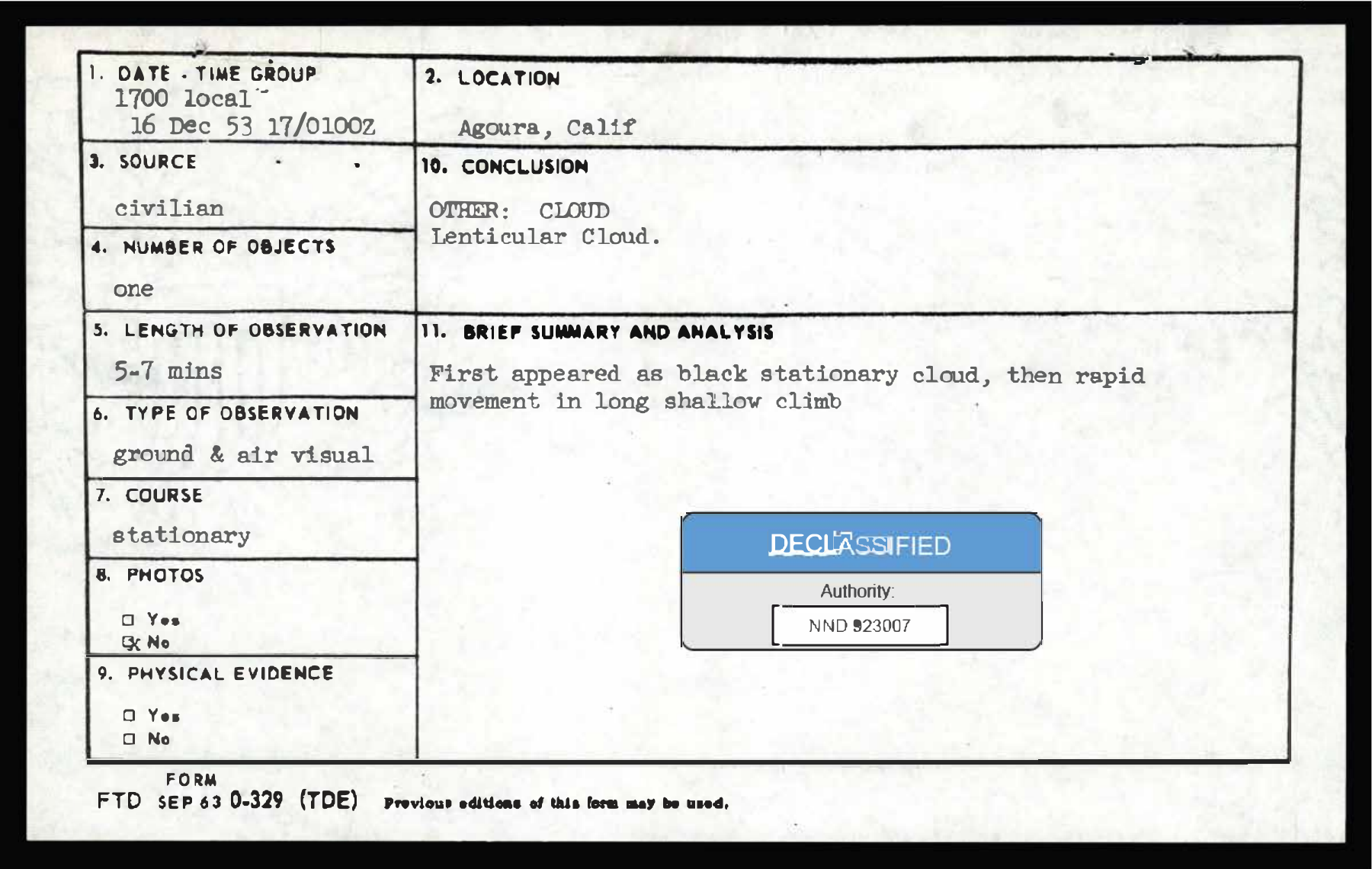
The Kelly Johnson UFO packet is catalogued in Release 8 as an unresolved California report from 1953. Its first page nevertheless gives the Air Force conclusion as a lenticular cloud.
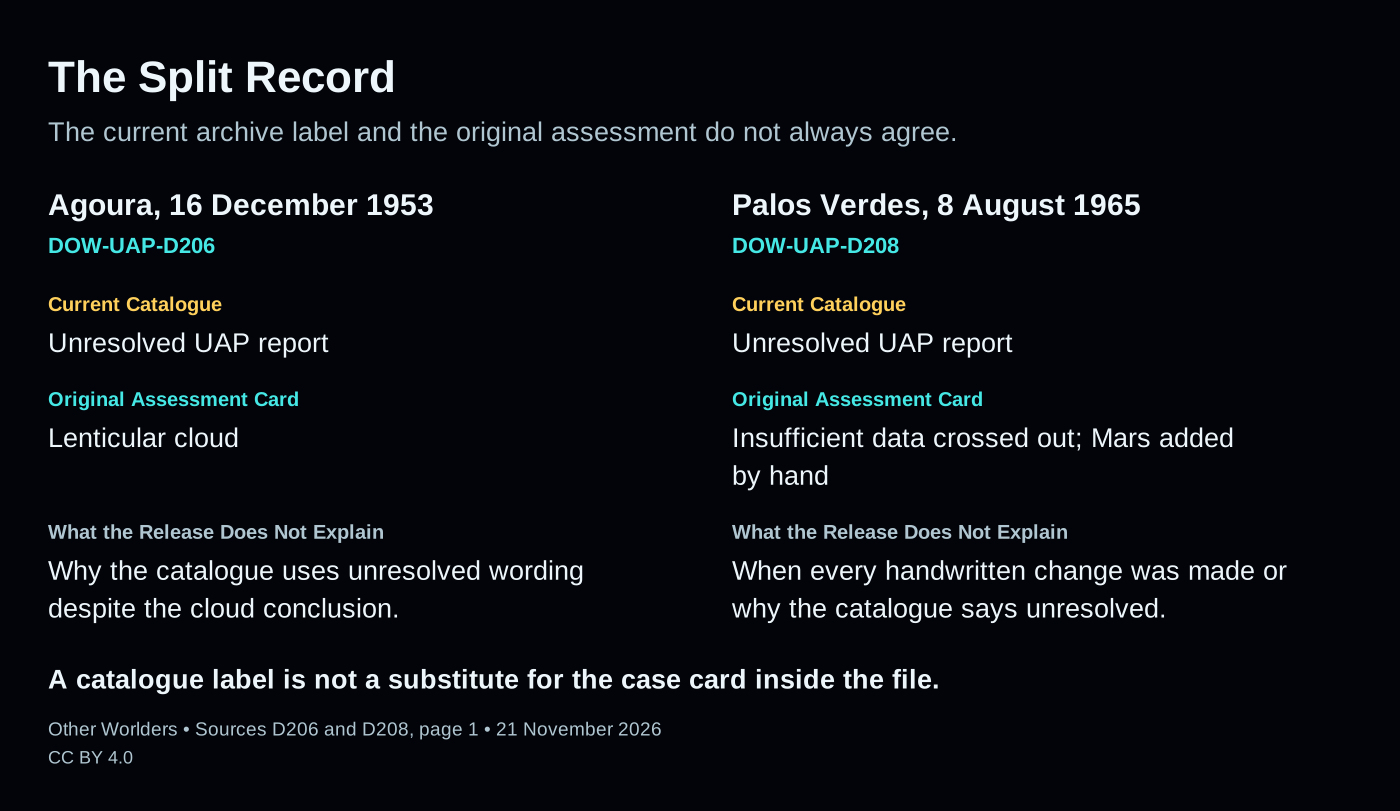
A Split Record is a UFO file whose current catalogue label and original assessment give different answers.
Imagine an “unresolved” sticker on a folder with a “cloud” case card inside. Both are there. The newer sticker does not erase the card, and the card does not make the witnesses’ account vanish.
The Lockheed Witnesses Described Something They Could Not Identify
On 16 December 1953, Johnson and other Lockheed witnesses reported an unusual dark object seen from the ground and from an aircraft. Their accounts describe an apparently stationary object followed by a departure, and reject an ordinary cloud explanation.
The packet also preserves uncertainty between the witnesses. Johnson said he could not establish physical dimensions without knowing the distance. Estimates of departure time differ. These are not the ingredients of a measured speed, even though the observers had considerable aviation experience.
The Air Force Card Gives a Conventional Explanation
The government case card summarises a black, initially stationary appearance followed by rapid movement in a shallow climb. Its conclusion field identifies a lenticular cloud, a cloud form that can have a smooth, lens-like outline.
The card is an official assessment. The witness accounts challenge that assessment. The Release 8 catalogue does not explain whether its unresolved label reflects a fresh review, a grouping choice or something else.
The original Project Blue Book records often preserve this mixture of observations, proposed explanations and administrative conclusions. D206 is especially striking because the contrast is visible on the opening page.
The Split Record
The current archive label and the original assessment do not always agree.
Agoura, 16 December 1953
DOW-UAP-D206
Current Catalogue
Unresolved UAP report
Original Assessment Card
Lenticular cloud
What the Release Does Not Explain
Why the catalogue uses unresolved wording despite the cloud conclusion.
Palos Verdes, 8 August 1965
DOW-UAP-D208
Current Catalogue
Unresolved UAP report
Original Assessment Card
Insufficient data crossed out; Mars added by hand
What the Release Does Not Explain
When every handwritten change was made or why the catalogue says unresolved.
A catalogue label is not a substitute for the case card inside the file.
The Palos Verdes Card Was Amended Too
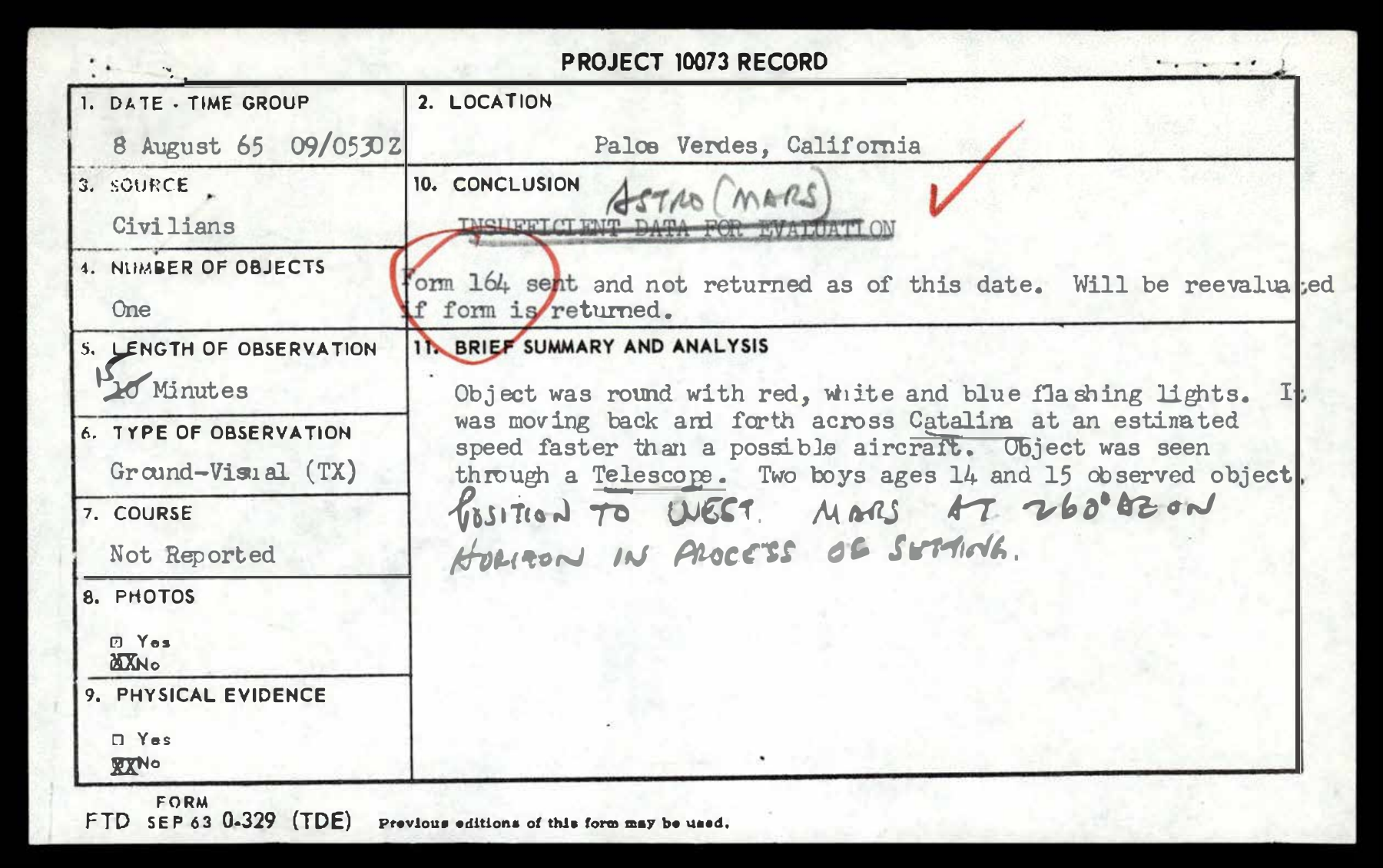
D208 concerns Palos Verdes on 8 August 1965. Its card describes a telescopic sighting of flashing lights. A typed insufficient-data conclusion is crossed out, with a handwritten astronomical explanation identifying Mars.
The packet also includes a request for further information. It does not date every handwritten alteration, so the visible changes do not establish a complete assessment timeline.
Neither case can be fairly reduced to its current catalogue title. Release 8 gives access to the disagreement as well as the sighting.
8. Which Other Historical Files Deserve Attention?
D205 describes a 17 December 1956 encounter near Ube, Japan, during F-86D practice intercepts. One pilot reported an airborne radar return and an intermittent visual sighting. The report estimates a departure at 1,500 to 1,800 knots.
The same report says that speed exceeded what the radar’s negative closure-rate indication could display. It also records possible electronic interference, the second pilot’s failure to obtain the same object return, and no corresponding unidentified ground-radar track.
Those details make the case interesting without making every estimate equally secure. The reporting officers also cautioned that the absence of a ground return carried limited weight because the ground station had needed identification signals to plot the two participating aircraft.
Levelland Was Forwarded as Unresolved
D191’s closing assessment of the 1957 Levelland reports leaves the principal sighting unresolved. The preparing officer considered the main witness credible and listed possible explanations including electrical weather phenomena, ball lightning and reflected light from burning gas.
The investigation included checks on local weather, gas burning and downed power lines. Some additional witnesses mentioned in newspapers could not be located. The officer said the unit lacked enough knowledge of the proposed phenomena to settle the main account.
That is an unresolved judgement inside the original report itself. The officer also separated the main account from other reported streaks of light and from a later hovering-object sighting. Combining them into one uninterrupted flight would discard the distinctions made by the investigation.
Other Packets Include Press Claims and Conventional Assessments
Three other examples show the range of the historical material.
- D198 is a translated Japanese press account of a claimed Soviet circular aircraft. A reported newspaper claim is not an independent observation of the machine.
- D211 concerns a 1956 Fontana sighting. Its case card favours a jet aircraft and contrail, despite the unresolved wording in the new catalogue title.
- D212 opens with a 1966 San Pedro sighting and a possible hot-air-balloon explanation. Its 34 pages also contain separate NICAP correspondence and a newspaper clipping. The packet is not one continuous San Pedro case.
The batch includes intriguing pilot reports, modest light sightings, press reporting and conventional explanations. The full register below keeps those very different records available by their original identifiers.
9. How Does Release 8 Connect to Our Earlier PURSUE Coverage?
The PURSUE UFO files have arrived in batches, and several subjects recur. This release adds programme evaluations to the technical papers seen earlier, as well as another set of military sensor records and older sighting packets.
Our Release 3 investigation covers that earlier tranche. The Release 4, Release 5 and sixth-release articles linked above follow the expansion of the collection through sensor material, historical cases and AAWSAP research.
The earlier BAASS guide remains the report-specific companion to this article. The DIA papers show how the agency assessed the work described in BAASS’s report.
10. What Has PURSUE Release 8 Changed?
The strongest addition is the ability to compare documents that answer different parts of the same story. Reid’s request sits beside DIA’s refusal. Positive technical reviews sit beside Burgess’s judgement of limited value to his agency. Historical witness accounts sit beside the explanations officials assigned to them.
We found the radar slide especially revealing because its caveat is as explicit as its speed estimate. The 1,650 mph figure is on the page. So is the reason it cannot yet be treated as a confirmed single-object track.
Release 8 has made those disagreements easier to examine. It has also left specific gaps. The radar case needs a reliable association between returns; the videos need fuller range and sensor context; the historical packets need an explanation of how their current labels were assigned.
A later release could fill one of those gaps without settling every UFO case. For now, the most compelling story is the one visible inside these files, where the witnesses, contractors and intelligence officials sometimes reached different conclusions about the same material.
Where Can You Open Every Release 8 Record?
This register contains all 43 records counted on 21 November 2026. Document links point to the original government PDFs, with a public mirror alongside each one. Page totals count PDF pages, including covers and appendices. The linked records retain their original language.
CIA Papers
| Identifier | Record | Pages or Duration | Sources |
|---|---|---|---|
| CIA-UAP-D024 | Approval in Principle, Research Concerned with UFOs, 1952 | 4 | Government Record · Public Mirror |
| CIA-UAP-D025 | Proposal to Consider Psychological Warfare Implications of UFO-Related Issues, 1952 | 16 | Government Record · Public Mirror |
| CIA-UAP-D026 | Summary Assessment of “Flying Saucers,” 1952 | 3 | Government Record · Public Mirror |
| CIA-UAP-D027 | Office of Scientific Intelligence Briefing on “Flying Saucers,” 1952 | 11 | Government Record · Public Mirror |
| CIA-UAP-D028 | Assessment of National Security Issues Relating to “Flying Saucers,” 1952 | 4 | Government Record · Public Mirror |
| CIA-UAP-D029 | Official Diary Entry on “Flying Saucers,” 1952 | 2 | Government Record · Public Mirror |
Radar, BAASS and AAWSAP
| Identifier | Record | Pages or Duration | Sources |
|---|---|---|---|
| DOW-UAP-D165 | Unresolved Radar Detection, North America, 2023 | 1 | Government Record · Public Mirror |
| DOW-UAP-D172 | BAASS Ten-Month Report, July 2009 | 538 | Government Record · Public Mirror |
| DOW-UAP-D182 | AAWSAP Statement of Work, August 2008 | 7 | Government Record · Public Mirror |
| DOW-UAP-D183 | Correspondence from Senator Harry Reid, June 2009 | 4 | Government Record · Public Mirror |
| DOW-UAP-D184 | AAWSAP Talking Paper for Senator Reid Engagement, May 2009 | 2 | Government Record · Public Mirror |
| DOW-UAP-D185 | Review of AAWSAP Special Access Program Request, November 2009 | 3 | Government Record · Public Mirror |
| DOW-UAP-D186 | DIA Memorandum on AATIP and AAWSAP | 2 | Government Record · Public Mirror |
| DOW-UAP-D187 | DIA Talking Paper for Senator Reid Engagement, January 2009 | 1 | Government Record · Public Mirror |
| DOW-UAP-D188 | Review of AAWSAP Contract Deliverables October 2009 | 8 | Government Record · Public Mirror |
Historical Sighting Packets
| Identifier | Record | Pages or Duration | Sources |
|---|---|---|---|
| DOW-UAP-D189 | Air Intelligence Information Report, Virginia, 1957 | 5 | Government Record · Public Mirror |
| DOW-UAP-D190 | Air Intelligence Information Report, Massachusetts, 1957 | 8 | Government Record · Public Mirror |
| DOW-UAP-D191 | Air Intelligence Information Report, Texas, 1957 | 21 | Government Record · Public Mirror |
| DOW-UAP-D192 | Air Intelligence Information Report, Nebraska, 1957 | 10 | Government Record · Public Mirror |
| DOW-UAP-D193 | Air Intelligence Information Report, New Mexico, 1957 | 8 | Government Record · Public Mirror |
| DOW-UAP-D194 | Air Intelligence Information Report, New Mexico, 1957 | 10 | Government Record · Public Mirror |
| DOW-UAP-D195 | Air Intelligence Information Report, New Mexico, 1957 | 7 | Government Record · Public Mirror |
| DOW-UAP-D196 | Air Intelligence Information Report, Washington, 1957 | 6 | Government Record · Public Mirror |
| DOW-UAP-D197 | Air Intelligence Information Report, Michigan, 1957 | 7 | Government Record · Public Mirror |
| DOW-UAP-D198 | Air Intelligence Information Report, Japan, 1957 | 4 | Government Record · Public Mirror |
| DOW-UAP-D199 | Air Intelligence Information Report, Iran, 1957 | 3 | Government Record · Public Mirror |
| DOW-UAP-D200 | Air Intelligence Information Report, Peru, 1957 | 3 | Government Record · Public Mirror |
| DOW-UAP-D201 | Air Intelligence Information Report, Iran, 1957 | 3 | Government Record · Public Mirror |
| DOW-UAP-D202 | Air Intelligence Information Report, Peru, 1957 | 6 | Government Record · Public Mirror |
| DOW-UAP-D203 | Air Intelligence Information Report, California, 1957 | 10 | Government Record · Public Mirror |
| DOW-UAP-D204 | Air Intelligence Information Report, Virginia, 1957 | 10 | Government Record · Public Mirror |
| DOW-UAP-D205 | Air Intelligence Information Report, Japan, 1956 | 5 | Government Record · Public Mirror |
| DOW-UAP-D206 | Unresolved UAP Report, California, 1953 | 15 | Government Record · Public Mirror |
| DOW-UAP-D207 | Unresolved UAP Report, California, 1956 | 5 | Government Record · Public Mirror |
| DOW-UAP-D208 | Unresolved UAP Report, California, 1965 | 14 | Government Record · Public Mirror |
| DOW-UAP-D209 | Unresolved UAP Report, California, 1955 | 4 | Government Record · Public Mirror |
| DOW-UAP-D210 | Unresolved UAP Report, California, 1957 | 17 | Government Record · Public Mirror |
| DOW-UAP-D211 | Unresolved UAP Report, California, 1956 | 3 | Government Record · Public Mirror |
| DOW-UAP-D212 | Unresolved UAP Report, California, 1966 | 34 | Government Record · Public Mirror |
| DOW-UAP-D213 | Unresolved UAP Report, California, 1949 | 17 | Government Record · Public Mirror |
The Three Videos
| Identifier | Record | Pages or Duration | Sources |
|---|---|---|---|
| DOW-UAP-PR166 | Unresolved UAP Report, Middle East, 2020 | 20 seconds | Government Record |
| DOW-UAP-PR168 | Unresolved UAP Report, Middle East, 2026 | 54 seconds | Government Record |
| DOW-UAP-PR169 | Unresolved UAP Report, Middle East, 2023 | 13 seconds | Government Record |
The official portal restricted access during our review. We read public mirrored copies and checked their identifiers, page counts and hashes across the downloaded set. The register’s 40 PDFs have 40 distinct file hashes. Event years below follow the underlying documents where archive date fields conflict.
The appearance of U.S. Department of War (DoW) visual information does not imply or constitute DoW endorsement. DVIDS Public-Use Conditions.
What Else Do People Ask About PURSUE Release 8?
When Was PURSUE Release 8 Released?
PURSUE Release 8 was released on 20 November 2026. It contains 43 records, comprising 40 PDFs and three videos.
How Many Pages Are in the Release 8 Documents?
The 40 distinct PDFs total 841 pages, counting covers and appendices. The BAASS report accounts for 538 PDF pages; its numbered main body ends at page 494.
Did the New Radar File Confirm a Mach 2.5 UFO?
The slide calculates roughly Mach 2.5 if eight radar detections belonged to one object. It also says the 12-second sweep interval cannot independently establish a single continuous object track.
Was the BAASS Ten Month Report Previously Public?
Yes. The report circulated publicly before its inclusion in PURSUE Release 8, and Otherworlders had already covered it. An official release date does not establish that every enclosed document is appearing publicly for the first time.
Did Harry Reid’s AAWSAP Secrecy Request Succeed?
DIA’s 13 November 2009 review said it could not justify the restricted special access programme requested by Reid. It said the first-year deliverables were unclassified and identified no report needing the proposed extra protection.
Do the CIA UFO Files Describe an Approved Psychological-Warfare Operation?
The 1952 files include a proposal to examine psychological-warfare uses and a response saying planning such uses was premature. The released discussion does not provide an approved operational plan to manufacture UFO encounters.
Why Is the Kelly Johnson File Labelled Unresolved?
The current catalogue uses unresolved wording, while the original Air Force card identifies a lenticular cloud. The released packet does not explain the basis for the newer label. The two descriptions should be kept distinct.
Where Can You Watch the Release 8 UFO Videos?
The three clips are embedded in this article and hosted on DVIDS under identifiers DOW-UAP-PR166, PR168 and PR169. Their event years are 2020, 2026 and 2023 respectively.