
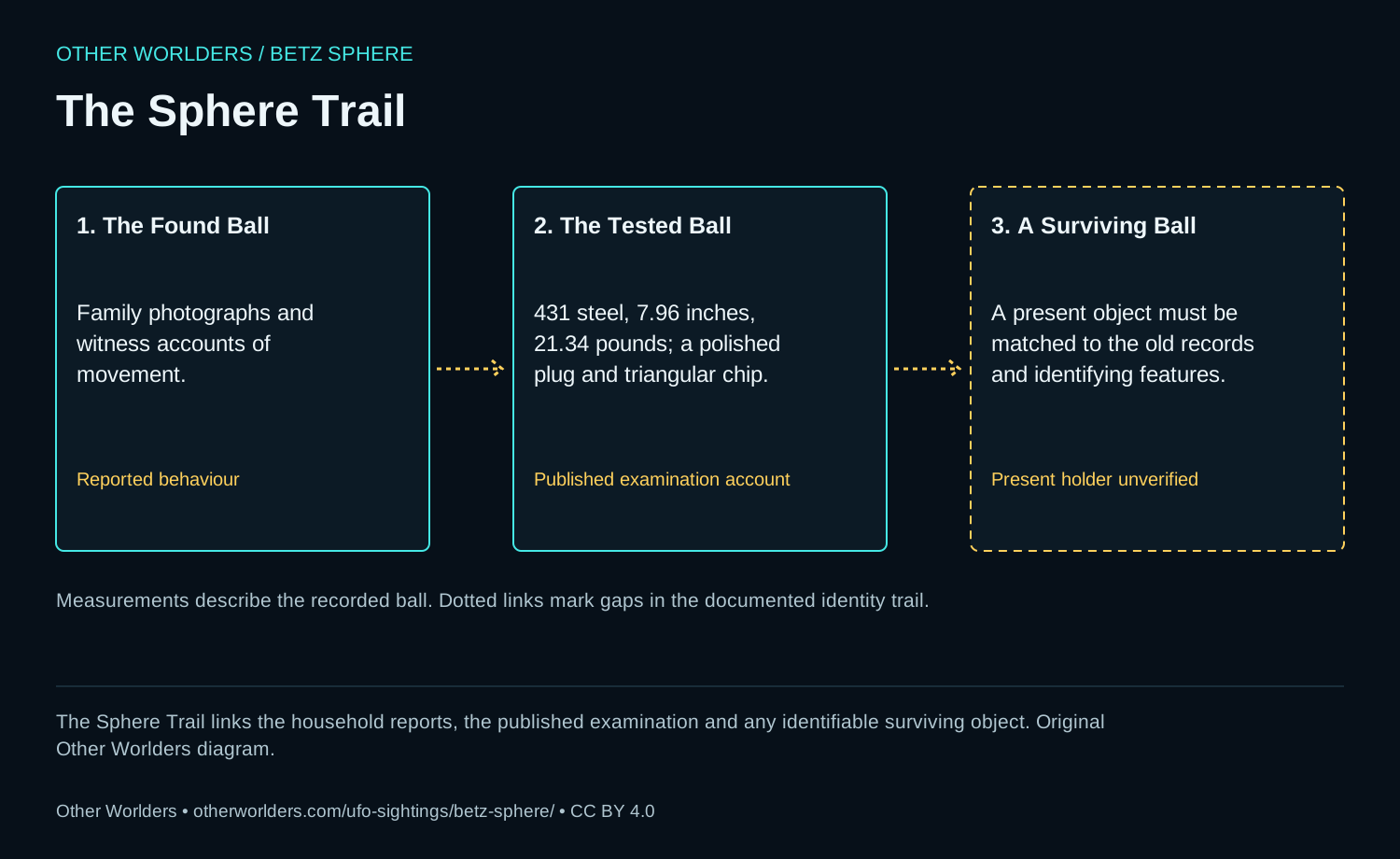
The Sphere Trail tracks whether the found ball, the tested ball and any surviving ball can be identified as the same object.
Contents
1. What Is the Betz Sphere Supposed to Have Done?
Early reports credit Terry Matthews, also named Terry Betz in coverage, with finding the sphere on family land in the Fort George Island area of Jacksonville. The object became known as the Betz Mystery Sphere. Its reputation came from what the family said happened after they brought it home.
The Betz Family Sphere at Home
Gerri Betz said the ball began vibrating while Terry was tuning a guitar. She also described it rolling around a table and returning towards someone who had pushed it. A household curiosity had begun to look responsive.
Florida Times-Union photographer Lou Egner reported a particularly striking sequence: the ball stopped, turned, travelled in an arc and returned to his feet. Radio host Ron Kivett later recalled it rolling to a glass table's edge and stopping. He also described a faint tinkling sound inside when he tilted it.
WJCT's first Odd Ball episode brings together the archived Gerri interviews, Egner's newspaper account and the later Kivett interview. They describe different encounters. Egner's newspaper account and Kivett's later recollection concern different visits and surfaces.
| Date | Record |
|---|---|
| Late March or early April 1974 | Reported discovery on Betz family land. |
| 11 April 1974 | Earliest Florida Times-Union story located by WJCT reporter Lindsey Kilbride. |
| 13 April 1974 | Florida Times-Union coverage of Navy Chief Chris Berninger's test findings. |
The clippings reproduced in WJCT's archive gallery show how quickly the discovery became an examination story. The family had an object that could be photographed, carried away and tested. That gave the mystery a physical centre that a distant light in the sky would not have.
2. The Betz Sphere Navy Tests Named the Steel, but Not the Maker
NICAP's May 1974 newsletter identifies 431 stainless steel, a hollow shell and a polished welded plug. It notes abrasion and a triangular chip. The published examination account is on page 3.
| Property | Reported Result |
|---|---|
| Outside diameter | 7.96 inches |
| Weight | 21.34 pounds |
Those details support manufacture much more directly than they support a particular purpose. There is a named alloy, a shell and a plug, but no maker's name, serial number or ownership record in the report.
The alloy itself has ordinary engineering uses. Carpenter Technology's 431 datasheet lists applications including pump shafts and valve stems. Its Selectaloy guide describes 431 as magnetic. A magnetic response is therefore compatible with the reported material; it does not require an unknown metal.
That is a comparison with a recognised alloy, not a claim that Carpenter made the Betz ball. A material specification can be shared by many manufacturers and many kinds of part.
The same NICAP account reports no unusual behaviour on a flat surface plate. Chief Chris Berninger attributed the household rolling to the contours of the old stone floor.
The newsletter names the floor as the explanation but prints no floor survey, measured route or recreation of Egner's return. The account supports an ordinary object in the laboratory setting without documenting exactly what happened in the house.
3. Why Did the Betz Sphere X Ray Divide the Examiners?
Astronomer J. Allen Hynek examined the sphere with colleagues at a UFO conference in New Orleans. In archived radio audio, he said the panel had found no evidence of extraterrestrial manufacture. Engineer James Harder favoured more testing and challenged Hynek's confidence that it was man-made.
WJCT's fourth episode includes Hynek's original audio and actor-read historical Harder passages. The disagreement extended to what the X-ray implied about the interior.
An X-ray makes a shadow picture. The front wall, back wall and contents of a sphere are projected into the same flat image. A dark patch can depend on the thickness of material in that path as well as its composition.
Radiologist Diane Johnson reviewed a reproduced image for WJCT. She explained that its quality prevented her from resolving the shell's boundary clearly. A darker internal object did not necessarily mean a different, denser material; it could be a thicker piece of the same material. She did not examine or scan the ball itself.
WJCT's later records requests did not locate the original Navy laboratory report. The surviving newsletter and reproduced image consequently cannot supply every exposure setting, original reading or examination note behind the 1974 conclusions.
4. Is the Betz Sphere Explained by Ordinary Mechanics?
An industrial valve component could explain the steel shell and polished plug. Egner's return path would still need a cause.
Explanation 1. The Betz Sphere Ball Valve Theory
Robert Edwards, president of Holley-Edwards Sales Inc., told the Florida Times-Union that the ball was a type used in boiler blow-out valves. His company distributed stainless-steel balls to paper mills, according to the clipping in WJCT's gallery. That provides an industrial comparison, although the report did not trace this ball's ownership.
Under this explanation, ordinary forces also produced the surprising motion. A floor with changing slopes could redirect a ball. An initial push could also affect how it travelled or stopped. These are possible mechanisms, not measurements recovered from the Betz house.
The flat-plate result fits a passive object that behaves differently on different surfaces. It does not establish which combination of surface shape, push and construction would reproduce Egner's account. Nor does a floor explanation automatically account for Gerri's reported vibration during guitar tuning.
Ordinary manufacture has several specific clues in its favour. A complete ordinary-motion explanation still needs to fit the particular behaviour being discussed.
Explanation 2. A Mechanism Inside the Ball
Kivett interpreted the ball as an autonomous device associated with UFOs. The household reports make that interpretation tempting because they sound purposeful: responding to a sound, changing direction and stopping before a fall.
A mechanism would have to do more than make a noise when the ball was tilted. Gerri's guitar account would require a response to sound. An active-device explanation would also have to account for Egner's return path and Kivett's stop at the edge. Those are separate demands drawn from separate reports, not one recorded demonstration.
Familiar steel would not, by itself, exclude an internal mechanism. Human machines are routinely made from familiar materials. But an operating device would need a source of energy and a way to produce the claimed movement. The published examinations describe a shell and internal objects, without demonstrating that operation.
This explanation therefore has a more demanding performance claim to establish. Reproducing unusual movement would be a substantial finding even before anyone identified the maker or proposed an extraterrestrial origin.
Could a Sculptor's Lost Load Explain the Journey?
Artist James Durling-Jones said he had driven through Jacksonville around Easter 1971 with metal balls on his Volkswagen's roof carrier. He was collecting them for a giant clock sculpture and said three or four had fallen off during the trip through the South.
WJCT investigated his account, but no documented match identifies one of those balls as the Betz object. His story could fit an industrial origin: a manufactured component might be reused for a sculpture and then lost. It is a proposed route to the woods, rather than a competing explanation of how the ball moved.
Was the Betz Sphere Debunked?
The industrial account explains more of the construction than the exotic-device account does. Neither the alloy name nor a similar-looking component supplies a measured reconstruction of the household encounters. Calling the whole case solved or wholly unexplained gives those different claims the same verdict when the published record does not.
5. Can We Still Follow the Same Betz Ball?
The measurements and surface marks could help compare a newly produced object with the recorded sphere. The diameter and alloy describe a type; the plug, chip, abrasion and dated photographs could help identify a particular example. None of those details alone is a unique identification.
Betz Sphere Video and Photos
Betz Sphere photos taken at the family's property appear in WJCT's gallery alongside contemporary newspaper coverage. The SMU Jones Film collection supplies the WFAA news film below through its official YouTube channel.
What Happened to the Betz Sphere After the Tests?
Gerri lent the sphere to the Navy on condition that it be returned within two weeks if it was not government property, as reported in The Jaxson's history. The Navy was reported to have returned it. Family friend Dick Burnett later recalled doubts about whether the family had received the same ball back.
Burnett's recollection appears in WJCT's second episode. WJCT did not verify that a swap had occurred. A concern about substitution is part of the history of the case, not an established explanation for the differing accounts.
Betz Sphere Current Location
Where is the Betz Sphere now? The sources checked for this 12 November 2026 update do not identify a verified current holder. That leaves an immediate obstacle to a new examination: producing a ball is not the same as authenticating it as the Betz ball.
The Sphere Trail
1. The Found Ball
Family photographs and witness accounts of movement.
Reported behaviour2. The Tested Ball
431 steel, 7.96 inches, 21.34 pounds; a polished plug and triangular chip.
Published examination account3. A Surviving Ball
A present object must be matched to the old records and identifying features.
Present holder unverifiedMeasurements describe the recorded ball. Dotted links mark gaps in the documented identity trail.
6. Betz Sphere vs Buga Sphere: Are They Connected?
The Betz Sphere and Buga Sphere are separate objects. The Betz ball was found near Jacksonville in 1974; the Buga Sphere case comes from Colombia. There is no documented connection between their origins in the sources reviewed here.
7. So What Happened to the Metal Ball That Seemed Alive?
The published examinations supplied a credible account of a manufactured steel object. They did not supply a measured reconstruction of the most striking movements described at the house. The later records checked here do not identify a verified present holder.
I would put an industrial origin ahead of an exotic device on this record. That is a judgement about construction. It leaves the detailed history of this particular ball, and the cause of each reported movement, unfinished.
An authenticated surviving sphere could be weighed, scanned and compared with the old marks. That would be a real advance. It would not bring back the exact floor, table, push or viewing conditions of a witness's visit in 1974.
No new examination of an authenticated surviving sphere is announced in the sources checked here. A surviving ball could give investigators new measurements. What still needs an explanation is the moment Egner said it turned and rolled back.
Questions About the Betz Sphere
What Is the Betz Sphere?
It is a metal sphere found on the Betz family's property near Jacksonville in 1974. The family and other witnesses reported unusual rolling and vibration.
Was the Betz Sphere Debunked?
An industrial component is the strongest proposed identification in the published account. Its complete origin and later history were not established there.
What Did the Navy Find?
The published account identifies stainless steel and records no unusual behaviour on a flat plate.
Does Its X-Ray Prove an Unknown Technology?
No. The reproduced X-ray reviewed for WJCT did not establish a mechanism or extraterrestrial manufacture.
Where Is the Betz Sphere Now?
The sources checked for this article's 12 November 2026 update do not identify a verified current holder.
Is There Genuine Betz Sphere Video?
Yes. SMU's Jones Film collection supplies a WFAA news report through its official YouTube channel. Its source-file label refers to April 1974.
Is It the Same Object as the Buga Sphere?
No. They are separate cases, associated with Florida and Colombia respectively. No shared origin has been documented in the sources reviewed here.
Why Did It Roll Back Towards People?
Chief Berninger blamed the house's uneven stone floor, according to NICAP's May 1974 account.