Explore the Sphere
1. A UFO You Can Put on a Table
Ask what is the Buga sphere? and you immediately meet two parts of the story. There are clips presented as an airborne sphere above the Buga area. There is also the engraved ball subsequently displayed by Mexican UFO broadcaster Jaime Maussan.
Maussan's presentation connects the object with a reported recovery in Colombia. Watching the programme lets you examine how that account was introduced, rather than relying on a short clip with its explanation removed.
The ball itself has been seen at close quarters. Lawyer Joshua McDowell attended the 20 June 2025 presentation in Mexico City and later published his own observations and photographs. He described a scratched, pockmarked object slightly larger than a bowling ball, with etchings on one hemisphere and small holes around its equator.
He also described copper-coloured terminals that appeared to have been added separately. Those are a visitor's observations, not a materials laboratory's identification. They nevertheless give the investigation something wonderfully concrete: features another examiner could look for on the same ball.


So, is the Buga sphere real? A physical ball has been publicly displayed and handled. The bigger question is whether it is the object in the flight footage, and what its construction would tell us if that connection were established.
Its rounded appearance also invites comparisons with the sphere recorded near USS Omaha. A similar outline can start a comparison. Identifying a shared kind of object requires much more.
2. What Do the Scans Reveal?
The possibility of seeing inside is Buga's most compelling hook. In his broadcasts, Maussan has presented radiographic images and interpretations of internal structures. A longer live analysis programme from May 2025 lets you see the images and hear the explanations in their original setting.
In a separate May scan presentation, contributor Nacho Rojo points to an outer shell, an intermediate region and an apparent inner feature he provisionally calls a device. Maussan also says two equatorial openings reach the interior. These are the programme's interpretations; the images do not establish what that inner feature does.
One detail is especially easy to lose in a retelling. At about 6:35 in that presentation, the number sixteen refers to pins in what the presenter calls the “chip”. It should not be turned into a verified count of sixteen tiny spheres inside the ball.
At about 33:49 in the longer live programme, a contributor describes the interior as not solid and claims that an internal feature moves under a magnetic field. That is a specific claim another team could test. Later comparisons with Tesla's tower and proposed levitation mechanisms remain hypotheses about its function.
An X-ray is rather like a shadow made with radiation that can pass through some of an object. Several structures can overlap in that flat view. Light and dark areas depend on how the object blocks the beam and how the image is displayed; they do not automatically identify a component's material or job.
A CT scan takes many views to reconstruct the interior in three dimensions. Think of a loaf revealed slice by slice instead of one silhouette of the whole loaf. NIST's explanation of computed microtomography describes how hundreds or thousands of projections become an interior model.
For Buga, the exciting prospect is a model that another team can examine. Are the apparent features attached to the shell? Do they connect? Are they repeated components, material inclusions or features of the image reconstruction? Original scan files and instrument settings would help distinguish those possibilities.
The materials story deserves the same close attention. Portal Vigília published its review of a circulated May 2025 report attributed to UNAM's Institute of Materials Research. Its account describes aluminium-silicon alloys, casting features and equatorial material discussed as possible optical fibres in a polymer.
That is a firsthand review of the circulated document, not a university announcement establishing the sphere's origin. The original promoter-hosted report page was unavailable when checked for this article. We could inspect the review, but could not authenticate the full report against an institution-hosted copy.
The scans make the interior worth investigating. Calling an apparent feature a processor, power source or propulsion system would require evidence of what it actually does. The distinction also runs through the Whistling Mike material-evidence claims.
3. Do the Symbols Contain a Message?
The Buga sphere symbols turn a strange ball into something that looks as though it wants to be read. Geometric markings suggest a code, an inscription or a deliberate design. Each possibility invites a different kind of investigation.
McDowell's close-up account describes the etchings as apparently freehand. His photographs provide a better starting point than a redrawn graphic: you can inspect the marks, their edges and their arrangement. A tracing can accidentally tidy away the very details that might reveal how an inscription was made.
A Buga sphere translation would need a way to test whether the reading is correct. Imagine receiving a postcard in an unknown script. Recognising a shape that resembles a letter you know is only the beginning; the proposed reading must explain the other marks too.
Agnese Sartori has documented her proposed reading and public presentations, including her participation in a March 2026 event in Mexico City. Her page lets you trace a claimed decipherment to the person presenting it. It does not demonstrate that the reading has been independently verified.
Likewise, asking an AI system to suggest meanings can produce possibilities, but does not supply a translation key. A persuasive decipherment would identify consistent symbols, explain repeated patterns and make predictions that other people could check. It should also survive a comparison with decorative or invented writing.
The markings may be the object's most personal-looking feature. Establishing who engraved them, with which tools and at what stage of construction could tell us more than an elegant message attached afterwards. Even an undeciphered inscription can preserve evidence of its maker.
4. Where Does the 12,560-Year Claim Come From?
The age claim makes this story much stranger. In an original newsletter circulated by Steven Greer's team, the material said to have been dated is resin associated with the sphere. The newsletter credits the University of Georgia's Center for Applied Isotope Studies.
The accompanying report image is dated 19 September 2025. Its table lists sample BGS, material “resin” and a radiocarbon age of 12,560 ± 30 BP. BP here means before 1950, and the document describes an uncalibrated radiocarbon age. That is not simply a calendar date for when a metal ball was manufactured.
Even a securely measured date needs its connection to the object explained. Picture a new chair made from old timber. Dating the wood and dating the construction answer different questions. For Buga, investigators would need to document exactly where the sampled material came from and how it became part of the ball.
There is also an inconsistency worth preserving: the opening paragraph refers to foraminifer samples, while the table and preparation text refer to resin. We have not authenticated this circulated image with the laboratory. Its existence establishes what Greer's team distributed, rather than independent confirmation of the sphere's age.
The laboratory's own radiocarbon dating guidance explains why sample preparation and contamination need attention, and distinguishes reported radiocarbon ages from calibrated calendar ages. That guidance explains the method; it contains no authentication of the Buga claim.
The striking possibility is that the object contains material with an old carbon signature. The testable question is whether that material records its manufacture, a later addition or something else. A second, documented sample could move that question much further than repeating the headline number.
5. Three Explanations for the Same Strange Object
Buga sphere real or fake? sounds like a single decision. It contains several: whether the displayed object exists, whether its reported behaviour occurred, and whether it has been correctly connected to the airborne footage. Three broad explanations deserve a fair test.
Explanation 1. A Human-Made Object With an Unusual Design
The ball could be an intentionally constructed human object whose function or maker has not been identified publicly. An artwork, experimental assembly or fabricated mystery could all have elaborate details. A lack of an obvious seam would not, by itself, rule out human manufacture.
This explanation should produce evidence of its own. Tool marks, a documented fabrication method, matching components or a credible maker could connect the object to a workshop. Simply finding another shiny sphere would leave the identity question open. Calling the Buga sphere debunked requires a demonstrated explanation for the relevant evidence, rather than a resemblance alone.
Explanation 2. Separate Events Have Become One Story
A real object and a real video could have been linked incorrectly. Distinctive marks and a continuous recovery record would connect the ball on the table to the object filmed outside. Matching a ball's general shape would leave too many possible objects in the picture.
This possibility does not require every participant to be dishonest. A misunderstanding, an edited sequence or missing context could allow separate observations to become one narrative. Original files, precise locations and independently recorded handovers would either strengthen that connection or expose where the stories diverge.
Explanation 3. The Object Has a Genuinely Unexplained Property
The most exciting possibility is that the sphere does something ordinary manufacture cannot yet explain. A repeatable effect involving weight, movement or an internal component would give researchers a specific phenomenon to investigate. That would be more revealing than an unusual appearance.
The route is practical. Let another team test the same marked object with documented equipment, control objects and a recorded procedure. If the effect persists, the result earns closer investigation. An unexplained measurement would still leave questions about the object's origin, but it would give the mystery a firm place to begin.
These explanations compete on different evidence. Our guide to what UFO evidence can establish explores the broader distinction between an observation, an unexplained result and an identified origin.
6. The Sky-to-Table Test
The Sky-to-Table Test asks whether the object in a UFO video, the object on the examination table and the material in a laboratory report can be traced to the same thing.
When I compared the public presentations with the circulated age report, those connections stood out. Looking inside a sphere is one investigation. Showing that it is the ball filmed in flight is another. Each could move forward, but a result from one cannot silently complete the other.
THE SKY-TO-TABLE TEST
In the Sky
Original footage
Time, location and the full recording
On the Table
Identifiable object
Distinctive marks and a documented recovery
In the Laboratory
Traceable sample
Recorded sampling, methods and repeatable results
Connect 01 to 02 with the recovery record. Connect 02 to 03 with the sampling record.
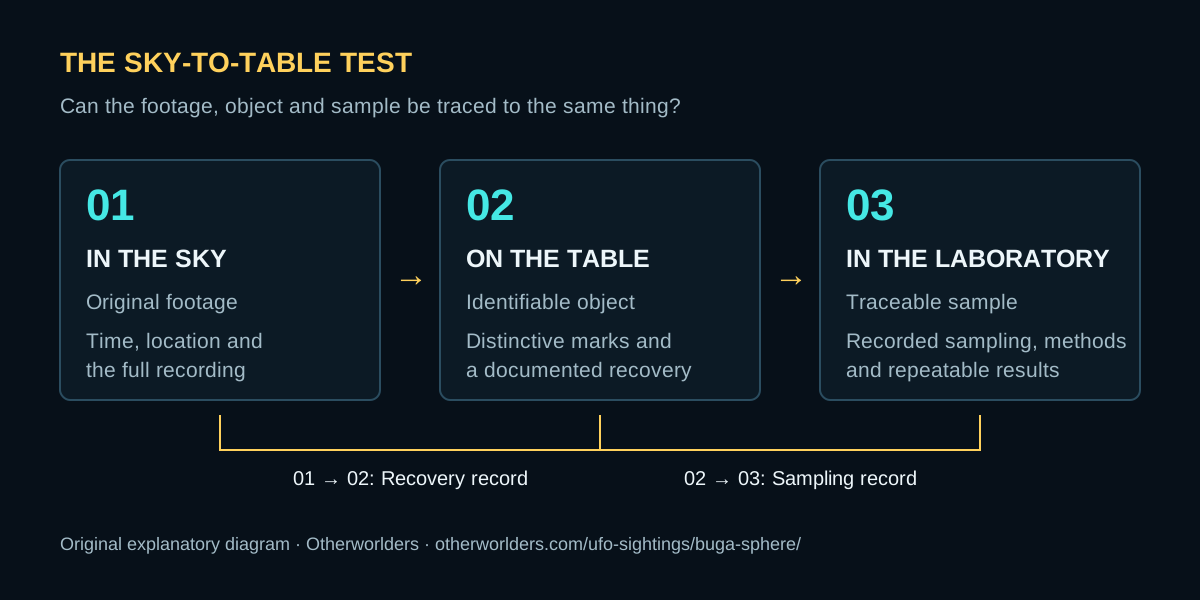
The connection is called provenance: the documented history of an object. It works like the baggage tag and tracking record that let you follow a particular suitcase through several airports. For a sample, the record needs to continue through removal, packaging and laboratory receipt.
This gives the public a way to recognise a substantial advance. A new scan might improve our understanding of the ball's interior. A witnessed recovery record might strengthen its link to the flight footage. Both are valuable, and neither needs to wait for the other.
7. What Would Change the Case?
The story is still being promoted. Greer's own website featured a Planet Tyrus interview on 16 October 2026 that explicitly includes the Buga Sphere. Maussan also published a January 2026 programme about attempts to make it fly. Those are dated public presentations, rather than newly verified laboratory findings.
The next Buga sphere update could be decisive if it supplies something another investigator can use. For the interior, that means original scans tied to an identifiable object. For a claimed change in weight, it means a continuous recording, a checked scale, control measurements and a procedure that can be repeated.
Calibration means checking an instrument against a known reference, like testing a kitchen scale with a known weight before trusting an extraordinary reading. Controls are the comparison runs that reveal whether the equipment or surroundings produced the effect. These details make a surprising result more interesting because they give it something to survive.
For the ancient-age claim, the next step would be an authenticated laboratory document and a traceable sampling record, followed by an independent test. There is no reliable timetable for those steps in the public sources examined here.
You can already do something useful: watch the original presentation, inspect the images and keep each observation attached to its source. Our guide to preserving UFO sighting evidence explains why original recordings and context matter when something strange appears.
Buga is compelling because a physical object puts so many questions within reach. Someone can measure its shell, map its interior, examine its marks and follow a sample into a laboratory.
The possibility that there is something extraordinary inside deserves a test strong enough to recognise it.
Questions About the Buga Sphere
What Is the Buga Sphere?
The Buga Sphere is a marked metal ball publicly presented by Jaime Maussan and linked by its promoters to a reported UFO recovery near Buga, Colombia, in March 2025. Its flight history, construction and claimed unusual properties require separate investigation.
Has the Buga Sphere Been Opened?
The sources examined for this article include scan presentations and claims about sampled material. They do not establish an independently documented full opening of the same recovered object, with its entire interior available for inspection.
What Do the Buga Sphere Scans Show?
In Maussan Televisión's May 2025 presentation, Nacho Rojo points to a shell, an intermediate region and an apparent inner feature he provisionally calls a device. The programme's images and interpretations do not establish the feature's function or an extraterrestrial origin.
Is the Buga Sphere 12,560 Years Old?
Greer's team circulated a report image listing resin with an uncalibrated radiocarbon age of 12,560 ± 30 BP. We have not authenticated that image with the laboratory. A date for associated material would also need a documented connection to the sphere's manufacture.
Have the Buga Sphere Symbols Been Translated?
A verifiable translation would need a consistent reading supported by evidence, rather than resemblance or an AI-generated interpretation. The sources examined here do not establish a reproducible decipherment of the markings.
What Is the Latest Buga Sphere Update?
Greer's website featured a Planet Tyrus interview discussing the sphere on 16 October 2026. That is a verified dated presentation, not confirmation of a new scientific discovery. Repeatable tests and traceable documents would be the most substantial next developments.
Is the Buga Sphere an Alien UFO?
The physical sphere and the public claims make a case that can be investigated. Establishing an extraterrestrial origin would require reliable evidence connecting the object, its reported flight and any independently measured unusual properties.