What Happened Near Kelly?
The case began at a farmhouse outside Kelly, about seven miles north of Hopkinsville. Later summaries differ on small details, but the stable outline is that 11 people were present, usually described as eight adults and three children, when Billy Ray Taylor returned from the well and said he had seen a bright object descend toward a nearby field or gully.
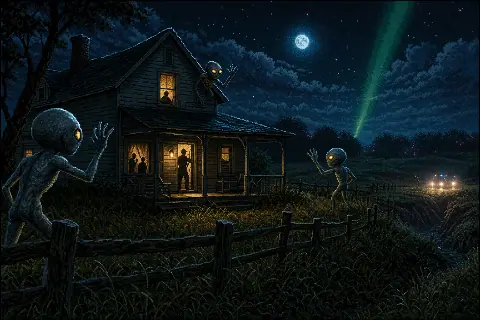
The others initially treated the report as a meteor or falling-star story. Later that evening, Taylor and Elmer "Lucky" Sutton went outside after the dog reacted. They reported seeing a short figure with a large head, bright eyes, long arms, and raised hands coming toward the house.
The men armed themselves with a shotgun and rifle. Over the next several hours, the family said the figures appeared near the doors, windows, roofline, yard, and trees. The witnesses fired repeatedly, but reported that the figures fell, floated, or moved away without leaving a body.
Quick Timeline Of The 1955 Case
| Stage | What The Source Trail Describes |
|---|---|
| Evening, 21 Aug 1955 | Billy Ray Taylor reported seeing a bright object descend near the Sutton/Lankford farmhouse outside Kelly, Kentucky. |
| Later that night | Witnesses said small glowing figures approached the house, appeared at windows and doors, and returned after being fired on. |
| Around 11 p.m. | The household left in two cars and went to the Hopkinsville police station for help. |
| Late night search | Local police, state police, sheriff's officers, Fort Campbell military police, and a newspaper photographer searched the property. |
| After officers left | The family later said the figures returned and continued appearing until before dawn. |
| Aftermath | Press attention, sightseers, ridicule, investigator interviews, CUFOS analysis, and sceptical owl theories turned the case into a lasting archive problem. |
The timeline matters because the case is often reduced to one colourful phrase. The stronger version keeps the event sequence separate from later branding. The family did not simply tell a story years later. They interrupted the night, went to the police, and pulled multiple authorities into the scene while they were still visibly shaken.
Why The Case Survives
Kelly-Hopkinsville survives because it has a rare mix of immediacy, multiple witnesses, and later source work. Many entity reports rely on one witness, a delayed memory, or a retelling filtered through books and television. This one has a same-night police station report, named investigators, a specific farmhouse, and a witness group large enough to create both strength and complication.
The case also predates the standard modern Grey alien template. The reported figures were short, bright-eyed, long-armed, and oddly weightless or floating, with descriptions that later became tied to the "Hopkinsville goblin" image. That does not make the report true. It makes it historically interesting because the entity description sits in a different lane from later abduction iconography.
The best source trail is not the sensational newspaper language. It is the CUFOS treatment by Isabel Davis and Ted Bloecher, the NICAP-preserved case material, and the way later sceptical writers tried to explain the same facts through animals, meteors, fear, and misperception.
What Police Found And Did Not Find
The police response is the case's strongest anchor. Chief Russell Greenwell and other responders treated the family's fear as real enough to investigate, and the source trail says officers searched the house, yard, outbuildings, and surrounding area. They did not find creatures, a landed object, bodies, tracks, or a simple physical proof that would settle the case.
That absence matters. Shotgun and rifle fire would normally create a scene with recoverable evidence if physical intruders had been hit at close range. Instead, the evidence remained indirect: frightened witnesses, damaged screens or shot paths, reported roof and window activity, and a disputed luminous patch on grass mentioned in the CUFOS account.
The police search therefore cuts both ways. It protects the case from being dismissed as a purely private campfire story, but it also limits the claim. The responders confirmed disturbance, fear, and a serious callout. They did not confirm alien beings.
Where Project Blue Book Fits
The Kelly-Hopkinsville case belongs to the broader Project Blue Book era, when the U.S. Air Force was receiving and filing UFO reports across the country. The National Archives notes that Project Blue Book records were retired to federal custody after the programme closed in 1969, and the Air Force fact sheet reproduced there says 12,618 sightings were reported to Blue Book, with 701 left unidentified.
For Kelly-Hopkinsville, the Blue Book connection is not the strongest part of the case. The strongest part is the local response and later investigator work. Still, the Blue Book context helps place the incident in the same official-record ecosystem as other 1950s cases, including the 1957 Levelland UFO case and later disputed police-witness files such as the Exeter UFO incident.
The Owl And Meteor Explanation
The strongest sceptical explanation is not a lazy "they made it up" dismissal. Joe Nickell's Skeptical Inquirer treatment argues that the figures may have been great horned owls seen at night under fear, expectation, and gunfire. Large reflective eyes, wing-and-claw impressions, awkward movement, roof or tree positions, and repeated returns near a rural house all give the owl theory real explanatory force.
The initial object report can be handled separately. Taylor may have seen a meteor or bright fireball before the household's later panic. CUFOS also preserved reports of other lights or meteor-like objects that night, including accounts around 6:30 p.m. and during the later police response. Those sky reports do not prove a landed craft. They do explain why a household primed by a bright descending light might interpret later animal movement as part of the same event.
The owl theory has to carry several hard details, though. It must account for the number of adult witnesses, repeated close approaches, the family's choice to flee to police, the long duration, the lack of alcohol evidence reported by investigators, and the witnesses' later insistence that the figures were not ordinary animals.
Evidence Limits
The limits are blunt. There are no verified photographs of the entities, no recovered object, no creature body, no clean track evidence, and no laboratory-grade physical sample from the scene. The reported physical effects mainly come from the witnesses' own gunfire and the search aftermath, not from a demonstrable unknown technology.
There is also a folklore problem. Once newspapers and sightseers arrived, the phrase "little green men" attached itself to the case even though the better source descriptions did not describe green men. The more the case entered popular culture, the more it became a symbol. A good reading has to strip that symbol back to the farmhouse, the family, the police response, and the competing explanations.
Hoax remains possible, but it is not the cleanest explanation. A hoax would need to explain the same-night panic, the number of people involved, the lack of obvious profit, the willingness to endure ridicule, and the fact that the family reportedly became less cooperative as the publicity became intrusive.
What Remains Unresolved
The unresolved core is narrow. Something pushed a frightened household to abandon the farmhouse and ask police for help. The responders found no creatures, but they did find a family whose fear was difficult for several witnesses to dismiss. The sceptical explanation has a plausible animal mechanism, but it cannot erase every human-behaviour detail without assuming a strong cascade of fear and misidentification.
That is why Kelly-Hopkinsville remains a classic. It is not a clean alien proof case. It is a high-strangeness case where the evidentiary weight sits in the human response, the immediate police callout, and the later source trail rather than in hard physical residue. It belongs beside the best documented UFO cases only if "documented" means the record can be inspected, not that the mystery has been solved.