What Webb Found In MoM-BH*-1
MoM-BH*-1 was selected for follow-up because it appeared exceptionally red and compact in NIRCam images of the Ultra Deep Survey field. Webb observed it through three programmes using NIRCam, MIRI and NIRSpec. The final NIRSpec prism observation came from the Mirage or Miracle survey, which targets unusual sources that could either reveal new early-universe physics or turn out to be foreground interlopers.
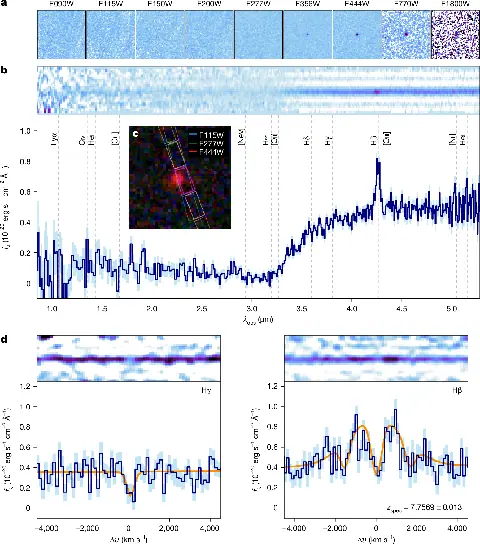
The spectrum fixed the source at a redshift of 7.7569. That means the light began its journey when the universe was about 660 million years old. MoM-BH*-1 also appears point-like at Webb's resolution, with an upper size limit below 100 parsecs.
| Observation | Measured Or Modelled Result |
|---|---|
| Object | MoM-BH*-1 |
| Redshift | 7.7569 |
| Cosmic age | About 660 million years after the Big Bang |
| Balmer break | 7.7, far stronger than expected from a normal stellar population |
| Gas envelope | About 10 to 100 AU across in the black-hole model |
| Central mass | About two million Suns in the near-Eddington model |
What Is A Black Hole Star?
A black hole star is a proposed system in which a growing supermassive black hole is completely surrounded by hot, dense gas. It resembles the older theoretical idea of a quasi-star, but the name here describes the way the gas reprocesses light from the central engine.
A normal star is powered by nuclear fusion in its core. MoM-BH*-1 would instead be powered by accretion. Gas falling towards the black hole releases enormous amounts of energy, which cannot escape directly through the thick envelope. The energy is absorbed and reradiated by the gas farther out.
The researchers modelled a dust-free envelope spanning roughly 10 to 100 astronomical units. One astronomical unit is the average distance between Earth and the Sun. That would place the cocoon on the scale of the Solar System, although MoM-BH*-1 is far too distant for Webb to resolve the envelope directly.
Why The Spectrum Is So Unusual
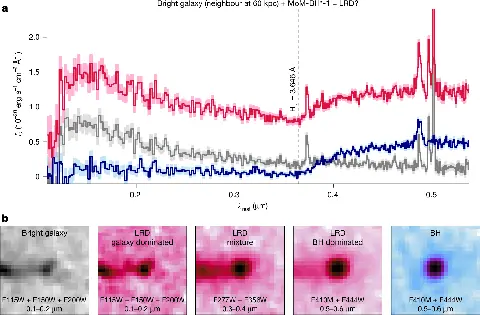
The strongest clue is an enormous Balmer break, a sudden change in brightness around wavelengths shaped by hydrogen. Stellar populations can create Balmer breaks, particularly when A-type stars contribute heavily to the light. The break measured in MoM-BH*-1 has a strength of 7.7. The paper places the expected maximum below 5 even for an extreme population made entirely of A-type stars.
NIRSpec also detected broad H-beta emission together with deep H-beta and H-gamma absorption. The absorption requires hydrogen at extreme density, while the broad emission and compact appearance are associated with active supermassive black holes. A possible 30 per cent brightening over 56 rest-frame days supplies another clue, although the observations came from different instruments and need confirmation.
Spectroscopy turns faint points of light into evidence about composition, motion and temperature. Webb uses the same broad technique across very different targets, from this object at cosmic dawn to atmosphere studies such as K2-18 b.
How It Could Explain Little Red Dots
Little Red Dots are compact sources that became common roughly 600 million years after the Big Bang and declined by about 1.5 billion years after it. Many show broad hydrogen lines associated with active black holes, yet they are faint in X-rays and often appear too red, too compact or too numerous for familiar quasar models.
MoM-BH*-1 may show the black-hole component almost by itself. It sits close to a young galaxy at the same redshift, separated by about 60 kiloparsecs, or 200,000 light-years, in physical distance. The team expects the two systems to merge in around 100 million years.
When the researchers combined the spectrum of MoM-BH*-1 with the light from that neighbouring galaxy, the result resembled a typical Little Red Dot. The galaxy supplied more ultraviolet light, while the gas-wrapped black hole dominated at longer optical wavelengths. Different mixtures of those two components could produce much of the variety astronomers see among Little Red Dots.
The Black Hole May Be Lighter Than It Looks
Black-hole masses in distant active galaxies are often estimated from the width of their emission lines. The usual calculation treats that width as a sign of rapidly orbiting gas. In the new model, repeated scattering by electrons inside the dense envelope can broaden the line without requiring the gas to orbit at the same speed.
That changes the mass estimate substantially. A conventional calculation with dust reddening would put MoM-BH*-1 near 200 million solar masses. A dust-free calculation lowers it to about 50 million. If the source is radiating close to its Eddington limit and electron scattering produces most of the width, the paper estimates roughly two million solar masses.
The lower figure would ease one of the tensions created by Webb's early observations. Astronomers would no longer need to explain quite so many enormous black holes appearing shortly after the first galaxies formed. It would not solve the origin problem, but it would give smaller seeds more room to grow.
A Supermassive Star Could Also Fit The Data
The black hole star interpretation is not the only model for MoM-BH*-1. A separate 2026 paper in The Astrophysical Journal modelled Little Red Dots as metal-free supermassive stars weighing up to one million Suns.
That model reproduces a V-shaped Balmer break and the unusual mix of hydrogen emission and absorption within a single stellar atmosphere. With added wind and turbulent broadening, its predicted H-beta width for MoM-BH*-1 came within four per cent of the observed value.
The two ideas describe very different objects at adjacent stages of cosmic evolution. One has already collapsed into a black hole and is feeding inside a gas cocoon. The other is a huge primordial star that could later collapse and create a massive black-hole seed. Better measurements of variability, emission-line shapes and host-galaxy light will be needed to separate them.
What Has Been Confirmed And What Remains Modelled
JWST has confirmed the source's redshift, compact appearance, extreme Balmer break and complex hydrogen spectrum. Those measurements make MoM-BH*-1 an exceptional object regardless of which physical model survives.
The gas cocoon, its 10 to 100 AU scale and the central black-hole mass are inferred from a simplified model. The Nature authors explicitly describe their calculation as highly simplistic and intended to provide broad physical intuition. The assumed shape of the envelope and the original spectrum of the central engine can both change the result.
MoM-BH*-1 is therefore strong evidence for a black hole star, not a direct photograph of one. Webb's image contains a faint unresolved point. The case comes from the spectrum and from how well competing physical models can reproduce it, just as the observatory's image of the Treasure Chest star cluster reveals a very different stage of cosmic evolution through infrared light.
What Astronomers Will Test Next
Repeated observations can test whether MoM-BH*-1 truly varies on short timescales. Reliable variability would favour a compact accreting black hole over a stable stellar population, especially if the changes repeat in the same wavelengths.
Higher signal-to-noise spectra can map the hydrogen line profiles in more detail and test whether electron scattering accounts for the broad wings. Longer-wavelength observations may also reveal whether hot dust is genuinely absent rather than merely difficult to detect.
A larger sample will show whether MoM-BH*-1 is a rare extreme or part of a sequence connecting naked black hole stars, Little Red Dots and early quasars. If the same spectral pattern appears around many compact sources, astronomers will have a clearer route for reconstructing how the first massive black holes acquired their gas and entered young galaxies.
Frequently Asked Questions
Is A Black Hole Star A Real Star?
Not in the normal sense. A black hole star would be powered by matter falling towards a central black hole, not by nuclear fusion. Its dense outer gas reradiates that energy and gives the system some star-like properties.
How Far Away Is MoM-BH*-1?
Its light was emitted about 660 million years after the Big Bang and has travelled for more than 13 billion years to reach us. Astronomers report its measured redshift as 7.7569.
How Big Is The Black Hole Star?
The proposed gas envelope spans about 10 to 100 astronomical units in the paper's model. Webb cannot resolve that structure directly, so the size remains model-dependent.
Did Webb Confirm A New Type Of Object?
No. Webb measured an unusual spectrum that the gas-enshrouded black-hole model can explain. A metal-free supermassive star is among the competing interpretations still being tested.
What Are Little Red Dots?
Little Red Dots are compact, red sources found in Webb deep fields of the early universe. Many appear to contain active black holes, but their weak X-rays, colours and apparent abundance do not fit ordinary quasar models neatly.