What Webb Photographed
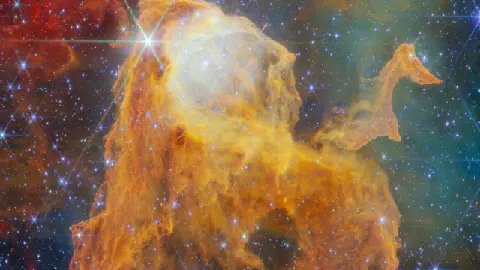
The Carina Nebula spans roughly 260 light-years and contains some of the most massive stars in the Milky Way, along with tens of thousands of protostars. The Treasure Chest is one small structure inside that much larger stellar nursery.
Webb observed the cloud with its Near-Infrared Camera, or NIRCam. Infrared light can pass through some of the dust that blocks visible-light telescopes, exposing young stars and energetic activity that would otherwise remain hidden.
This is a different part of Carina from the Cosmic Cliffs shown in Webb's first image release in July 2022. Both targets demonstrate how Webb can look through dusty star-forming regions. The telescope can also use infrared light to examine distant planetary atmospheres, including the changing cloud cycle on WASP-94A b.
What Is A Cometary Globule?
The Treasure Chest is a cometary globule, an isolated cloud with a dense head and a long tail of gas and dust. The name describes its shape. It is not a comet and does not travel around a star like the icy bodies in our Solar System.
Cometary globules form when radiation and winds from nearby massive stars erode a larger molecular cloud. Dense material survives longer than the thinner gas around it, leaving a compact head with a swept-back tail.
The Treasure Chest does not present the classic comet shape from Webb's angle. Its dense walls instead resemble the base and raised lid of a chest, while the young cluster illuminates the cavity between them.
The Young Stars Inside The Treasure Chest
Researchers estimate that the embedded cluster contains about 70 stars. Its most massive member is a rare O-type star known as CPD-59 2661, with a mass roughly 19 times that of the Sun.
O-type stars are extremely hot, bright and short-lived. CPD-59 2661 ionises nearby gas and helps hollow out the cavity around the cluster. Less massive young stars contribute through their own radiation and outflows.
The cluster's age is not settled. A 2005 study estimated an age below about 100,000 years, while a later near-infrared analysis placed it closer to 1.3 million years. Both estimates describe a very young cluster that remains partially buried in the cloud from which it formed.
Many of the stars appear to have circumstellar discs. These flattened structures contain gas and dust around young stars and can become the raw material for planetary systems. They provide an early-stage counterpart to the mature worlds covered in our guide to exoplanets and their potential for life.
How The Cloud Is Being Sculpted
The strongest external influence lies outside Webb's frame. Eta Carinae is about 39 light-years northwest of the Treasure Chest when measured across the sky. The system contains at least two stars, including one estimated at around 100 solar masses and five million times the Sun's luminosity.
Eta Carinae and the nearby Trumpler 16 cluster flood the region with ultraviolet radiation and fast stellar winds. This energy removes lower-density gas from the outside of the Treasure Chest, while the embedded cluster erodes the cloud from within.
Astronomers still debate the sequence. One possibility is that external pressure compressed the cloud and helped trigger the cluster's formation. ESA describes a second scenario as more likely. The stars formed first inside a larger cloud, then radiation stripped away the thinner gas and exposed the dense structure visible today.
What The Infrared Colours Show
The image does not reproduce colours that a human eye would see through a telescope. Webb recorded four infrared bands, which image processors assigned visible colours so different structures can be compared.
| Displayed Colour | Infrared Wavelength | Feature |
|---|---|---|
| Blue | 1.62 micrometres | Near-infrared starlight and cloud structure |
| Cyan | 1.64 micrometres | Emission from ionised iron |
| Orange | 4.44 micrometres | Warm dust and embedded structures |
| Red | 4.70 micrometres | Emission from molecular hydrogen |
The long diffraction spikes around bright stars come from the shape of Webb's mirrors and support structures. They are imaging effects rather than jets or material being expelled by the stars.
What Webb Will Study Next
The observations were collected through Webb programme 5408, led by Megan Reiter. The programme examines how young stars in the Carina Nebula gather gas from their surroundings and drive it away through jets and outflows.
Those two processes govern how quickly a forming star gains mass and how it alters the cloud around it. They also affect nearby discs that may later produce planets. Webb's sensitivity to ionised iron and molecular hydrogen gives researchers a way to trace different components of the outflowing material.
The Treasure Chest adds a compact laboratory to Webb's wider record of star and planet formation. The same observatory has examined possible atmospheric chemistry on K2-18 b, but here it is looking much earlier in the cycle, before much of the surrounding material has become stars or planets.
Frequently Asked Questions
Where Is The Treasure Chest Star Cluster?
It lies about 7,500 light-years from Earth inside the Carina Nebula, in the southern constellation Carina.
How Many Stars Are Inside The Treasure Chest?
ESA/Webb reports an estimated cluster population of about 70 stars. Dust still hides parts of the cluster, so the image does not provide a simple complete count.
Is The Treasure Chest A New Discovery?
No. Astronomers studied the cluster and its surrounding cloud before Webb launched. The August 2026 release is a new NIRCam view created from Webb observations.
Is The Webb Image True Colour?
No. NIRCam recorded infrared wavelengths that human eyes cannot see. The released image assigns visible colours to four infrared bands.
Is It The Same As Webb's Cosmic Cliffs?
No. Both objects are inside the Carina Nebula, but they are separate structures. The Cosmic Cliffs lie in NGC 3324, while the Treasure Chest is the cometary globule G287.84-0.82.