Ten Planets Under One Test
The team compared published transmission spectra from Webb's Mid-Infrared Instrument, MIRI, using a common analysis. They tested featureless models, compared spectral patterns and searched atmospheric models for more than 150 candidate trace species.
K2-18 b, TOI-732 c and TOI-270 d showed hints of complex molecules that were absent from the other seven planets. These are candidate Hycean worlds, a proposed class with oceans beneath hydrogen-rich atmospheres. Their status as ocean worlds is unconfirmed.
The survey uses existing observations. Its new contribution is the comparison across different planets, rather than a fresh observation of life.
How Webb Reads A Planet's Atmosphere
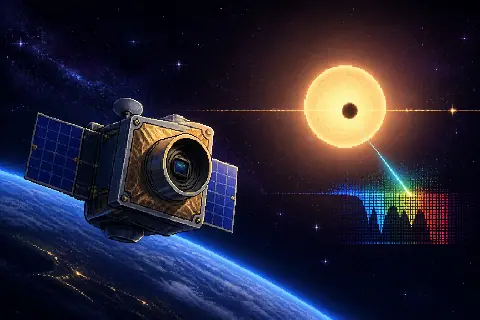
Transit spectroscopy measures starlight as a planet crosses in front of its star. Some of that light passes through the planet's atmosphere. Gases absorb particular wavelengths, leaving a pattern that astronomers compare with molecular models. NASA describes this approach as a way to investigate distant atmospheric chemistry.
A spectral pattern can indicate that an atmosphere contains an absorber without uniquely identifying it. Different molecules can have overlapping features, especially in noisy data. A good fit is therefore one stage in a chain of evidence.
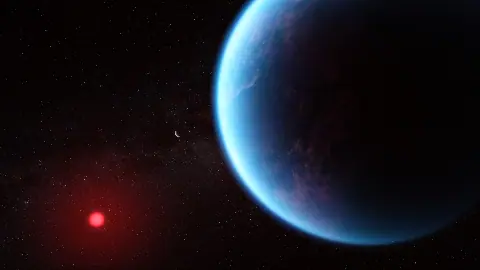
K2-18 b is about 120 light-years away and roughly 8.6 times Earth's mass. The 2023 Webb findings linked methane, carbon dioxide and a shortage of ammonia to the possibility of an ocean under a hydrogen-rich atmosphere. That interpretation helped make the planet a prominent target in the search for potentially habitable exoplanets.
Why The DMS Claim Remains Contested
Dimethyl sulphide, usually shortened to DMS, became central to the debate after Madhusudhan and colleagues reported a MIRI analysis in April 2025. They favoured DMS, dimethyl disulphide (DMDS), or both, at a reported three-sigma significance. They also called for more observations and further work on possible non-biological sources.
An independent analysis led by Rafael Luque, submitted the following month and subsequently published in Astronomy & Astrophysics, reached a different conclusion. It combined near-infrared and mid-infrared data, processed observations with three pipelines and used two atmospheric modelling codes.
That team found insufficient evidence for DMS or DMDS. Other molecules, including ethane, could fit the data comparably well. Small changes in data processing and the selection of molecules allowed in a model affected the apparent preference.
These studies ask related questions with different datasets and modelling choices. Evidence for atmospheric absorption, identification of a particular gas and evidence for biology are three separate claims. A result supporting the first does not automatically settle the other two.
What Would Strengthen A Life Claim?
The 2025 MIRI study identified two practical needs beyond collecting more light. Laboratory measurements must establish how proposed gases absorb radiation under relevant conditions, and chemical models must test whether those gases can arise without organisms.
Repeated observations and consistent results across independent analyses would help distinguish a persistent planetary signal from a processing-dependent feature. Coverage at additional wavelengths could then test whether the same proposed molecule explains more than one part of the spectrum.
NASA's Ladder of Life Detection treats potential biosignatures as evidence to evaluate against measurement quality and alternative explanations. For distant worlds, even a secure molecular identification would still require an explanation of the environment that produced it.
The prospect of microbial life beyond Earth remains compelling. Establishing it requires a chemical signal that survives those tests.
Sources
- Binet et al., A Homogeneous Survey of JWST MIRI Transmission Spectra of 10 Exoplanets, submitted 4 September 2026; listed as accepted for ApJL.
- Madhusudhan et al., New Constraints on DMS and DMDS in the Atmosphere of K2-18 b from JWST MIRI, April 2025.
- Luque et al., Insufficient Evidence for DMS and DMDS in the Atmosphere of K2-18 b, Astronomy & Astrophysics 700, A284 (2025).