A Familiar Shelter With An Overlooked Detail
The figures are at La Rochelle, also known as Klein Buffelspruit, near Carolina in Mpumalanga. David G. Pearce of the University of the Witwatersrand and Kiah Johnson of the University of Cambridge describe them in a 2026 South African Archaeological Bulletin paper.
The shelter was already known to researchers. Anna Steyn recorded its paintings in 1995, followed by Mduduzi Maseko in 2020. The new interpretation concerns two faint figures that earlier recording work appears to have missed.
Why Researchers Think They Were Stencilled
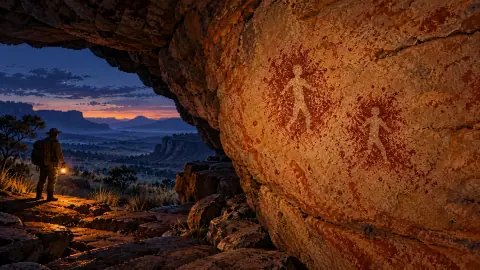
Each figure is about nine centimetres tall. Instead of a painted body, the image consists of bare rock surrounded by red pigment. A scattered halo of paint droplets suggests liquid pigment was blown or splashed around a template.
This reverses the usual drawing process. The artist covered the desired shape, applied pigment around it, then removed the covering. The resulting silhouette preserves the shape of the missing object.
That interpretation can be tested against the distribution of pigment and the edges of the figures. It does not require identifying what the figures represented to the person who made them.
The Missing Date And Meaning
In interviews published by Phys.org on 25 October, Pearce stressed that the makers, date and purpose are unknown. Archaeology Magazine highlighted the research on 28 October. Neither date should be mistaken for the day the images were first recognised. The paper records receipt in May 2023 and revision in October 2025, and acknowledges an earlier presentation in 2022.
Brush-painted animals and humanoid beings elsewhere in the shelter provide a rich setting, but proximity alone cannot show that the stencils share their age or cultural meaning. The shelter’s later use for church services, including a concreted floor and wooden pews, further complicates its archaeological context.
Those gaps leave room for research, rather than a licence to assign a story to the figures. Our discussion of ancient astronaut claims and their evidence examines the wider problem of treating an unfamiliar image as a literal record of a visitor.
What Australia’s Miniature Stencils Can Tell Us
Miniature stencilling has a documented comparison in Australia. Research at Yilbilinji, on Marra Country in the Northern Territory, investigated small images too tiny to have been made with full-sized bodies or objects.
A Flinders University account from 27 May 2020 describes experiments in which researchers heated and shaped beeswax before using it to make stencils. The experiments demonstrated a workable production method. They did not settle every question about who made the Australian images or what they meant.
Beeswax is consequently one possible material to consider at La Rochelle, alongside clay or other shaped materials. It has not been identified there. Similar techniques in distant places also do not, by themselves, demonstrate contact between the communities.
Our article on Aboriginal sky traditions and rock-art interpretation explores why a visual comparison must be kept separate from a community’s cultural knowledge.
A Technique To Look For Elsewhere
The immediate research opportunity is to look again at other painted shelters for comparable pigment patterns. More examples could make it easier to distinguish a wider tradition from an isolated experiment.
For now, La Rochelle offers a small but specific addition to the rock-art record. The proposed method is intelligible. The people and ideas behind it remain beyond what the surviving evidence can securely tell us.