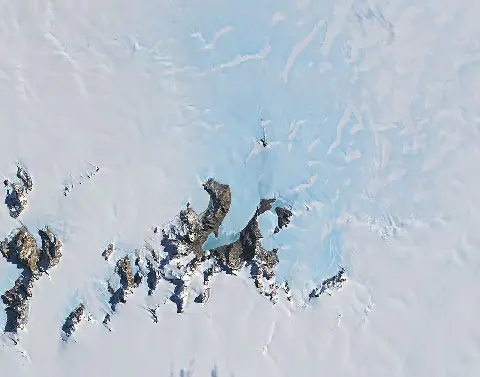
The new field season will focus on collecting sediment cores two to three metres long for dating and chemical analysis. SETI Institute astrobiologist Dale Andersen describes the plans in an expedition preview first published on 16 October and republished by SETI on 21 October 2026.
The published itinerary planned a 19 October departure from the United States, arrival in Antarctica around 25 October and an overland journey to the lake afterwards. Those are scheduled movements, subject to weather and logistics. The preview does not confirm that the team has reached the lake.
A Living Lake Beneath Permanent Ice
Lake Untersee lies in Queen Maud Land, East Antarctica, beneath a permanent ice cover. NASA’s March 2026 account of the lake describes ice two to four metres thick and water reaching almost 170 metres deep. Sunlight penetrates the ice, supporting photosynthetic microbes below.
The lake floor contains unusually large, soft, layered cones built by microbial communities. Andersen and colleagues discovered these structures in 2008. They resemble ancient stromatolites, layered formations associated with early microbial life, rather than representing a new discovery made this October.
The Natural History Museum’s StromatoLife project describes cones with a pigmented cyanobacterial surface over alternating layers of sediment and organic material. Cyanobacteria are microbes that use sunlight to make food. The structures offer a way to investigate how living communities assemble forms resembling those preserved in ancient rocks.
Living Microbes With An Apparently Ancient Age
Dating the lake’s sediments is difficult because melting glacial ice supplies ancient carbon dioxide, while the ice cover restricts exchange with the atmosphere. Microbes incorporate that old carbon as they grow.
Andersen reports that living surface mats can consequently yield apparent radiocarbon ages of about 10,000 years. This reservoir effect means a radiocarbon measurement alone cannot reliably establish when a sediment layer formed. The team plans independent dating work in Japan, including luminescence methods, to help reconstruct the lake’s history.
The distinction reaches beyond Antarctica. Before treating an apparent age as a biological history, researchers need to understand where the measured material came from. Old carbon can enter a living organism without making the organism itself thousands of years old.
The Enceladus Connection Is In The Dark Water
The lake’s southern basin contains an oxygen-free, methane-rich layer. A 2022 study in Scientific Reports investigated microbial communities at depths of 92 and 99 metres and in the sediment, identifying genetic potential for several chemical pathways, including methane, sulphur and nitrogen metabolism.
That dark-water habitat is distinct from the sunlight-fed mats. Researchers study it as a possible analogue for Enceladus, Saturn’s icy moon, where any life in a buried ocean would need an energy supply that does not depend on sunlight reaching the water.
The comparison concerns environmental conditions and microbial survival strategies. It does not establish that Enceladus has organisms, or that its ocean duplicates this Antarctic lake. Our guide to ocean worlds examines the wider search for habitable water beneath icy surfaces.
How To Recognise A Trace Of Life
The museum’s research combines imaging with DNA and RNA analysis to examine the organisms, genes and interactions involved in building Untersee’s cones. Comparing different layers can help connect a visible structure with the biological processes that produced it.
That connection is central to interpreting a possible biosignature, a feature that might record biological activity. A striking shape alone leaves questions about its origin. Measurements of its material, surroundings and formation process provide additional tests.
Studies of extremophiles and the limits of habitability explore how Earth organisms tolerate harsh conditions. Untersee adds a place where researchers can examine those organisms alongside the structures and sediments they leave behind.
What This Expedition Can Establish
New cores could improve the chronology of the lake and reveal changes in its chemistry and biological activity. Those results would describe an Earth ecosystem and strengthen the comparisons scientists use when investigating possible life below other worlds’ surfaces.
For now, the confirmed development is a published research plan. Sample recovery, laboratory analysis and new conclusions remain ahead. Lake Untersee offers a demanding place to test how scientists recognise life when its traces are subtle, its environment unfamiliar and its apparent age misleading.