Where The August 12 Eclipse Will Be Total
The eclipse begins in northern Russia before the path of totality moves across Greenland, Iceland and the North Atlantic. It reaches northern Spain late in the evening, continues across the country and the Balearic Islands, and clips a small area of Portugal.
Only locations inside the narrow red path on NASA's map will experience totality. A location just outside that path may see 99 per cent of the Sun covered, but the remaining sliver of sunlight keeps the sky much brighter and requires eye protection throughout the event.
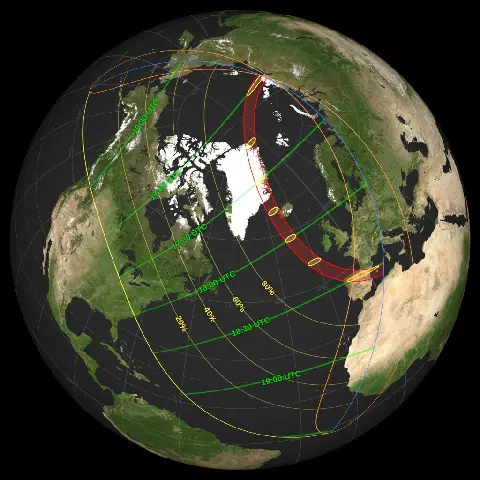
Spain has the largest populated section of the European totality path. ESA says this will be the first total solar eclipse visible from mainland Spain since 1905 and the first of three solar eclipses visible from the country between 2026 and 2028.
Eclipse Times For Iceland And Spain
The eclipse arrives late in the day for Iceland and Spain. The table below uses NASA's published local times for four cities inside the path of totality.
| Location | Partial Eclipse Begins | Totality | Partial Eclipse Ends |
|---|---|---|---|
| Reykjavík, Iceland | 4:47 pm | 5:48 to 5:49 pm | 6:47 pm |
| León, Spain | 7:32 pm | 8:28 to 8:30 pm | 9:22 pm |
| Zaragoza, Spain | 7:34 pm | 8:29 to 8:30 pm | Sunset at 9:07 pm |
| Valencia, Spain | 7:38 pm | 8:32 to 8:33 pm | Sunset at 9:01 pm |
Madrid and Barcelona sit extremely close to totality but remain outside the published path. NASA lists maximum coverage of 99 per cent for both cities. Travellers seeking totality need to confirm their exact coordinates against the latest official eclipse map rather than relying on a city or regional name.
Where The Eclipse Will Be Partial
Much of the Northern Hemisphere will see part of the Sun covered. The partial eclipse will be visible across most of Canada, parts of the northern United States, the United Kingdom, Ireland, mainland Europe and northwestern Africa.
NASA lists 94 per cent coverage for Dublin, 91 per cent for London, 95 per cent for Lisbon, 92 per cent for Paris and 87 per cent for Casablanca. Many observers in mainland Europe and Africa will watch the partially eclipsed Sun approach or pass below the horizon.
North American coverage is smaller. NASA lists 37 per cent for Fairbanks, 28 per cent for Anchorage, 24 per cent for Bangor and 9 per cent for New York City.
Can The Eclipse Be Seen From Australia?
The eclipse will not be visible from Australia. Greatest eclipse occurs at 3:45 am AEST on Thursday, 13 August, when the Sun is below the horizon across the country.
NASA's live broadcast begins at 3:15 am AEST on 13 August, which is 17:15 UTC on 12 August. The stream will carry views from Iceland and Spain at NASA Live. ESA will run a separate English-language broadcast from the Observatorio Astrofísico de Javalambre in Spain.
NASA Will Chase The Moon's Shadow At 50,000 Feet
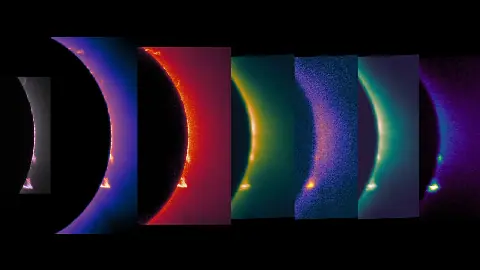
A NASA WB-57 high-altitude research aircraft will carry four cameras inside its nose cone. The Scientifically Calibrated In-Flight Imagery team designed the system to record the corona in several visible and infrared wavelengths at a rate of at least 20 images per second.
Flying above clouds, dust and much of the water vapour in the lower atmosphere gives the cameras a clearer view. It also opens infrared wavelengths that are normally absorbed before they reach ground-based instruments.
The jet will travel along the eclipse path at about 740 kilometres per hour. Ground observers can receive no more than 2 minutes 18 seconds of totality, while the aircraft should remain inside the Moon's shadow for almost three minutes.
The cameras will track structures and rapid changes in the corona, the Sun's outer atmosphere. Researchers will use the images to study solar prominences, the connection between the corona and solar wind, and the unresolved process that heats the corona to temperatures approaching one million degrees.
Why NASA Is Launching 86 Balloons
NASA's Nationwide Eclipse Ballooning Project will measure how the sudden loss of sunlight changes the lowest part of Earth's atmosphere. Student teams will operate the balloons before, during and after the eclipse.
Two teams in Iceland plan to launch 80 balloons over a 26-hour period. Their instruments will monitor the atmospheric boundary layer, which normally contracts at night as the ground cools. Balloon measurements during the 2023 and 2024 eclipses found that this layer contracted under clear skies but not at cloudy sites.
Three teams in Spain will launch another six balloons equipped with 360-degree cameras and ozone sensors. The cameras will photograph the Moon's shadow from above, while the sensors test how ozone levels respond when the sunlight needed for ozone production abruptly falls.
How To View The Eclipse Safely
Looking directly at any visible part of the Sun can permanently damage the eyes. Regular sunglasses do not provide enough protection.
- Use eclipse glasses or a handheld viewer that complies with the ISO 12312-2 international standard during every partial phase.
- Inspect the viewer before use and discard it if the filter is torn, punctured or badly scratched.
- Do not look through a camera, telescope or binoculars while wearing eclipse glasses. Those devices require a solar filter mounted over the front aperture.
- Remove eye protection only when the Sun is completely covered and only if you are inside the path of totality.
- Put eye protection back on as soon as any bright part of the Sun reappears.
- Use a pinhole projector or another indirect method if certified solar viewers are unavailable.
Anyone outside the path of totality must keep proper eye protection on for the entire eclipse, even where coverage reaches 99 per cent.
Eclipses And Reports Of Strange Skies
Total solar eclipses produce a predictable sequence of dramatic changes. The light dims, shadows sharpen, the temperature can fall and bright planets or stars may appear around the darkened Sun. Older observers recorded these effects without modern orbital calculations, which is one reason eclipses appear throughout accounts of historical sky phenomena.
The event should not be confused with reports in which the Sun appeared to move, change colour or spin outside a calculated eclipse. The Miracle of the Sun at Fátima on 13 October 1917, for example, did not coincide with a solar eclipse and remains a separate religious, cultural and perceptual case.
Frequently Asked Questions
When Is The 2026 Total Solar Eclipse?
The total solar eclipse occurs on Wednesday, 12 August 2026. Greatest eclipse is at 17:45:51 UTC, when the central shadow is over the North Atlantic near Greenland and Iceland.
How Long Will Totality Last?
The maximum duration is 2 minutes 18 seconds. Most populated locations along the path will receive less than two minutes.
Which Countries Will See Totality?
The path crosses a remote part of northern Russia, Greenland, Iceland, Spain and a small part of Portugal. It also crosses the North Atlantic.
Will The Eclipse Be Visible In The UK?
Yes, as a partial eclipse. NASA lists 91 per cent coverage for London, beginning at 6:17 pm and reaching maximum coverage at 7:13 pm local time.
Will The Eclipse Be Visible In Australia?
No. It occurs during the Australian night. NASA's livestream begins at 3:15 am AEST on Thursday, 13 August.
Do You Need Eclipse Glasses?
Yes, during every partial phase. Eclipse glasses can only be removed during the brief period when the Sun is completely covered for observers inside the path of totality.
Source Trail
- NASA: Total Solar Eclipse on August 12, 2026
- NASA: Science flights and balloon experiments during the August eclipse
- NASA GSFC: Besselian elements and greatest eclipse calculations
- ESA: Join ESA for the total solar eclipse
- American Astronomical Society: Eye safety during a solar eclipse
Verdict
The 12 August eclipse brings totality back to mainland Europe, with the most accessible viewing route running across northern Spain. The maximum dark phase is brief, but NASA's aircraft and balloon teams will stretch the event into a detailed study of the solar corona and Earth's atmosphere.
Observers outside the narrow totality path will still see a major partial eclipse across much of Europe. The distinction is absolute for eye safety: protection stays on whenever any part of the Sun remains visible.