What Is The Hitchhiker Effect?
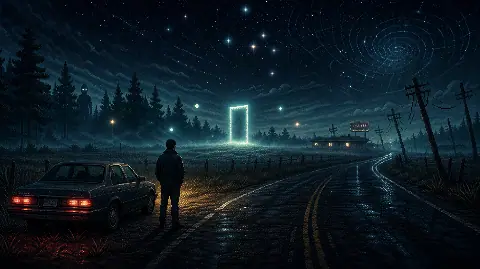
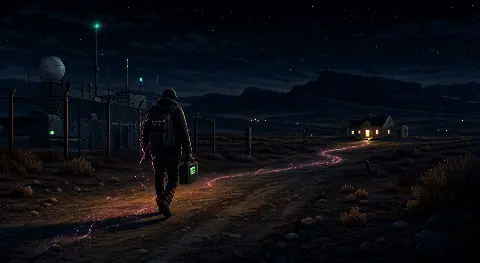
The Hitchhiker Effect describes a reported transfer of anomalous activity from an encounter site to a witness's private environment. The person visits a location associated with unusual phenomena, experiences something there, returns home, and then reports related activity in a new place.
That activity is usually described as domestic and personal rather than aerial. The recurring claims include footsteps, knocks, shadow figures, blue or white orbs, strange animal behaviour, electrical anomalies, sleep disturbance, intense dreams, sudden fear, and family members seeing things even if they never visited the original site.
The label does not prove that an anomaly is literally contagious. It names a pattern in testimony. That distinction is important because the subject attracts two opposite errors: believers can treat every later household event as confirmation, while sceptics can treat every account as folklore without examining the witness sequence.
Where The Term Comes From
The modern use of the term is tied closely to Skinwalker Ranch and the AAWSAP/BAASS era. AARO's historical review identifies AAWSAP as a Defense Intelligence Agency effort contracted to Bigelow Aerospace Advanced Space Studies. The public debate became messy because AAWSAP, AATIP, Bigelow, Skinwalker Ranch, Navy UAP videos, and later disclosure politics all became tangled in the same story.
In Skinwalkers at the Pentagon, James Lacatski, Colm Kelleher, and George Knapp describe military and intelligence-linked visitors who allegedly experienced phenomena after leaving the ranch. Kelleher later expanded that argument in an EdgeScience article, using contagion language and describing visitors who, in his telling, "brought something home" after ranch exposure.
Kelleher is not a detached source. He was directly involved in Bigelow-linked anomalous research and served as a senior figure in that world. His account is still central because it gives the public its clearest description of how insiders understood the pattern.
What The BAASS Report Adds
The 2009 BAASS Ten-Month Report does not read like a polished paranormal book. It is a contractor report full of programme structure, field observations, UAP case criteria, Brazilian research leads, sensor plans, and Utah ranch strategy.
The report's Utah section describes the ranch as a "living laboratory" and records a June to July 2009 visit by Robert Bigelow and three military observers. It describes a sharply bounded cold zone, hair standing up, heavy legs, an unsafe feeling, a reported shadowy humanoid figure, and later a bright object seen differently by several observers through night vision equipment.
The same strategic-plan section lists additional ranch phenomena observed over the previous 18 months, including materialising or dematerialising objects, shadow figures in buildings, sudden temperature drops, unusual underground sounds, photographed orbs, and apparent energy fields. That is the BAASS context behind later Hitchhiker Effect discussion: a programme already treating the ranch as observer-responsive and consciousness-linked.
The report also shows how BAASS wanted cases documented. Its appendix asks investigators to capture physical effects, trace evidence, electromagnetic effects, physiological effects, pathological effects, animal reactions, witness reactions, consciousness effects, and lifeforms. That framework is broader than a normal UFO sighting form, and it explains why household spillover claims later found a home inside the same research culture.
The Reported Pattern
| Stage | Typical Claim | Evidence Problem |
|---|---|---|
| Exposure | A witness visits Skinwalker Ranch, investigates a UAP case, or has a close encounter elsewhere. | The original event may be witnessed, but it is often not instrumented well enough for independent reconstruction. |
| Delay | Activity begins hours, days, or weeks later after the witness returns home. | Delayed onset makes causation hard to separate from expectation, stress, and ordinary household events. |
| Domestic spillover | Orbs, shadow figures, knocks, footsteps, animal reactions, dreams, or electrical effects appear in the home. | Private homes rarely have baseline sensor data, controlled observation, or neutral investigators present before the first claim. |
| Witness expansion | Spouses, children, housemates, neighbours, or friends report related events. | That expansion may support the case, but it can also reflect suggestion, shared anxiety, or story reinforcement. |
| Medical layer | Some accounts add headaches, sleep disruption, autoimmune illness, or neurological claims. | Medical claims need records, controls, and publication standards. Anecdotes cannot establish exposure or mechanism. |
The pattern is compelling as a narrative because it moves the anomaly from a remote place into ordinary domestic space. It is harder as evidence because each step adds variables. A single ranch incident may already be difficult to verify. A later bedroom shadow, a dog's reaction, or a family member's dream is even harder to isolate.
A Skinwalker Ranch Example
The clearest public example is the case Kelleher calls "Axelrod," a pseudonymous Naval Intelligence officer connected to the July 2009 Skinwalker Ranch visit. Kelleher describes Axelrod, Jim Costigan, and David Wilson encountering a frightening anomaly on the property, then says the household events began after Axelrod returned home to Virginia.
The on-site precursor matches the kind of ranch incident described in the BAASS report. On 30 June 2009, three military observers walked near the irrigation canal toward the west end of the property. About 800 yards west of the primary homestead, all three reportedly entered a sharply bounded cold zone. The report says their hair stood up, their legs felt heavy, and they felt unsafe moving toward the old homestead. One observer reported a shadowy humanoid figure ahead. All three turned back, and in debriefing they rated the perceived threat as seven out of ten.
Kelleher's later account moves the story from the ranch to the home. Within a month of Axelrod's return to Virginia, he says Axelrod's wife and teenage children began reporting coloured orbs moving through the home and yard, loud unexplained footsteps on the stairs, black shadow figures standing over beds, and wolf-like or "dogmen" figures in the backyard. One teenage son later claimed blue and red orbs attacked him in his bedroom on 7 February 2011.
The neighbourhood layer is the part that made the case a model for the Hitchhiker Effect. According to Kelleher, two of the teenager's school friends later reported related events without being prompted by him. One friend allegedly saw a large wolf-like creature outside his bedroom window. Another described blue lights moving around his backyard. Kelleher interprets that as evidence that the reported phenomenon spread beyond the original household.
That example also shows why the claim remains so difficult. The names are pseudonymous, the home events are not supported by public sensor files, and Greenwood's review stresses the lack of independently inspectable physical evidence. The Axelrod case is the most detailed public narrative of the effect, but it is still a reported sequence rather than a verified transmission event.
Why Skinwalker Ranch Became Central
Skinwalker Ranch already sat in the high strangeness lane before the term Hitchhiker Effect became common. The property attracted reports of lights, animal mutilations, cryptid-like figures, apparitions, poltergeist-like events, and unusual psychological reactions. That made it a natural setting for a theory in which the phenomenon does not stay neatly in one category.
The BAASS report treats the ranch as a place where the observer may be part of the event. Its language around perception, consciousness interaction, and different observers seeing different shapes is striking. Whether that framing is brilliant, premature, or mistaken depends on what evidence one accepts.
The ranch also has a modern media afterlife. Television, podcasts, books, and interviews have turned the Hitchhiker Effect into a familiar phrase among UAP followers. That wider exposure helps people find a vocabulary for strange experiences, but it also creates a feedback loop in which later witnesses may already know what kind of story they are expected to tell.
What Stronger Evidence Would Look Like
A serious Hitchhiker Effect case would need more than a frightening story. It would need a before-and-after record that makes the transfer claim testable.
- Baseline data: home video, audio, environmental sensors, health records, and animal behaviour logs before the alleged exposure.
- Event logs: timestamped notes written immediately, not reconstructed months later after interviews or media exposure.
- Independent witnesses: people who report events separately, with careful controls against leading questions.
- Physical checks: inspection of wiring, plumbing, HVAC, pests, local light sources, medications, sleep conditions, and carbon monoxide risk.
- Medical documentation: records reviewed by qualified clinicians, with attention to ordinary causes and pre-existing conditions.
- Chain of custody: original files, sensor exports, camera metadata, lab samples, and investigator notes preserved for outside review.
Without that structure, the claim stays in the testimony archive. It may still be culturally and psychologically important, but it cannot carry the weight of a biological, physical, or consciousness-based contagion model.
What Sceptics Say
The sceptical critique is not just "that sounds weird." Barry Greenwood's review of Skinwalkers at the Pentagon in the Journal of Scientific Exploration presses on anonymous witnesses, missing public evidence, unverified medical danger claims, and the lack of enough independent material for outside researchers to test the story.
Those concerns are serious. If a location or phenomenon can cause illness, neurological injury, or household spread, the public should expect medical papers, exposure controls, hazard protocols, and open datasets. Instead, much of the Hitchhiker Effect record is reported through books, interviews, TV-adjacent claims, and privately held files.
There are also ordinary pathways that can produce real experiences without requiring an external anomaly. Stress can change sleep, attention, and threat detection. A frightening encounter can prime a household to notice noises and shadows. Family discussion can align memories. Sleep paralysis, grief, anxiety, medication effects, pets, plumbing, electrical faults, and media suggestion can all create events that feel targeted.
What Remains Unresolved
The unresolved core is the witness expansion. A strange personal experience is one thing. Reports in which spouses, children, housemates, or neighbours later describe related activity are harder to dismiss casually and harder to prove cleanly.
The strongest version of the Hitchhiker Effect would be a documented transfer pattern: known exposure, immediate logs, household baseline data, independent witness statements, medical review, and sensor records that show a real before-and-after change. Public cases rarely meet that threshold.
For now, the Hitchhiker Effect belongs in the archive as a high-strangeness claim with unusually high stakes. If true, it would challenge ordinary ideas about place, perception, contagion, and family experience. If false, it still shows how powerful anomalous narratives can become once they leave the original encounter and enter the home.
Source Trail
- BAASS Ten-Month Report, public PDF copy
- Other Worlders guide to the 2009 BAASS Ten-Month Report
- AARO Historical Record Report, Volume 1
- Colm A. Kelleher, The Pentagon's Secret UFO Program, the Hitchhiker Effect, and Models of Contagion
- Barry Greenwood review of Skinwalkers at the Pentagon, Journal of Scientific Exploration