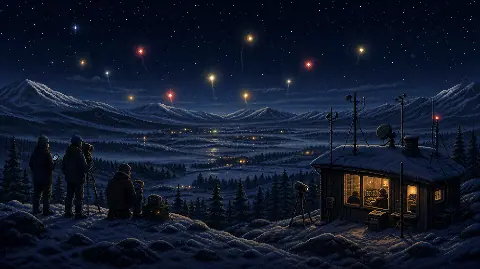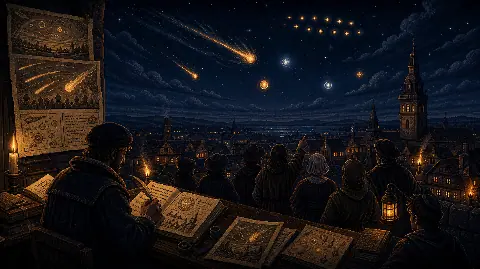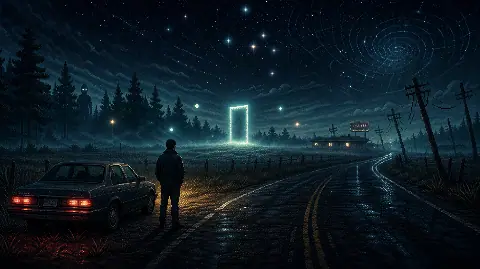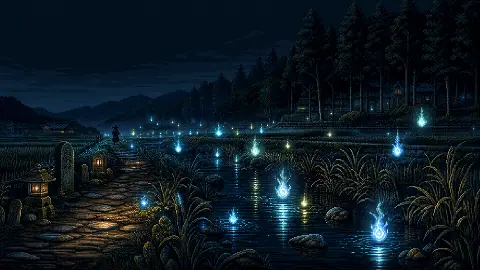
Onibi At A Glance
Onibi are best understood as anomalous lights interpreted through Japanese ghost and yōkai traditions, not as animals with a standard anatomy.
| Question | Short Answer |
|---|---|
| What does onibi mean? | The characters 鬼火 combine a supernatural being or ghost with fire. "Ghost fire" and "demon fire" are common English renderings. |
| What do onibi look like? | Accounts and dictionaries describe floating blue, blue-white, yellow or red lights, sometimes round and sometimes trailing a tail. |
| Where do they appear? | Wetlands, graveyards, dark fields, roads, riverbanks and places associated with death recur in the tradition. |
| Are they human souls? | Some are interpreted that way, but hitodama is the more precise term for a human soul appearing as a light. |
| Are they real? | People can see real unexplained lights. No evidence shows that every report has one cause or that a verified spirit produces them. |
The stable element is the light. Its owner, purpose and danger vary. Once that distinction is clear, apparent contradictions become local versions rather than errors in one universal field guide.
What Does Onibi Mean?
The written form 鬼火 is older than modern yōkai entertainment. Kotobank's entry from the Seisenban Nihon Kokugo Daijiten traces onibi to the tenth-century Wamyō Ruijushō, compiled around 934. That source glossed a mysterious fire through an older belief that the blood of dead humans, cattle or horses could become a wandering light.
That early explanation records a belief, not a chemical finding. Its value is chronological. The connection between death and strange night fires was already present in Japanese reference writing more than a thousand years ago.
Modern dictionary definitions remain broad. They describe blue or pale fires drifting through the air on dark or rainy nights, particularly around wetlands and graveyards. The same entries cross-reference terms such as kitsunebi, hitodama and fireballs. That overlap is built into the language.
The character 鬼 can evoke an ogre, demon, ghost or dangerous supernatural presence depending on context. "Demon fire" is therefore possible, but it can make English readers imagine a horned creature throwing flames. "Ghost fire" better preserves the ambiguity in many accounts.
Onibi Is A Light Category, Not One Creature
Japanese folklorist Kazuhiko Komatsu uses yōkai as a broad term for supernatural, strange, mysterious, anomalous or extraordinary phenomena and experiences. Onibi fits that model unusually well because the perceived event comes first. A light appears, moves or vanishes. Story and place then supply an identity.
Some traditions connect the fire to a dead person's soul. Others assign it to foxes, resentful dead, battlefields or unnamed supernatural forces. Regional fire-yōkai can have their own names and stories while still being grouped loosely with onibi in later reference works.
Modern character design reverses that process. Games and animation need a recognisable opponent, companion or elemental type, so an unstable light category acquires a face, powers and fixed behaviour. The design may be inspired by folklore without representing a traditional consensus.
Onibi, Hitodama, Kitsunebi And Shiranui
Four terms often translated as ghost lights carry different centres of gravity. Their boundaries can overlap, but they should not be treated as perfect synonyms.
| Term | Core Idea | What Distinguishes It |
|---|---|---|
| Onibi, 鬼火 | A broad supernatural or mysterious fire | The cause and identity can remain unspecified. |
| Hitodama, 人魂 | A human soul seen as a floating light | The light is specifically linked to a person's soul leaving or surviving the body. |
| Kitsunebi, 狐火 | Fox fire | Folklore attributes the light to foxes, often in fields, hills or processions. |
| Shiranui, 不知火 | Multiple marine lights seen in Kyushu | Modern dictionaries identify a place-bound optical effect involving distorted fishing lights over the Yatsushiro and Ariake seas. |
Hitodama narrows the interpretation to a human soul. Kitsunebi supplies a non-human agent. The National Diet Library describes kitsunebi as eerie fires said to be lit by foxes and records an Edo belief that foxes gathered at Ōji Inari Shrine on New Year's Eve, with villagers reading the flow of lights as a harvest omen.
Shiranui demonstrates why the umbrella must stay loose. It has a supernatural name and a long legend, but its repeated marine pattern is now explained as unusually refracted images of fishing lights. A named ghost light can preserve real observation after its mechanism changes.
How Edo Artists Gave Ghost Fire A Form
Toriyama Sekien helped standardise the visual language of yōkai in the late eighteenth century. His 1776 Gazu Hyakki Yagyō, or Illustrated Night Parade of the Demon Horde, was the first of four books that presented supernatural beings as individual illustrated entries.
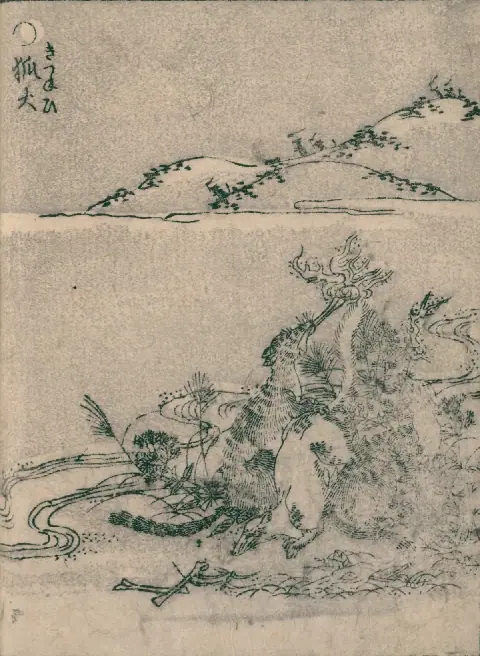
Sekien's kitsunebi image shows foxes grouped beside water with flame rising near their heads. It does more than illustrate a report. It turns a distant, unstable glow into a scene with agents and intention.
The National Diet Library notes that later ukiyo-e artists used Sekien's books as guides. Repetition gave particular fire-yōkai a durable shape, while oral accounts could remain inconsistent. Many images now presented online as "the onibi" are therefore illustrations of a named relative, not a canonical portrait of the entire category.
What Onibi Are Said To Do
Onibi stories describe motion more consistently than motive. The lights hover above the ground, gather and separate, appear in one place after vanishing from another, or trail through darkness. They may be solitary or form a sequence.
Location supplies much of the narrative. A light near a grave becomes a soul or remnant of death. A row of lights near fields can become fox fire. A glow over a battlefield can inherit the violence remembered there. A light along a dangerous road can become an omen or lure.
No single behaviour applies to every onibi. Claims that all onibi steal souls, attack travellers or contain visible faces usually come from one text, one local story or a modern adaptation. The broad dictionary tradition defines the phenomenon by uncanny fire, not by a universal attack pattern.
Why Ghost Lights Can Seem To Move
A distant light against a nearly black background is difficult to locate in depth, size and speed. The visual system has few stable reference points, so small head and eye movements can be misread as movement in the light itself.
Laboratory research calls one version the autokinetic effect. A stationary, dim point viewed in darkness can appear to drift in random directions. Experiments show that adding visual structure changes the illusion because the observer gains a reference frame.
Several other effects can create reported onibi behaviour without requiring the source to fly.
- Parallax makes a distant light shift against nearer trees or reeds as the observer moves.
- Atmospheric refraction can displace, multiply or distort lights, as in the modern explanation of shiranui.
- Intermittent obstruction by vegetation, terrain, mist or waves makes one steady source appear to blink and reappear.
- Unknown distance turns a small nearby source and a large distant source into competing interpretations of the same visual angle.
These mechanisms explain why sincere descriptions can include pursuit, splitting and sudden acceleration. They do not identify the source of every light.
Can Science Explain Onibi?
Science offers several mechanisms for ghost-light reports, but no experiment retroactively identifies every historical onibi. The setting and behaviour of a report decide which explanation is plausible.
| Candidate | What It Can Explain | Limit |
|---|---|---|
| Combustion or chemical luminescence | Brief light associated with methane-rich wetlands and decaying organic matter | A mechanism demonstrated in a laboratory is not proof that a reported light formed the same way outdoors. |
| Refraction and mirage | Duplicated, displaced or apparently suspended lights over water or layered air | Requires an underlying light source and suitable atmospheric conditions. |
| Autokinetic perception | Apparent wandering or direction changes in an isolated dim light | Explains perceived motion, not the source of the light. |
| Obscured human light | Blinking, rows and reappearance near roads, boats, farms or settlements | Needs a source consistent with the location and timing. |
A 2025 study in the Proceedings of the National Academy of Sciences tested one missing part of the marsh-gas idea. Researchers generated methane-containing microbubbles in water and recorded tiny spontaneous electrical discharges between charged bubbles. The flashes initiated non-thermal methane oxidation and produced luminescence and measurable heat under ambient laboratory conditions.
The study supplies a possible natural ignition pathway for some will-o'-the-wisp reports. It did not capture an onibi in a Japanese wetland, reproduce a long-moving fireball or show that methane explains graveyard, mountain and marine accounts. It strengthens one mechanism within a mixed category.
Shiranui provides the opposite kind of example. No flame is required. The light can be real while its apparent position and multiplication come from refraction. Similar appearance is therefore weak evidence for a shared cause.
Are Onibi The Same As Will-O'-The-Wisps?
Onibi and will-o'-the-wisps are close comparisons, not exact cultural duplicates. Both traditions describe elusive night lights near dangerous or liminal ground, and both connect those lights with death, spirits and misdirection.
The European will-o'-the-wisp is often personified as a deceptive lantern-bearer that draws travellers into marshes. Onibi has a wider Japanese network around it, including human soul imagery, fox fire, named regional lights and illustrated yōkai. Translating onibi as will-o'-the-wisp helps a reader picture the phenomenon but discards those local relationships.
The reverse translation also causes problems. Not every Japanese ghost light is onibi, and not every onibi belongs to a wetland gas story. A translation can orient the reader without settling the taxonomy.
When A Ghost Light Becomes A UFO
Modern UFO language can recode a strange light without changing the observation. A witness who once reported a spirit fire might now report an orb, UAP or energy being. The new label changes the implied cause from folklore to technology or non-human intelligence.
The archive contains several useful comparisons. Hessdalen Lights are recurring luminous phenomena studied with instruments in Norway. The Foo Fighters were unexplained lights described by aircrews during the Second World War. Older historical sky phenomena were recorded through religious, political and astronomical frameworks available at the time.
Those cases do not prove that onibi were early UFOs. They show that "unexplained light" is an observation class, while spirit, aircraft, plasma and alien probe are competing interpretations. The overlap belongs within high strangeness only when the distinctions remain visible.
What The Evidence Supports
The evidence supports a long Japanese tradition of naming and depicting anomalous night lights. The word onibi appears in early reference writing, Edo artists gave related fire-yōkai durable visual forms, and modern dictionaries preserve overlapping categories rather than one fixed creature.
Known mechanisms can reproduce important parts of the experience. Refraction can multiply distant lights. Vegetation and terrain can make them blink. Autokinesis can make a stationary point wander. Laboratory microlightning offers a possible ignition route for methane-rich wetland lights.
No verified observation shows that a dead person's soul, fox magic or one external species causes the full category. The strongest conclusion is plural. People have seen lights, cultures have interpreted them, and different physical and perceptual processes can converge on the same haunting shape.
The Onibi NFT model carries that ambiguity into the Other Worlders collection with green eyes, a Beyond background and a shooting-star holographic effect.
Source Trail
- Kotobank: Japanese dictionary and encyclopaedia entries for onibi
- Kotobank: Japanese dictionary and encyclopaedia entries for hitodama
- Kotobank: Japanese dictionary and encyclopaedia entries for kitsunebi
- Kotobank: Japanese dictionary entries for shiranui
- National Diet Library: Toriyama Sekien's illustrated yōkai and kitsunebi
- International Research Center for Japanese Studies: mysterious phenomena and yōkai database
- PNAS: Unveiling ignis fatuus: Microlightning between microbubbles
- Frontiers in Psychology: experiments on the autokinetic effect