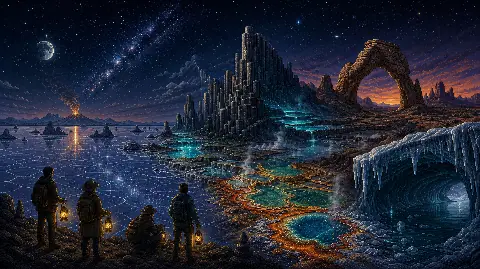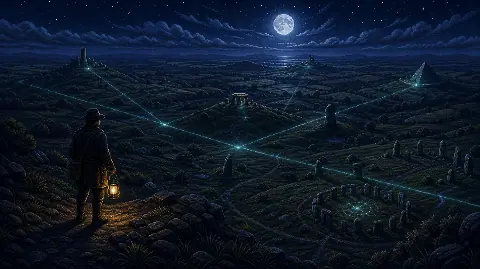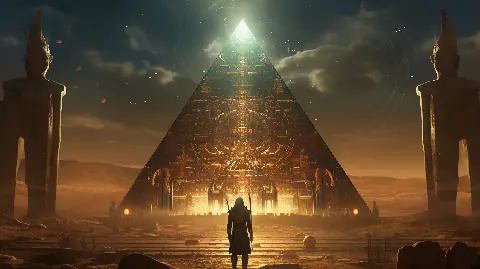
Here we explore the possibility that our ancestors interacted with advanced beings from the stars.
Overtime this theory has evolved from fringe belief to a cultural phenomenon, influencing books, television, and even the realm of academia.
What is the Ancient Astronaut Theory?
The Origins of the Theory
The idea that our planet was visited by intelligent extraterrestrial life forms in the distant past isn't new, and I've found it quite fascinating how this concept has woven itself into the fabric of contemporary mythos.
Ancient astronaut theory took a mammoth leap into mainstream culture largely thanks to Erich von Däniken's groundbreaking book "Chariots of the Gods". Consider this: as a testament to its influence, the book has sold over seven million copies and celebrated its 50th anniversary with a special edition release. Not to mention, its 1970 documentary adaptation even secured an Academy Award nomination.
Before television programs like Ancient Aliens championed the theory across our living rooms, it was literature — from von Däniken's bestseller included in a 50th-anniversary reissue by Berkley Books, to numerous other publications — that seeded the hypothesis amid society's consciousness.
What's really striking is that the ancient astronaut hypothesis suggests interpretations of historical texts, artifacts, and monuments that starkly contrast with conventional historical and archeological understandings, proposing an interstellar impact on human history.
Key Beliefs of the Ancient Astronaut Theory
Quite simply, the key belief of this theory is that extraterrestrials had a key role in shaping human civilization.
This perspective views historical records, sacred texts, and ancient architecture not as purely man-made or divine but as the handiwork or the result of influence due to visitors from the stars. It's claimed that technology far ahead of their time are found in ancient cultures, and that these are gifts from advanced beings.
The hypothesis also extends to religious doctrine, stating that what we interpret as divine encounters could be contacts with alien entities. If you're familiar with Star Trek, you'll remember examples in the show of how this could happen. A primitive intelligence witnesses a space craft land, where beings emerge with magical technology.
Afterall, how would a caveman, or even an individual from just a few hundred years ago interpret a modern day helicopter and smart phone, let alone an alien space craft?
Followers of the theory assert that myths of gods or angels might be based on these cosmic travelers — misunderstood due to the technological gap between humans and visitors. The implications of such beliefs are profound, questioning the very foundation of human origins, achievement and spirituality.
While the theory poses questions to religions, it doesn't require the abandonment of religious beliefs. In fact, both renowned figures associated with the theory, Tsoukalos and von Däniken, claim they are not atheists. This suggests a broader, more inclusive dialogue between the realms of faith and the possibility of ancient astronaut involvement in our past.
In another article I actually explore how aliens could be searching for apotheosis, and that they themselves might be driven by spiritual beliefs and a quest for finding God.
So it's definitely not just about dismissing traditional teachings; it's about expanding the scope to consider how unconventional theories can contribute to our understanding of humanity's history.
For those of us exploring the theory further, these key beliefs open a gateway into a reimagined past where human history intersects with the cosmic narrative, introducing a captivating blend of science, history, and the potential of extraterrestrial life.
Ancient Astronaut Claims
Evidence from Ancient Civilizations
There are many intriguing claims suggesting that ancient civilizations may have been influenced by visitors from the stars. It's not just about legends or rituals, but about tangible interactions that left a footprint in history.
Some advocates propose that beings from another planet imparted knowledge essential for constructing iconic monuments and influencing cultural evolution, or the origins of homosapiens themselves. Ancient texts and accounts often speak of sky gods or celestial visitors, stirring the imagination about early human contacts with extraterrestrial travelers.
For instance, there's the story of Osira, an ancient alien who, by her own proclamation, received the worship of the Egyptians. However, historical records indicate that their reverence was not without limit, as they eventually sealed her away. This speaks to the complex relationship between humans and these purported spacefarers—admiration mixed with fear.
Ancient Structures and Monuments
Like many, when I look at the colossal achievements in ancient architecture, I can't help but wonder how such feats were accomplished with the tools assumed to have been available.
Ancient astronaut proponents argue that these structures are too complex, too advanced, and share too many similarities across continents to be coincidental. They cite the pyramids, Stonehenge, and the intricate Nazca lines as some prime examples. The hypothesis is that these marvels of engineering are not just human ingenuity at work but the result of extraterrestrial assistance.
Scholars, on the other hand, have provided evidence of indigenous methods like the rope-and-lever systems used in Inca constructions which challenge the need for alien intervention. Yet, it's difficult for some to accept that such splendid and mysteriously aligned edifices like the Moai of Easter Island or the Pumapunku ruins are solely the work of Earth-bound hands, given the size and weight of these stones.
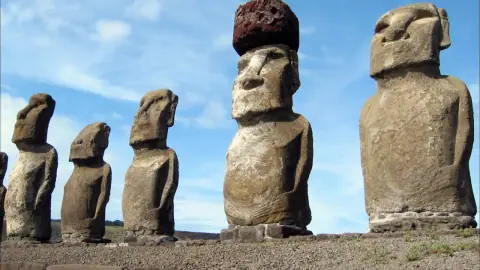
Additionally, the celestial alignments many of these ancient structures exhibit show that whoever built them, had an incredible understanding of cosmology. An understanding so far beyond what makes sense for otherwise bronze age, or pre bronze age cultures as we know them.
Some of the key ancient structures that seem to defy the abilities of those who supposedly built them include:
- Pyramids of Giza, Egypt: The precision and size of the pyramids often lead to theories about alien involvement.
- Stonehenge, England: The massive stones and their arrangement have spurred theories about extraterrestrial help.
- Nazca Lines, Peru: These large geoglyphs, only fully visible from the air, have been linked to alien theories.
- Moai Statues, Easter Island: The size and transport of these statues have fueled speculation about alien technology.
- Teotihuacan, Mexico: The advanced urban layout and architectural knowledge of this ancient city have intrigued alien theorists.
- Puma Punku, Bolivia: The precise stone cutting in this site is often cited as too advanced for the technology of the time.
- Machu Picchu, Peru: Its remote location and advanced engineering are sometimes attributed to extraterrestrial influence.
- Sacsayhuamán, Peru: The immense and perfectly fitted boulders in this fortress are often cited in ancient alien theories
Artifacts and Relics
When it comes artifacts and relics, the ancient astronaut narrative finds even more to speculate on, believe it or not.
There are items and depictions that, at first glance, might seem to portray anachronistic understandings of aerospace technology. On display at museums like the Louvre are artifacts such as the winged priest of Dudu that depicts images of flight and beings not of this Earth.
Similarly, Sumerian texts refer to the Anunnaki, theorized as travellers from another world, and Hindu sculptures showcase aerial vehicles known as Vimanas. The Dogu figurines of Japan with their goggle-like eyes have also been interpreted as representations of space-suited alien visitors.
It's not solely about the art, however. Archaeology has unearthed confounding finds such as the "helicopter hieroglyphs" in Abydos. Each instance fuels debate over whether ancient humanity had contact with societies from distant galaxies or whether these are merely coincidental shapes and myths borne of human imagination.
Again, putting yourself in the shoes of a human from these time periods, how would you draw a space craft/UFO, or alien beings? If they are flying, wings make sense. Why do so many ancient gods have wings?
The prevalence of these icons and objects across time and geography give the ancient astronaut theory its tantalizing allure and has kept it in the realm of compelling pseudoscience for both enthusiasts and skeptics alike.
Criticisms of the Ancient Astronaut Theory
Lack of Scientific Evidence
The foundation of the ancient astronaut theory often comes under scrutiny because of its scant empirical support. Critics argue that the theory relies heavily on confirmation bias, where proponents selectively interpret ancient texts and artifacts to fit their hypotheses.
In the academic community, the notion that extraterrestrials influenced ancient civilizations is viewed with skepticism due to the lack of direct evidence. This skepticism is reinforced by the work of researchers like Carl Sagan and Iosif Shklovsky, who emphasize that extraordinary claims require extraordinary evidence.
Alternate Explanations
When considering the ancient astronaut theory, it's essential to acknowledge the multitude of indigenous methods and innovations. Archaeologists and historians have provided multitude alternative explanations for the construction of ancient monuments and megalithic structures.
Technological advancements made within ancient civilizations often negate the need to invoke extraterrestrial intervention. This understanding is crucial in appreciating human ingenuity without dismissing it in favor of sensational explanations. We do sometimes forget how knowledgeable ancient cultures were. However… there are still some ancient things that just seem to defy even modern technology.
Bias and Pseudoscience
The ancient astronaut theory also comes under fire for often disregarding established scientific methodologies. Critics highlight that some arguments put forth by proponents teeter on the edges of pseudoscience, primarily when they repurpose the cultural achievements of ancient peoples as evidence of alien contact.
There's a troubling trend where these theories can inadvertently perpetuate a form of cultural bias, undermining the capabilities and achievements of non-Western civilizations. Additionally, scholarly engagement and public outreach are imperative to counter these narratives to promote a more fact-based understanding of our past.
But that has become quite ridiculous. Instead of being open to alternate theories, even if outlandish, people like Graham Hancock have been labelled as racist for suggesting ancient indigenous cultures built structures that don't align with what we know now of their advancement. Maybe a lost civilization and not aliens? Who knows, but having an open mind is important.
Conclusion
While the theory captivates imaginations and challenges our understanding of history, it's crucial to approach it with a critical eye. The fervor of popular culture has undeniably fanned the flames of this theory, yet it remains a topic of contentious debate.
As I continue to explore the mysteries of our past, I'm reminded that our quest for knowledge is never-ending, and each theory—no matter how controversial—adds a unique perspective to the human story. Let's keep our minds open as we seek the truth behind the monumental achievements of ancient civilizations and the possibility of extraterrestrial influence.