What Archaeologists Found at Chleby
Chleby lies in the Nymburk district north-east of Prague. Archaeologists led by Petr Krištuf of the University of West Bohemia have been examining an enclosure that their dating places more than 6,500 years in the past, during the Eneolithic or Copper Age.
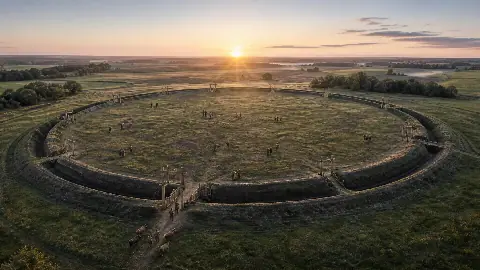
The monument was not a Stonehenge-style ring of standing stones. It was a large earthwork defined by a deep ditch, an enclosed interior and twelve entrances. The university says circular enclosures of this form are otherwise unknown in the region for the period.
Organic material recovered from the site provides the chronological anchor. The public announcement does not yet provide the full sample list, laboratory results or calibrated date ranges, so the headline age should be read as the research team's current summary of its dating work.
How the Sun and Moon Alignments Work
The twelve entrances are not evenly distributed around the enclosure. According to Krištuf, their geometry creates two principal observation systems.
- One observation point corresponds with extreme positions of the Moon on the horizon during its roughly 18.6-year cycle.
- A second axis connects sunrise at the summer solstice with sunset at the winter solstice.
The lunar cycle described here is usually called the lunar standstill cycle. The Moon's rising and setting points move along the horizon over many years, reaching their widest northern and southern limits approximately every 18.6 years. A stable entrance or sightline could preserve those horizon positions across generations.
Solar alignment is easier to test because the solstice positions repeat annually. The case becomes stronger when surveyed entrance bearings, reconstructed local horizons and dated construction phases converge. Similar-looking lines drawn across a plan are not enough by themselves. The same evidence discipline applies to debated sites such as the Great Pyramid and Orion alignment.
What Is Confirmed and What Is Interpreted
| Physical or Dated Evidence | Research Interpretation |
|---|---|
| An almost circular enclosure approximately 230 metres across. | The enclosure functioned as a sanctuary or ritual centre. |
| A ditch more than 2.5 metres deep and twelve entrances. | The entrance geometry intentionally tracked solar and lunar cycles. |
| Bull skulls and horns were found near entrances. | The remains decorated gateways or represented a bull cult. |
| Human bones and a later collective burial occur at the site. | The monument retained a sacred or funerary identity across every period. |
This separation does not weaken the discovery. Archaeology moves from material remains to explanations by testing context, chronology and competing possibilities. Chleby offers unusually rich material for that process, but the function of any prehistoric monument is harder to establish than its dimensions. The same distinction matters when later traditions are attached to prehistoric sites, including claims that Göbekli Tepe was Noah's altar.
Is Chleby Really Older Than Stonehenge?
Yes, with an important qualification. The Chleby team dates its enclosure to roughly 4500 BC. English Heritage dates the earliest major earthwork at Stonehenge to about 3000 BC and the famous raised sarsen stones to about 2500 BC. Chleby is therefore approximately 1,500 years older than Stonehenge's first earthwork and about 2,000 years older than its central stone settings.
The university's simpler description of "1,000 years older" is conservative, but age does not make Chleby an earlier version of Stonehenge. The monuments differ in materials, architecture and cultural setting. Their strongest parallel is the apparent use of a large circular space and horizon alignments to organise communal activity. That is different from ley line claims, which propose relationships between separate places rather than a measured sightline to a celestial event.
English Heritage's Stonehenge timeline also shows why the comparison needs phases. Stonehenge changed repeatedly over more than a millennium. Chleby appears to have had its own long afterlife, including uses that were not part of the original enclosure.
Bull Remains and Human Bones Mark Different Chapters
Bull skulls and horns were recovered from the ditch near the entrances. Jan Turek of Charles University suggests they may have decorated monumental gateways and connected the site with bull symbolism known among early European farming communities.
That is an archaeological inference, not a direct record of belief. The placement of the remains can support a ritual explanation, especially if repeated at several entrances, but it cannot tell us exactly what the animal represented to Chleby's builders.
Human bones add another chronological layer. Previous work identified a Bronze Age burial containing the remains of about 18 people, deposited gradually. This burial belongs to the Únětice culture and is much later than the enclosure's original construction. By the Iron Age, the ditch was filling and an ordinary settlement occupied the former monument.
Chleby was therefore not frozen in one sacred moment. Communities encountered, reused and eventually built over the landscape for thousands of years. That changing sequence is more informative than treating every object at the site as evidence for one continuous ceremony. It is also why accounts of otherworldly places on Earth need archaeology, later reuse and folklore placed on separate timelines.
What the Discovery Does Not Show
The Chleby announcement contains no evidence of lost advanced technology or extraterrestrial involvement. Those are ancient astronaut theory claims, not findings reported by the excavators. Nor is there evidence of astronomical knowledge beyond careful long-term observation of the horizon. Constructing a large earthwork and tracking celestial cycles were major human achievements, but neither requires tools outside the known Copper Age sequence.
The monument also should not be reduced to a calendar. Farming communities had practical reasons to watch seasonal change, while communal monuments could combine ceremony, memory, burial, gathering and territorial identity. One alignment may be deliberate without explaining every activity that occurred inside the enclosure.
Modern survey methods can establish bearings and terrain with high precision. As with LIDAR archaeology, however, mapped geometry still needs excavation, dating and cultural context before researchers can assign function.
What Researchers Need to Establish Next
The current project will analyse soil chemistry for traces of how different areas were used. Those results may help identify concentrations of burning, animal activity, food preparation or repeated human occupation that are no longer visible as objects.
A complete published case for the astronomical interpretation would ideally include surveyed entrance azimuths, local horizon profiles, construction dates for each opening and a statistical test against accidental alignment. It would also need to account for entrances altered during later occupation.
The excavation remains active. Until a detailed study is available, the university press release is the primary public account and the alignment claim should be attributed to the research team.
Source Trail
- University of West Bohemia press release, 18 August 2026
- Archaeological Summer field event at Chleby, 19 August 2026
- English Heritage timeline of Stonehenge
- English Heritage evidence on Stonehenge's solar alignments
Verdict
Chleby is an exceptional prehistoric monument even before its purpose is settled. A 230-metre enclosure from roughly 4500 BC demonstrates large-scale planning, communal labour and a landscape design that archaeologists can now test against the sky.
The strongest account keeps two ideas together. The site is genuinely ancient and its entrance geometry may encode sophisticated solar and lunar observation. Calling it a sanctuary or ritual calendar remains a reasoned interpretation awaiting fuller publication, not a final fact carved into the earthwork itself.