What Hubble And Gaia Found
The research team analysed 39 globular clusters within the inner 20,000 light-years of the Milky Way. Hubble observations supplied precise relative ages and measurements of metallicity, the abundance of elements heavier than helium. Gaia data helped reconstruct how the clusters move through the galaxy.
A statistical analysis separated the clusters into three populations. One formed in the Milky Way itself. Another arrived with Gaia-Sausage-Enceladus around 10 billion years ago. The third population follows its own age, metallicity and orbital sequence, indicating that it formed in a different galaxy that merged with the Milky Way even earlier.
| Finding | Result |
|---|---|
| Clusters analysed | 39 globular clusters |
| LKH members | 12 clusters assigned with greater than 50% probability |
| Merger timing | About 1.8 billion years before Gaia-Sausage-Enceladus |
| Estimated stellar mass | Roughly 500 million Suns |
| Present location | Most debris deposited within 6 kiloparsecs of the Galactic Centre |
How Globular Clusters Preserve A Destroyed Galaxy
Globular clusters are dense, roughly spherical groups containing tens of thousands to millions of stars. Many formed during the earliest stages of galaxy growth. Their stars share an origin, allowing astronomers to estimate the cluster's age and chemical history more precisely than they can for isolated stars scattered across the Milky Way.
When a dwarf galaxy is torn apart, its globular clusters can survive the collision. Their original galaxy disappears, but the clusters retain a record of when and where their stars formed. They are very different from young stellar nurseries such as the Treasure Chest star cluster, where stars are still clearing away the cloud that created them.
The CARMA project measured the clusters through the same Hubble filters and with the same analysis method. That consistency reduced systematic differences between earlier age estimates. Typical relative-age uncertainties were brought down to a few hundred million years, enough to separate populations formed close together during the Milky Way's turbulent youth.
Three Populations Hidden In The Inner Milky Way
The researchers compared models containing two, three or four progenitor populations. The three-component model received the strongest statistical support. It divided the sample into clusters born in the Milky Way, clusters associated with Gaia-Sausage-Enceladus and an intermediate sequence assigned to LKH.
Twelve of the 15 clusters previously associated with a loosely defined low-energy group fell into the LKH population. They occupy the inner six kiloparsecs of the galaxy, about 19,600 light-years from the centre. The region is crowded, dust-obscured and strongly affected by the Milky Way's rotating central bar, which can erase or distort ancient orbital patterns.
Other discoveries in the same broad region rely on completely different evidence. The detection of erythrulose near the Galactic Centre, for example, came from molecular radio signatures rather than the ages and motions of ancient stars.
Why It Is Called Low-Energy-Kraken-Heracles
The name joins three earlier attempts to identify ancient material in the inner Milky Way. A low-energy group of globular clusters was proposed as debris from an unknown accretion event. Simulations predicted an early merger called Kraken. Surveys also identified a chemically distinct population of inner-galaxy stars named Heracles.
Those labels did not initially describe exactly the same collection of stars and clusters, and the external origin of some candidates remained disputed. The new study defines a cleaner population using cluster ages, metallicities and orbital properties together. The authors retained all three names to recognise the work that led to the identification.
When The Merger Happened
NASA's 17 August release describes the collision as occurring about 11.8 billion years ago, roughly two billion years after the Big Bang. The Nature Astronomy paper estimates an accretion time around 12.3 billion years ago, or about 1.5 billion years after the Big Bang.
The difference reflects how the relative cluster ages are anchored to an absolute cosmic timeline. The paper cautions that its cluster ages are highly precise relative to one another but can shift on an absolute scale depending on the stellar models used. The firmer result is the sequence: LKH merged with the Milky Way around 1.8 billion years before Gaia-Sausage-Enceladus.
How LKH Changed The Milky Way
LKH had a stellar mass comparable to Gaia-Sausage-Enceladus, estimated at about 500 million Suns. The young Milky Way was much smaller than it is today, so absorbing a galaxy of that size would have contributed a significant share of its early stars and clusters.
Most of the identified LKH material now lies deep inside the Milky Way. The merger may have contributed to the metal-poor stellar populations of the inner halo and bulge before the galaxy developed its present disc. It also shows that some of the earliest Milky Way stars were born outside our galaxy and arrived through mergers.
The physical galaxy has been rebuilt repeatedly even as cultures have given its bright band very different meanings. Those traditions form a separate record of how people interpreted the Milky Way in myths around the world long before its merger history could be measured.
What Has Been Measured And What Remains Inferred
Hubble measured the cluster photometry used to determine precise relative ages and metallicities. Gaia supplied the stellar motions used in the orbital analysis. The data support three distinct cluster populations, with the LKH sequence separated from both Milky Way and Gaia-Sausage-Enceladus clusters.
LKH itself is a reconstruction. Astronomers have not photographed the dwarf galaxy before impact. Its mass, merger date and surviving membership are inferred from statistical, dynamical and chemical-evolution models. The study also cannot exclude smaller early galaxies that lacked globular clusters or whose clusters were completely destroyed.
The result provides strong evidence for one substantial early merger, not a complete inventory of everything the young Milky Way absorbed.
What Astronomers Will Study Next
The team is extending the same analysis to globular clusters that have not previously received precise Hubble age measurements. A larger sample could reveal whether additional major merger populations remain buried in the inner galaxy.
Future stellar-age measurements from missions such as PLATO may help connect the LKH clusters to a broader population of inner Milky Way stars. Better age estimates could also resolve the absolute timing of the collision and distinguish LKH debris from material contributed by smaller galaxies during the same early period.
Frequently Asked Questions
What Is Low-Energy-Kraken-Heracles?
Low-energy-Kraken-Heracles, or LKH, is the name given to an ancient dwarf galaxy that merged with the young Milky Way. It is reconstructed from a distinct population of globular clusters now found in the inner galaxy.
When Did LKH Merge With The Milky Way?
NASA places the event about 11.8 billion years ago. The paper's model estimates roughly 12.3 billion years ago. Both estimates put it around 1.8 billion years before the Gaia-Sausage-Enceladus merger.
How Large Was The LKH Galaxy?
The study estimates that LKH contained roughly 500 million solar masses in stars. Its total mass, including gas and dark matter, would have been higher but is not directly measured by this analysis.
Can Astronomers Still See LKH?
Not as a separate galaxy. The Milky Way tore it apart and absorbed its material. Astronomers identify its surviving record through ancient star clusters with shared ages, chemistry and orbital behaviour.
Did Hubble Photograph The Collision?
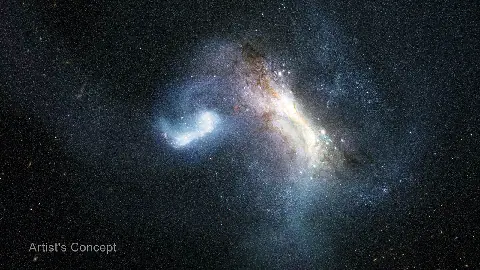
No. The collision happened billions of years before the Solar System formed. Hubble measured surviving globular clusters, while the accompanying collision image is an artist's concept.
Source Files
- Nature Astronomy: Evidence of a massive accretion event 1.8 billion years before the Gaia-Sausage-Enceladus merger
- arXiv: Proof that the Milky Way experienced a significant merger only 1.5 billion years after the Big Bang
- NASA: Hubble Solves Merger Mystery From Milky Way's Early Years
- ESA: Gaia uncovers a major event in the formation of the Milky Way