Explore the Waterline
1. Why Does the Ocean Keep Appearing?
The term unidentified submerged objects puts the mystery below the surface. Think of a label on an unopened parcel. The label tells you how someone has classified it; opening the parcel is a separate job.
The term is often shortened to USOs, while transmedium describes movement between environments such as air and water. Neither word identifies the thing being observed. Calling something an underwater UFO does not establish its depth, construction or origin.
Descriptions of underwater UFOs sometimes begin with an object already said to be underwater. Others begin with an aerial sighting near the coast. A third group centres on the instant an object apparently crosses the surface. These accounts ask different questions, even when a compilation places them side by side.
If you have searched USO UFO and found those descriptions mixed together, start by separating the observation from the interpretation. Was an object tracked below the water, reported to enter it, or simply lost from view nearby?
The ocean is an extraordinary setting for a mystery. But the strongest comparison begins with the specific observation, as the older coastal account at Shag Harbour also reminds us. What would show that a crossing actually happened?
2. The Waterline Is Where the Record Breaks
A car disappearing behind a hill has left your view without leaving the road. An object fading near the sea can create a similar gap between what the camera records and what you imagine happened next.
The Waterline Test separates an object disappearing at sea from one being continuously tracked into the water.
This is a way to organise the evidence, rather than a scientific test that can identify a vehicle from a few pixels. It asks which parts of the journey are actually documented.
Observation 1. The Target Approaches the Apparent Surface
A camera frame can show a target beside a patch of sea without telling us its exact position above that patch. Imagine pointing at a distant building through a window. Your fingertip and the building overlap in your view while occupying very different places.
The apparent meeting between object and water needs to be checked against the camera position, viewing direction and available measurements. Those details can turn a convincing-looking contact into a different arrangement in space.
Observation 2. The Crossing Is Recorded
A continuous recording could preserve the object's approach, contact with the surface and subsequent motion. Investigators would still need to establish that the target stayed correctly identified throughout the sequence.
A relay race offers a good comparison. Watching one runner arrive and another depart does not prove the baton changed hands. The handover itself is the crucial part.
Observation 3. The Underwater Track Connects
A matching underwater detection could strengthen the case, provided its time and position connect to the aerial record. A sonar contact somewhere in the same area would not automatically be the same object.
The Waterline Test
1. Above the Water
Identify the target and retain the original sensor record.
2. At the Surface
Document the crossing. A disappearing image leaves a gap.
3. Below the Water
Match the same target with time-aligned underwater observations.
A reported disappearance and a continuous air-to-water track are different records.
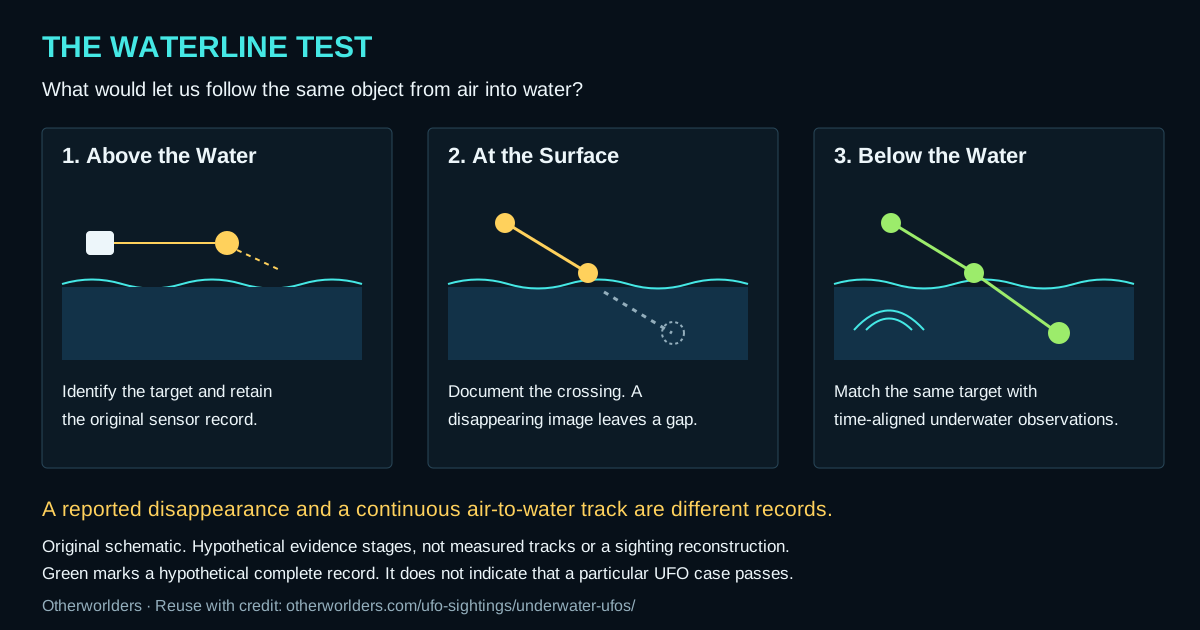
The most revealing missing evidence may therefore be a connection between records, rather than a sharper-looking image. The Calvine photograph raises a related problem when apparent size is mistaken for measured distance. Omaha brings the waterline question into a more immediate setting.
3. Omaha Makes the Question Hard to Ignore
The USS Omaha footage became public in May 2021, attached to an account of a July 2019 encounter off Southern California. Its attraction is easy to understand. A dark target appears near the water, and the accompanying voices react as it disappears.
In Jeremy Corbell's original release, the scene is attributed to the ship's combat information centre on 15 July 2019. His published transcript includes the reaction, "Whoa, it splashed!", followed by an instruction to mark bearing and range.
That is a remarkable account to investigate. Think of a match report and the footage of the match. The visible target, recorded reaction and publisher's wider account relate to the same event, but each preserves different information.
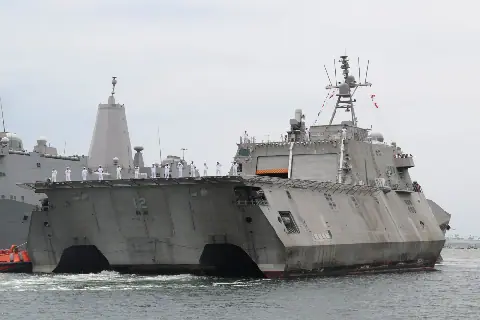
Former US Navy rear admiral Tim Gallaudet brought the incident into a congressional hearing on 13 November 2024. He described watchstanders observing an object aloft and then seeing it enter the water. His testimony gives that account a named public advocate under oath.
Gallaudet was describing what the watchstanders reportedly saw. He was not presenting his own observation of the crossing, nor publishing a continuous underwater sensor track.
Corbell's release also describes a submarine search that recovered nothing. That remains a claim in the publisher's account, rather than a public sonar record that lets us follow the target after its disappearance.
The full USS Omaha case deserves attention because its surrounding account is substantial. To complete the Waterline Test, the next breakthrough would be a linked record of what happened beneath the surface. A different famous video shows why the camera's position is equally important.
4. Aguadilla Changes When You Change the View
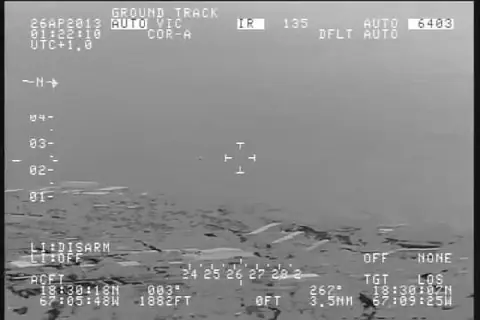
A U.S. Customs and Border Protection aircraft recorded the Puerto Rico encounter on 26 April 2013. The infrared footage appears to show rapid movement, a split into two objects and a passage through water near Aguadilla. It is a compelling sequence to watch before reading anyone's explanation.
The complete published infrared clip is available to watch. It was published on DVIDS in November 2024 and runs for three minutes and 54 seconds. This was a Customs and Border Protection recording, not a Navy camera.
An overhead view can change a scene that looks straightforward from the side. Imagine watching two people through a long corridor. Their paths can appear to cross even when one is much farther away. To understand the encounter, you need to recover the arrangement the camera flattened into an image.
AARO's published assessment says two objects were travelling close to each other at wind speed. It concludes that they did not enter the water. The office's March 2025 reconstruction illustrates the aircraft's flight path, the sensor's viewing direction and the assessed route over land.
The reconstruction is an analysis of the original scene. It is not another recording of the encounter. Keep the two labelled separately while comparing the features each is intended to explain.
This gives an underwater UFO video a more interesting examination than repeatedly watching its most dramatic seconds. The question becomes whether the proposed geometry explains the whole sequence, including the apparent changes that made the footage famous.
Aguadilla shows how an apparent water crossing can be tested against a reconstructed viewpoint. That conclusion applies to this case, rather than automatically settling every report at sea. Our GOFAST investigation explores a different example of apparent movement and measured geometry. What do the more recent releases add?
5. What the 2026 Releases Actually Add
A Gulf of Oman clip released on 7 August 2026 adds another maritime scene to the public archive. Its release date is newer than its encounter date. The footage was recorded in September 2021.
The official PR117 release describes 16 seconds filmed with a phone from an AC-130J infrared display. It warns that this secondary recording introduces limitations in fidelity, resolution and visual quality.
A phone filming a television match records the television's display as well as the game. Blurring or flickering in that copy may come from recording the screen, which is why access to the original sensor file would help.
PR117 belongs to a group of contemporaneous clips, PR117 through PR122. The release adds material for comparison, but supplies no demonstrated underwater crossing. A newly released maritime video and a newly recorded underwater event are different discoveries.
An underwater UFO caught on video can sound like a complete answer. The original file, its date and the camera system tell us which part of the encounter is actually available to examine. Even after gathering those details, several explanations can remain open.
6. Three Explanations Need Different Evidence
A genuinely unusual event and an unfamiliar view of an ordinary event can begin with the same striking image. The next measurements should help us distinguish them, rather than reward whichever explanation has the most dramatic caption.
Explanation 1. An Object Really Crosses the Surface
Movement between air and water is a real engineering problem. The Naval Research Laboratory's Flimmer programme combined flying and swimming capabilities, describing a vehicle that flies to an area, lands on the water and dives. A crossing by itself would therefore not identify an extraterrestrial technology.
This explanation needs a recorded path that actually reaches the surface and continues beneath it. Think of a diver entering a pool. Seeing the approach, entry and underwater continuation connects the action; seeing someone disappear behind the pool wall does not. Evidence of remarkable underwater speed would then require its own measurements. A documented crossing would be a major step, while the object's identity and performance would remain separate questions.
Explanation 2. A Real Object Is Lost From View
A target might remain above the sea while the camera loses it. A small object can disappear against a changing background, pass behind something or leave a sensor's view. A distant bird vanishing against a hillside has not necessarily landed there.
This explanation needs the camera's motion, viewing direction and target position to account for the disappearance. An assertion that something was probably a drone is no substitute for reconstructing its path. Investigators should also ask whether another sensor retained the target after the camera lost it. If a proposed airborne route fits the complete record, it could explain the apparent entry. If that route conflicts with measured positions, the explanation would need revision.
Explanation 3. The Image Suggests Behaviour the Scene Did Not Contain
A recording can make a real scene appear to do something different. A reflection on a moving window can seem to race across a landscape, even though nothing is travelling along the apparent path. Camera geometry, display settings and recording quality deserve the same scrutiny as the target.
This branch needs a specific mechanism that reproduces the observed effect. Saying "sensor error" is too vague. Which setting, viewing arrangement or recording step would create the apparent movement or disappearance? The explanation should fit the relevant sequence rather than one convenient frame. A successful demonstration would establish a possible mechanism; matching the actual capture conditions would make it a stronger explanation of the historical event.
These are routes for investigation, rather than equal probability scores. One can explain a particular sequence without explaining every coastal sighting. For the broader distinction between a real observation and an identified origin, follow what UFO evidence can establish. The final step is to ask what an encounter should preserve next time.
7. What Would Let Us Follow It Underwater?
The strongest next record would connect the target before, during and after the apparent crossing. An original video with reliable timing and camera information would give investigators more to work with than a short edited clip.
A matching underwater detection would need enough information to establish that it was the same target. Think of two photographs of a suitcase taken at different airports. Shared timing, a distinctive feature and a traceable journey make the connection stronger than similar shape alone.
For underwater UFO sightings, that means retaining the circumstances as carefully as the image. Where was the observer? Which way was the camera pointing? When did the target disappear, and what was the sea doing? Separate a witness's impression of depth from a measured underwater position.
The same discipline applies to a map. A pin beside the coast can represent where a report was placed without measuring where an object travelled beneath the water. A map of stories is not automatically a survey of underwater vehicles.
When I compare the original release descriptions with the hearing testimony and the published reconstruction, the most revealing difference is what each lets us follow. Omaha preserves a striking disappearance and an attributed entry account. Aguadilla supplies a worked explanation of why an apparent crossing can arise from the camera's view. Neither should quietly lend the other evidence it does not contain.
If you search UFO underwater, begin with the complete recording. Watch where the target first becomes difficult to distinguish, then compare the accompanying account with the actual sequence. Our guide to preserving UFO sighting records explains how to retain the original files and surrounding details in a new case.
There is no dependable timetable for the missing measurements to emerge. But the first achievable step is already available. Keep the real footage, the analysis and the witness account distinct, then place them beside one another.
The ocean remains a compelling place to look. The record that could change this question most would carry the same target across the waterline and keep following it.
Questions About Underwater UFOs
What Is an Underwater UFO Called?
An unidentified submerged object is often called a USO. The term describes an object that has not been identified in an underwater account. It does not establish an extraterrestrial origin or confirm that a particular camera target went beneath the surface.
Can UFOs Move Between Air and Water?
Some reports describe that movement, and human engineering has explored vehicles that fly and swim. Establishing a crossing in an unidentified-object case requires evidence connecting the target above the surface with its underwater continuation. Its origin would remain a separate question.
Does the USS Omaha Video Show an Object Entering the Ocean?
The published clip and its accompanying account describe an apparent entry. Tim Gallaudet also repeated watchstanders' water-entry account under oath in 2024. The public material examined here does not supply a continuous underwater sensor track that independently connects the target after it disappears.
Was the Aguadilla UFO Filmed Underwater?
The 2013 recording came from an airborne Customs and Border Protection infrared sensor. AARO's published reconstruction assesses two nearby objects travelling over land at wind speed, without entering the water. The reconstruction is an analysis, not additional footage of the original encounter.
Is the Puerto Rico Reconstruction Real Footage?
It is a digital reconstruction showing the camera platform's route, viewing direction and the assessed object paths. The original infrared recording is a separate video. The two should be labelled and compared without presenting the reconstruction as a second camera's view.
Do the 2026 Gulf of Oman Releases Prove Underwater Travel?
The PR117 release supplies a phone recording of an infrared display, filmed in 2021 and released in 2026. Its official description identifies recording limitations. It does not demonstrate a crossing into the water or establish subsequent underwater motion.
Does Disappearing at the Waterline Prove a USO?
A target can disappear from a camera for several reasons. To establish a physical crossing, investigators need to connect the apparent contact with the surface to the target's actual position and subsequent movement. A disappearance alone leaves that connection open.
What Evidence Would Make an Underwater UFO Case Stronger?
Original recordings, reliable times, camera position and viewing direction can help reconstruct the approach. A continuous crossing and a matching underwater detection could then connect the stages. Witness accounts, recordings and later interpretations should remain clearly distinguished throughout that comparison.