One Word, Three Different Archives
The quickest way to understand jinn is to ask which archive a claim comes from. A Qur'anic statement, a medieval tale and a modern bedroom encounter do not carry the same kind of authority or evidence.
| Archive | What It Contains | How To Read It |
|---|---|---|
| Scripture and theology | Creation from fire, moral choice, belief and unbelief, Iblis, Solomon and an ifrit | Religious claims grounded in the Qur'an and interpreted through Islamic scholarship |
| Folklore and literature | Shape-shifting, desert ruins, wells, marriages, bargains, ghuls, marids, lamps and sealed vessels | Regional traditions that expanded and localised the idea across centuries |
| Encounter and paranormal reports | Sensed presences, shadow figures, voices, sleep paralysis, possession claims and interdimensional comparisons | Testimony and interpretation, not independent proof of an external being |
The boundaries are porous. Folklore borrows from scripture, religious practice absorbs local tradition, and witnesses use familiar language to describe frightening experiences. The categories still prevent a common error: treating every later jinn story as if it appeared fully formed in the Qur'an.
What Does The Qur'an Say About Jinn?
The Qur'an presents jinn as intelligent created beings, not as a metaphor for human evil and not as fallen angels under another name. Several passages establish the core framework.
| Qur'anic Point | Passage | What It Establishes |
|---|---|---|
| Created from fire | 15:27 and 55:15 | Jinn have a different origin from humans, who are described in the surrounding verses as created from clay. |
| Morally varied | 72:1 to 15 | A group hears the Qur'an, while the speakers say some among them are righteous and others follow different paths. |
| Iblis was a jinn | 18:50 | The named rebel who refuses God's command is identified as one of the jinn. |
| An ifrit serves in Solomon's court | 27:39 | An ifrit from among the jinn claims it can transport the Queen of Sheba's throne rapidly. |
| Jinn do not know the unseen | 34:12 to 14 | Jinn working for Solomon fail to recognise his death until his staff collapses. |
Popular lore often gives jinn near-limitless secret knowledge, yet the Solomon passage explicitly undercuts that idea. They may possess abilities unavailable to humans within the story, but they are not omniscient.
Surah Al-Jinn also breaks the all-evil stereotype. Its jinn describe themselves as divided into different paths and respond differently to revelation. Moral variation is part of the scriptural picture, not a modern attempt to soften it.
Are Jinn Demons?
No. Translating every jinn as a demon removes a central distinction in Islamic thought. Jinn are a broad class capable of obedience or rebellion. Demonic terms refer to adversarial beings or behaviour.
| Term | Core Meaning | Common Confusion |
|---|---|---|
| Jinn | A morally varied unseen creation | Often translated as demons even when no evil role is stated |
| Iblis | The named rebel identified as a jinn in Qur'an 18:50 | Sometimes treated as proof that every jinn is demonic |
| Shaytan or shayatin | Satan, devil or devils associated with rebellion and temptation | Used as if it were a neutral synonym for all jinn |
| Angels | A separate order of beings in mainstream Islamic theology | Jinn are sometimes described as fallen angels through a Christian template |
English translations make the problem harder because words such as spirit, demon, devil and genie arrive with their own religious and fictional baggage. The safest wording is often the original term followed by a clear explanation of how that source uses it.
Are Ifrit, Ghul And Marid Types Of Jinn?
Sometimes in folklore, but the neat online hierarchy of jann, jinn, shaytan, ifrit and marid is not a Qur'anic field guide. It combines scripture, lexicography, medieval cosmology, regional tales, modern occult writing and fantasy gaming into one ladder.
- Ifrit: The Qur'an uses the expression once, describing an ifrit from among the jinn in 27:39. Scholar Edmund Teuma notes that the word may function as a quality such as formidable, rebellious or audacious rather than a fixed biological class.
- Ghul: The ghul belongs primarily to Arabic and wider Middle Eastern folklore and literature. Its stories emphasise wilderness, graveyards, deception, predation and changing form. The English word ghoul carries only part of that history.
- Marid: Marids become prominent in later stories as powerful and defiant beings, often associated with water or grand magical force. They are familiar from the Arabian Nights tradition, not from a detailed Qur'anic taxonomy.
- Shaytan: This is an adversarial moral category, not simply the next power level above an ordinary jinn.
The terms are real, but their relationship changes by period, region and author. Any chart that gives each one a universal element, rank and personality is presenting a modern synthesis.
How Folklore Built A Much Larger Jinn World
Belief in jinn predates Islam in Arabia. The Qur'an did not invent the word, but placed existing ideas inside a new monotheistic framework. Over time, Islamic theology, oral storytelling, poetry, travel, local spirit traditions and everyday caution produced a much larger cultural world.
Folklore commonly situates jinn at thresholds such as ruins, deserts, caves, wells, crossroads, bathrooms and empty houses. They may appear as animals, strangers, shadows, winds or beautiful figures. Some stories describe tribes, religions, marriages and grudges that mirror human society. Others use jinn to explain sudden illness, inspiration, misfortune or an uncanny place.
There is no single global jinn folklore. Traditions from Morocco, Egypt, the Arabian Peninsula, East Africa, Persia, Turkey, South Asia and Southeast Asia absorbed different local beings and practices. Amira El-Zein's scholarly study of jinn draws across theology, law, poetry and folklore precisely because no single source stream contains the entire tradition.
These variations make claims about one fixed appearance unreliable. Islamic scripture does not provide an official anatomy. Horns, smoke bodies, animal feet, giant size and beautiful disguises come from different stories and artistic traditions. A claim that a jinn has one fixed true form goes beyond what the core text establishes.
How Jinn Became Genies
The Western genie is a literary descendant, not a complete translation. The One Thousand and One Nights brought genies, ghouls and other Middle Eastern story forms into European popular culture through translations beginning in the early eighteenth century.
Those tales contain jinn who are dangerous, proud, imprisoned, grateful, vengeful or bound by bargains. Later retellings concentrated the image around lamps, bottles, wishes and comic magical servants. The result is memorable but narrow. A Qur'anic jinn is not defined by granting three wishes, living in a lamp or serving whoever releases it.
Even the famous Aladdin story has a complicated transmission history. Scholars have not found an Arabic manuscript predating Antoine Galland's 1712 French publication. Galland recorded hearing the story from Hanna Diyab, a Syrian storyteller from Aleppo, in 1709. The modern genie therefore carries both Middle Eastern oral tradition and centuries of European adaptation.
What Do People Report During Jinn Encounters?
Modern jinn encounter accounts rarely look like a lamp story. They tend to cluster around ambiguous sensory events and altered states.
- A dark or human-like figure seen at the edge of vision.
- A strong sense that someone is in the room when nobody is visible.
- A voice, whisper, footstep or call with no identified source.
- Pressure on the chest, inability to move and a threatening bedroom presence.
- Nightmares, missing time, trance, abrupt personality changes or unexplained physical sensations.
- Repeated misfortune or illness interpreted as attachment, possession or retaliation.
Accounts in which an alleged presence follows someone away from the original location overlap with the Hitchhiker Effect. Both claims turn a single encounter into an ongoing relationship, but neither has produced a verified mechanism showing that an entity transferred between places.
That list records what people describe, not what caused it. Sleep disorders, trauma, neurological illness, psychiatric symptoms, environmental noise, expectation and family belief can produce or shape the same experiences. Some believers accept medical explanations alongside a religious one rather than seeing the two as mutually exclusive.
The Same Bedroom, A Different Intruder
Sleep paralysis provides the clearest example of one experience receiving different supernatural identities. A person becomes conscious while the muscle paralysis of rapid eye movement sleep is still active. They may be unable to move or speak, feel pressure on the chest, sense a presence and see a figure in the room.
In a comparative study of sleep paralysis explanations, nearly half of participants from the general Egyptian population who had experienced it attributed the event to jinn. Other research records culturally specific intruders elsewhere: the Old Hag in Newfoundland, ghost oppression in China, karabasan in Turkey and, in some American accounts, an alien abductor.
The recurring pattern can be strikingly similar. It includes immobility, a bedroom, a sensed intelligence, suffocation and a figure. Culture helps provide the intruder's identity. Someone raised with jinn narratives may recognise a jinn; someone immersed in abduction lore may recognise a Grey alien.
This does not prove that every jinn or alien telepathy encounter is sleep paralysis. Many reports happen while fully awake and contain different details. It does show why resemblance alone cannot establish that old jinn stories and modern alien reports describe the same external species.
What About Jinn Possession?
Jinn possession is a live religious and cultural belief, but clinical papers do not verify a supernatural cause. They study how people interpret distress, how symptoms present and how treatment can fail when clinicians dismiss a patient's worldview.
A transcultural psychiatric study in the Netherlands interviewed 47 Muslim patients selected because their clinical records contained references to jinn, magic or the evil eye. Twenty-one thought jinn could be causing their symptoms. Reported experiences included hallucinations, nightmares, sensed presences, sleep paralysis, anxiety, pain and dissociation. The sample was small and highly selected, so those percentages cannot be applied to Muslims generally.
The medical lesson is practical. Fever, seizures, confusion, voices, paralysis, sudden behavioural changes and persistent fear all deserve qualified assessment. One published case described a woman whose family attributed her worsening condition to jinn possession before hospital tests identified cerebral malaria. Respect for belief and medical investigation can coexist; delaying care can carry real risk.
A belief can be religiously meaningful, psychologically real and medically consequential without serving as laboratory proof of an external entity.
A frightening encounter can also cause ontological shock, particularly when it appears to contradict a person's previous model of reality. The lasting disruption is evidence of psychological impact, not evidence that the witness identified the cause correctly.
Are Jinn Aliens Or Interdimensional Beings?
No evidence demonstrates that jinn are extraterrestrials or beings from parallel universes or another physical dimension. The comparison exists because both traditions involve non-human intelligence, limited visibility, altered appearance, mind-to-mind communication and movement across a boundary humans cannot normally cross.
| Jinn Tradition | Modern UFO Parallel | Critical Difference |
|---|---|---|
| An unseen creation living alongside humanity | Ultraterrestrial or interdimensional intelligence | The jinn claim belongs to religious cosmology; the UFO claim is a modern paranormal hypothesis. |
| Shape-shifting or appearing in different forms in folklore | Entities changing appearance or controlling perception | Similar motifs do not establish a shared cause. |
| Communication, influence and bargains | Telepathy, contact messages and alleged agreements | Neither category has produced repeatable evidence of cross-species communication. |
| Threshold places and hidden communities | Portal locations, bases and other dimensions | The settings come from different historical and cultural systems. |
Jinn fit naturally into high strangeness discussions because they resist the clean split between material visitor and spiritual being. That makes them a powerful comparison, but comparison is not identification. Calling every anomalous entity a jinn simply replaces one unknown label with another.
What The Evidence Supports
The evidence supports a long, complex and still-living tradition. Jinn appear in the Qur'an, Islamic theology, medieval literature, oral storytelling, health beliefs and modern personal testimony. Their cultural reach extends far beyond the Western genie.
The evidence also supports known experiences that can feed encounter narratives. Sleep paralysis can produce immobility, chest pressure and a sensed intruder. Hallucinations, dissociation, neurological illness and expectation can shape voices, figures and possession interpretations. Clinical research shows that culturally sensitive care works better than ridicule or automatic supernatural confirmation.
No independently repeatable test has established a jinn as an external being, photographed a verified true form or shown that UFO entities are jinn under another name. The unresolved subject is not one creature with a stable field-guide entry. It is the way scripture, place, fear, sleep, illness and storytelling can converge on the feeling that an unseen intelligence has entered the room.
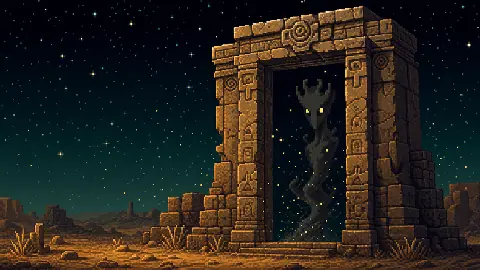
The Jinn NFT model carries that threshold imagery into the Other Worlders collection through an arid background, dark fire-like form and neutrino effect.
Source Trail
- Qur'an 15:27: creation of jinn from smokeless fire
- Surah Al-Jinn: belief, difference and moral choice among jinn
- Qur'an 18:50: Iblis identified as one of the jinn
- Qur'an 27:39: an ifrit from among the jinn
- Syracuse University Press: Islam, Arabs, and the Intelligent World of the Jinn
- University of Malta: Edmund Teuma, On Qur'anic Jinn
- Library of Congress: A Thousand and One Nights in world literature
- Transcultural Psychiatry: explanations of sleep paralysis in Egypt and Denmark
- Frontiers in Psychiatry: attribution of mental health problems to jinn
- Journal of the Royal Society of Medicine: possession and jinn