What Happened In Flatwoods?
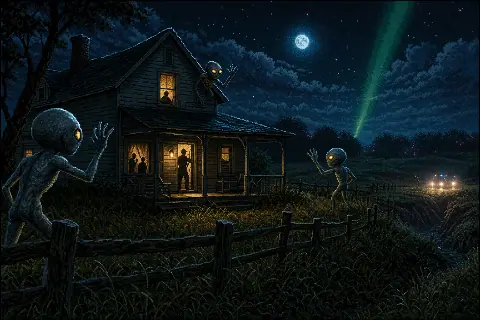
The stable outline begins near dusk. A group of boys playing football saw a bright object streak across the sky. In later tellings, the object appeared to land or settle beyond a hill, so several witnesses set out toward the reported location.
The group is usually centred on Kathleen May, her sons, other local boys, and National Guardsman Eugene Lemon. As they climbed toward the hilltop, they reported a pulsing red light, a strong odour, and then a figure partly revealed when Lemon aimed a flashlight toward the trees.
The description became famous: a tall figure, often given as 10 to 12 feet high, with a red face or glowing eyes, a head or hood shaped like an ace of spades, and a green lower body that witnesses interpreted as folded clothing, a skirt-like shape, or something floating. The group fled, and the story moved quickly into press coverage and local memory.
Quick Timeline Of The 1952 Case
| Stage | What The Source Trail Describes |
|---|---|
| Near dusk, 12 Sep 1952 | Boys in Flatwoods saw a bright fireball-like object cross the sky and appear to descend near a hill. |
| Shortly after | Kathleen May, Eugene Lemon, and several children went toward the reported location to investigate. |
| Hilltop encounter | The group reported a pulsing red light, a strong odour, and a tall figure with a red face and spade-shaped head or hood. |
| Immediate aftermath | Witnesses fled, local attention grew, and later accounts mentioned odour, skid-like marks, and disturbed grass. |
| Jan 1953 | Gray Barker's FATE magazine article, "The Monster and the Saucer," helped push the case into national saucer-era culture. |
| Later decades | Sceptical analysts argued for a meteor plus owl or beacon misperception, while Flatwoods built a museum and enduring local iconography around the story. |
The timeline matters because Flatwoods is often flattened into one image: the tall figure with the pointed head. The better version separates the sky event, the hilltop perception, the witness reaction, the media layer, and the later folklore layer.
Why The Case Survives
Flatwoods survives because the pieces are memorable and easy to fuse together. A fireball gives the story a sky trigger. A night walk up a hill gives it tension. The red light and metallic smell give it sensory force. The spade-headed figure gives it an image that can be redrawn for decades.
It also survives because it arrived at the right cultural moment. The United States was deep in the 1952 UFO wave, newspapers were primed for flying-saucer stories, and entity reports were still strange enough to feel less standardised than later alien-contact narratives.
That cultural timing cuts both ways. It makes the report historically important, but it also means later retellings were shaped by pulp saucer writing, local tourism, anniversary coverage, and pop-culture versions of the monster. A useful reading has to keep returning to the narrower source trail.
What The Witnesses Actually Add
The witness group makes the case harder to dismiss than a solitary late-night story. Kathleen May was an adult witness, Eugene Lemon had National Guard experience, and several children were present. The group response, including fright, flight, and reported illness or distress, is part of why the case remains durable.
At the same time, group witnessing does not automatically solve the case. Fear can spread quickly in a dark outdoor setting, especially after an impressive fireball report. A flashlight beam, trees, mist, smell, expectation, and a moving animal can become one shared interpretation in seconds.
The best question is therefore not whether every witness lied or every witness saw an alien. It is whether the witnesses encountered an unusual stimulus and then interpreted it through a fast-moving chain of fear, darkness, and saucer-era expectation.
Where Project Blue Book Fits
Flatwoods belongs to the same historical atmosphere as Project Blue Book, the U.S. Air Force UFO programme that began in 1952 and became the main official archive for classic American UFO reports. The National Archives says Project Blue Book records were retired after the programme closed in 1969, and the Air Force fact sheet reproduced there lists 12,618 reported sightings, with 701 left unidentified.
That does not make Flatwoods a strong Blue Book proof case. The more useful record is local reporting, West Virginia reference work, Gray Barker's early saucer-era article, later witness summaries, and sceptical analysis. The Blue Book connection is mainly context: Flatwoods happened during the same wave of public and official attention that shaped how 1950s UFO stories were filed, explained, ignored, or mythologised.
The Meteor, Beacon, And Owl Explanation
The strongest sceptical reconstruction separates the sky object from the hilltop figure. A meteor or bright fireball could explain the first report, especially if the same fireball was seen across a wider region. The hilltop light may then have been an unrelated red light, beacon, or point source seen through trees and excitement.
The figure itself is often explained as a large owl perched in or near a tree. In that reading, reflective eyes, a round or heart-shaped face, raised wings, branches, leaves, and the limits of a moving flashlight beam created the impression of a tall spade-headed being. Joe Nickell's Skeptical Inquirer treatment is the best-known version of this grounded explanation.
The owl explanation is plausible because it explains why there was no recovered object, no entity body, no clean landing trace, and no continuing physical presence after the group fled. Its weak point is human texture: the witnesses remembered a specific figure, odour, light, and fear response, and some details do not collapse neatly into one perched animal.
Gray Barker And The Folklore Layer
Gray Barker matters because he helped turn Flatwoods from a local scare into a saucer-era legend. Barker was from Braxton County, and his January 1953 FATE magazine article, "The Monster and the Saucer," gave the case a national paranormal readership.
That makes Barker part of the source trail, but not a neutral window. Later assessments of Barker's career often stress his flair for theatrical UFO writing and hoax-adjacent material. Flatwoods researchers therefore have to use the Barker layer carefully: it preserves early attention, but it may also amplify the very folklore pressure a careful reader is trying to control.
Evidence Limits
The limits are blunt. There is no verified photograph of the figure, no recovered craft, no biological trace, no official physical sample, and no landing-site evidence strong enough to close the case. Reports of odour, disturbed grass, or marks on the ground are interesting, but they do not establish a landed machine or entity.
The witness descriptions also changed as the story moved through newspapers, magazines, anniversary coverage, tourism, and monster imagery. Once a case becomes an icon, later audiences often remember the icon more clearly than the original event.
That is why Flatwoods should be read as a layered case rather than a clean proof file. The original report is worth preserving. The later monster image is worth studying. They are related, but they are not the same thing.
What Remains Unresolved
The unresolved core is small but durable. A group of witnesses connected a fireball-like sky event with a frightening hilltop encounter and then described a figure vivid enough to survive for more than seven decades. Sceptical explanations account for much of the structure, but they still require a sharp cascade from meteor to owl to shared panic.
That is the useful version of the Flatwoods Monster. It is not a simple alien proof story. It is a strong example of how UFO sightings, folklore, witness perception, media, and place-based memory can converge into a case that refuses to disappear. It belongs beside the Kelly-Hopkinsville Encounter and other documented UFO cases when the question is how strange reports survive, not when the question is whether an alien body was ever found.