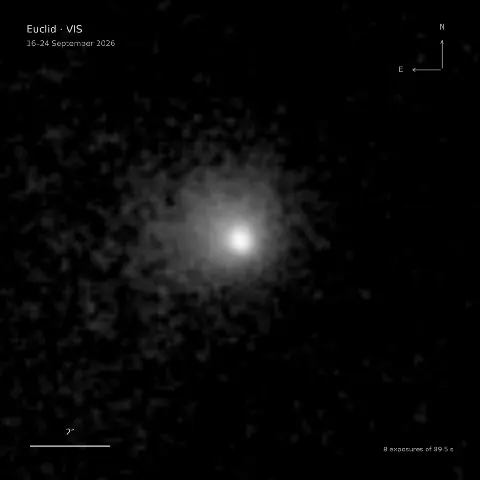
ESA announced the discovery on 19 October, using images taken between 16 and 24 September. Euclid had recorded known comets before. This is the first comet newly discovered in its data.
A Moving Streak Among Distant Galaxies
Mikko Pöntinen, a University of Helsinki researcher working with the Euclid Consortium’s Solar System Objects Science Working Group, developed software to search the telescope’s images for moving objects. The program flagged a streak that looked different from the surrounding stars and galaxies.
The telescope holds its view steady while collecting light from distant objects. A nearby body moving across that field can leave an elongated trail during the exposure. The consortium’s discovery account shows both the streak and a sequence of images recording the comet’s movement.
A diffuse cloud around the object supplied another clue. This cloud, called a coma, forms as a comet releases gas and dust. Motion alone could identify an asteroid or another Solar System body. The surrounding activity pointed towards a comet.
How The Discovery Was Confirmed
Pöntinen located the object in five image sets. ESA says the observations covered five fields of view in Euclid Deep Field North, producing 16 exposures altogether.
Checks against catalogues found no matching known object. The team reported the candidate to the International Astronomical Union’s Minor Planet Center, which collects observations, calculates orbits and assigns designations to comets and asteroids.
Ground-based observers then contributed follow-up measurements. The Minor Planet Center’s circular for C/2026 S1 provides the formal record behind the discovery. ESA gives 8 October as the confirmation date, separating the September observations from the later public announcement.
A Long Journey Through The Solar System
At the announcement, ESA placed the comet approximately 1.3 billion kilometres from Earth. Its path is steeply tilted relative to the plane in which the planets orbit.
The consortium describes a highly elongated orbit reaching far into the Oort Cloud, the distant reservoir of icy bodies surrounding the Solar System. Its account gives an estimated return time of about 345,000 years. ESA uses the broader description of an orbit taking thousands of years and explicitly says further observations will refine it.
The precise return date should therefore remain provisional. A short stretch of observations can establish a discovery while leaving the full journey less securely constrained.
This differs from the interstellar comet 3I/ATLAS, whose trajectory brought it into the Solar System from elsewhere. The published accounts place Euclid’s comet on a long orbit around our own Sun.
Why A Dark-Universe Telescope Found A Comet
Euclid’s main mission is to investigate dark matter and dark energy by mapping galaxies across cosmic time. It launched in July 2023 and operates near the Sun-Earth L2 point, approximately 1.5 million kilometres from Earth.
Its instruments measure galaxy shapes and distances. Gravity can distort the light arriving from a distant galaxy, while patterns in galaxy positions help trace the Universe’s expansion. Those measurements need clear images and careful identification of foreground objects.
Euclid’s survey avoids the dustier plane of the Solar System and generally moves on after observing a patch of sky. Finding the comet in several separate image sets was therefore a fortunate overlap between its path and the survey schedule. The search software turned that overlap into a discovery.
A Rehearsal For Comet Interceptor
ESA’s future Comet Interceptor mission is designed to wait in space before travelling to a suitable newly identified target. Its goal is to examine a relatively pristine comet, preserving material from the early Solar System.
C/2026 S1 is not a suitable target, ESA says. The discovery nevertheless tests the chain of detection, reporting and follow-up that could alert the mission to another comet in time.
Comets preserve a different part of planetary history from the dusty environments examined in Webb’s observations of extreme debris discs. Those discs reveal material around other stars; a comet offers a surviving sample of the small icy bodies in our own system.
Our coverage of the young planet Elias 2-24 b follows another stage of that history, when planets are still forming. Euclid’s find adds an object for future study at the other end of the process, after material has spent immense periods far from the Sun.