What Happened At Broad Haven Primary School?
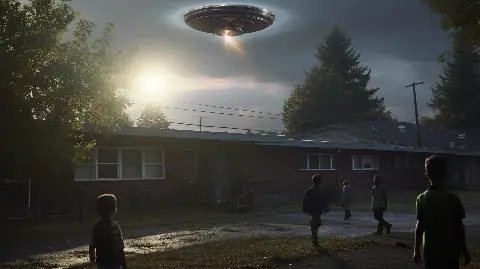
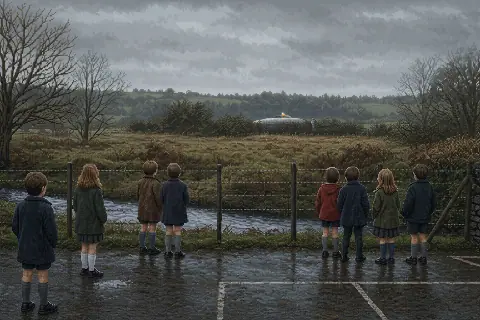
During a wet Friday in February 1977, children at Broad Haven County Primary School began reporting an object in fields beyond the school grounds. A retrospective account published by the British UFO Research Association says up to 14 pupils saw a silvery metallic object on or close to the ground between about 1 p.m. and 3:45 p.m.
The object was partly obscured by bushes. Witness descriptions included a cigar-like body, a disc or flattened base, a dome, and a light shifting through yellow, orange, and red. Several pupils said a silver or silver-green figure stood nearby. Nine-year-old Jeremy Passmore estimated the figure was roughly 350 yards away, which limited the detail any observer could reliably resolve.
The boundary shaped the encounter. A fence and stream separated the playground from the field, so the children could not simply walk up to the object. Some watched from school grounds. Others returned to the area later. No photograph was taken, no object was recovered, and no physical trace was documented well enough to settle what they saw.
The Sceptic Who Went Outside To Disprove It
David Davies was 10 and initially thought his classmates were talking nonsense. In his later account to BBC Wales, he said flying saucers belonged to bad science fiction and tabloid newspapers. He went to the reported vantage point expecting to find an ordinary explanation.
Davies said a silver cigar-shaped object briefly rose from behind the trees. He remembered a dome covering its middle third, then watched it drop out of view after only a few seconds. His reaction combined "awe and wonderment" with an urge to run.
Prior scepticism makes Davies an engaging witness, not an independent instrument. By the time he looked, other pupils had already described a strange object. That gave him an expectation. His account still adds a distinct sequence to the case: disbelief, a deliberate check, a brief sighting, and a story he continued to defend as an adult.
What The Children Actually Drew
Headmaster Ralph Llewellyn had pupils draw the object without conferring. The surviving images share a recognisable structure, usually a flattened or cigar-shaped body with a central dome. Some add lights, windows, legs, a ladder, or a nearby figure. They are similar, but they are not identical copies.
That distinction is important. The drawings preserve agreement about a broad silhouette while exposing disagreement about details. They do not provide a measured size, a verified distance, or a common viewing duration. Nor were the children sealed off from one another from the first report. They had already occupied the same school and discussed the object before the controlled drawing exercise.
Published sources also differ over whether 14 or 15 pupils were included. BUFORA described up to 14 witnesses, while later summaries refer to 15 children interviewed by the headmaster. The shifting count is a small example of how even a famous case can acquire a cleaner headline than its source trail supports.
Timeline Of The 1977 Broad Haven Case
| Date | What The Record Describes |
|---|---|
| 4 Feb 1977 | Pupils reported a silver, dome-topped object beyond the school boundary. Some also described a silver-suited figure. |
| Following school days | Headmaster Ralph Llewellyn separated pupils for written accounts and drawings, creating the case's best-known record. |
| 17 Feb 1977 | A teacher and school canteen workers separately reported a shiny oval or cigar-shaped object in the area. |
| Spring 1977 | Other Pembrokeshire reports involving lights, objects, and silver-suited figures fed the "Welsh Triangle" label. |
| 3 Jun 1977 | An RAF officer reported on a later hotel sighting after a request linked to local MP Nicholas Edwards. |
| 2015 | A parliamentary answer said surviving West Wales UFO files would be held by The National Archives. |
| 2017 to 2023 | Fortieth-anniversary reporting and the Netflix series Encounters returned the pupils' testimony to a global audience. |
The timeline prevents later reports from flowing backwards into the schoolyard. An adult sighting on 17 February may show that unusual reports continued around Broad Haven, but it does not independently confirm what the pupils saw on 4 February.
The Case In Five Evidence Streams
| Evidence Stream | What It Preserves | What It Cannot Establish |
|---|---|---|
| Pupil testimony | Multiple young witnesses described an object in the same area on the same day. | The group shared a setting and could influence one another. |
| Separated drawings | Broad agreement on a flattened body and central dome. | Exact scale, distance, motion, or material. |
| David Davies | A sceptical pupil's brief, deliberate attempt to check the claim. | Independence from descriptions he had already heard. |
| Later local reports | A wider cluster of object and humanoid stories in west Wales. | That every report had one cause or involved the school object. |
| Official records | Local political concern and later MoD and RAF correspondence. | Government confirmation of an alien landing at the school. |
Broad Haven is strongest as a witness-record case. It is weak as a physical-evidence case. In the close encounter categories, reported proximity and a possible occupant make the story dramatic, but classification does not upgrade the quality of the evidence.
How One School Sighting Became The Welsh Triangle
The Broad Haven Triangle, also called the Dyfed Triangle or Welsh Triangle, was a media label for a wider cluster of 1977 reports around Pembrokeshire. The name borrowed the mystery branding of the Bermuda Triangle and encouraged very different incidents to be read as parts of one event.
Later witnesses described lights, low objects, and tall faceless figures in silver clothing. The best-known report came from hotel owner Rosa Granville, who said an object descended near her property and two figures emerged. Other stories involved farms, roads, and the coast. Once collected under one label, each report appeared to corroborate the others.
A wave does not need one explanation because it may not have one cause. Aircraft, local machinery, pranks, expectation, unusual observations, and press attention can all produce reports in the same region. The psychosocial UFO hypothesis is relevant here, but it does not require the pupils to have lied. People can sincerely report ambiguous events while culture changes how those events are described and remembered.
What The Ministry Of Defence Actually Investigated
Official interest existed, but the surviving trail does not show the MoD recovering evidence from Broad Haven Primary School. A National Archives transcript by UFO historian David Clarke explains that Granville contacted her MP, Nicholas Edwards, after her later hotel encounter. Edwards passed the report to the MoD, which asked an officer from nearby RAF Brawdy to visit.
The officer found no obvious evidence of a landing. A discreet RAF police inquiry later considered whether someone in a fire-protection suit had staged a practical joke. The large visor and pale suit could account for some silver-humanoid reports, though the archive commentary does not claim that one prank explained the school object or every event in the region.
In 2015, the Ministry of Defence told Parliament that any surviving files on the 1977 West Wales sightings would be held by The National Archives. Dyfed-Powys Police gave a similarly limited answer to a 2022 information request, stating that its records did not extend back to 1977. Neither answer confirms a cover-up. They describe where the surviving record ends.
Britain's later Project Condign examined UFO reports as a broader defence question, but it did not solve Broad Haven. Connecting every British government UFO document to this school case creates an official certainty that the archive does not support.
The Best Ordinary Explanations
A sewage tanker, farm equipment, aircraft activity, and a local prank have all been proposed. The school overlooked wet agricultural ground, and the object was partly hidden behind vegetation. At several hundred yards, a cylindrical tank with a top fitting could produce a cigar-and-dome silhouette. Nearby RAF Brawdy and regional flight activity also supplied familiar objects that could look unfamiliar from a restricted angle.
Those explanations have limits. Several pupils described movement rather than a parked machine. Davies said the object rose above the trees and dropped back. A static tanker does not reproduce that sequence unless the apparent movement came from a changing viewpoint, an obscured vehicle on uneven ground, or memory reconstruction.
The silver-suit prank theory belongs mainly to the later humanoid reports. It does not automatically explain the pupils' distant object. Treating one mundane proposal as a master key is the same mistake as treating every report as one alien visit.
Why The Broad Haven Sighting Still Holds Attention
School UFO reports have an unusual tension. Children can be suggestible and socially connected, yet a school also provides a fixed location, many witnesses, adults who can record accounts, and a clear timetable. Broad Haven can be compared with the Westall UFO encounter in Australia, but the evidential shape differs. Westall involved a much larger witness group and adult observers on the day. Broad Haven's signature record is the set of pupil drawings.
The case therefore survives on procedure as much as strangeness. Llewellyn's decision to separate the children did not create laboratory conditions, but it was better than allowing one polished group story to replace individual recollections. The differences between the drawings are part of the evidence, not defects to hide.
What Remains Unresolved
The unresolved core is narrow. Several pupils said they saw a silver, dome-topped object beyond the school boundary. David Davies said he went out expecting to debunk them and saw something for a few seconds. No photograph, instrument record, verified trace, or adult observation from the same moment closes the gap between testimony and identification.
The later Welsh Triangle reports expand the history, not the proof. Broad Haven belongs among the best documented UFO cases only in the limited sense that its witnesses left material that can still be compared. The drawings are not a photograph. They are an experiment with imperfect controls, and that is precisely why the case remains worth examining.
Source Trail
- BBC News: Broad Haven UFO sightings marked 40 years on
- BUFORA Journal: The Welsh UFO Flap of 1977
- The National Archives: David Clarke on the released UFO files
- The National Archives: UFO reports in the UK government collection
- UK Parliament: Unidentified Flying Objects in Wales
- Dyfed-Powys Police: 1977 UFO records information request